

Skip to content

Batteries: starting, service, traction, marine

Whether for a car, a camper, a boat, or any other motorized equipment, batteries must meet very different characteristics depending on their use(s). We present to you some definitions that will help you define your need and thus not make a mistake in the choice and purchase of your battery.

Starting battery:
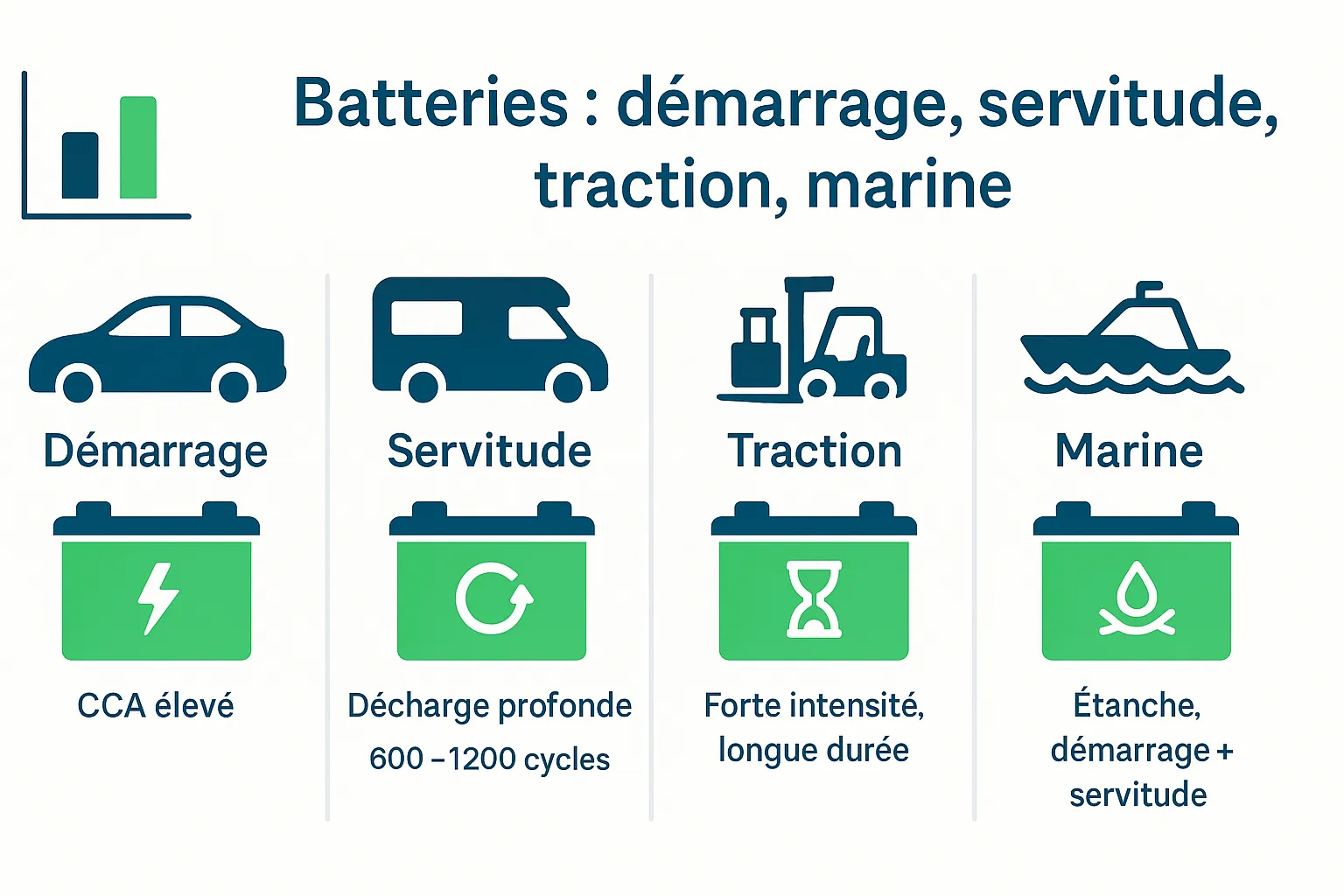
Infographic: comparison of starting, service (deep discharge), traction, and marine batteries – uses for cars, campers, boats

This type of battery prioritizes the maximum available intensity relative to volume. A starting battery like those sold for cars is designed to deliver a high current for a short moment. When it is a liquid electrolyte battery, it cannot be discharged more than 20% at the risk of irreversibly deforming the thin plates.
It should also be noted that often the service batteries in place on boats can be used to start the engine. To verify this, simply compare the maximum intensity the battery can provide (CCA) to that required for the starter. This is particularly true for AGM and Gel batteries which allow for higher discharge currents than service batteries for the same capacity.

Service battery:

A service battery is designed for deep discharge use (80%) and a significant number of charge-discharge cycles (up to 1200 cycles for a quality battery depending on the depth of discharge).
AGM or gelled electrolyte batteries are best suited even though some liquid batteries meet this need. Their capacity being generally large, they can also be used to start the engine.

Traction battery:

It is a battery capable of delivering high intensities for a long duration. It is used, for example, for forklifts. AGM and gel batteries meet this need, and maintenance liquid batteries (possibility of adding water) are also designed for this use.

Marine battery:

A marine battery is designed to take into account all the constraints of navigation. It is a service battery that can also be used for starting (although for safety reasons, it is preferable to dedicate a battery to starting). A marine battery must also be sealed and have a sufficient electrolyte level so that the electrodes are always immersed, regardless of the boat's heel. It must also have good mechanical resistance and be designed to limit gas emissions for safety and longevity reasons.

When buying a so-called marine battery, it is essential to check its technology and ensure that it meets the need (no leakage, low gas emissions, and finally study the performance). Gelled electrolyte batteries (AGM or gel) are, due to their technology, best suited for marine use.

Frequently Asked Questions

What is a starting battery?
A starting battery is designed to provide high intensity for a short duration, ideal for starting a car engine. It should not be discharged more than 20% to avoid permanently damaging its internal plates, especially when it comes to liquid electrolyte batteries.
What is a service battery?
A service battery is designed for deep discharges up to 80% and can support a large number of charge/discharge cycles. It is often used to power electrical equipment on board boats, campers, or autonomous installations. AGM and Gel batteries are particularly suited for this use.
What is a traction battery?
A traction battery is capable of providing high intensity for a long duration. It is often used in forklifts, electric vehicles, or other equipment requiring continuous power. AGM, Gel, and some maintenance liquid batteries are suitable for this use.
What is a marine battery?
A marine battery is specially designed to meet the constraints of navigation. It must be waterproof, resist the boat's movements and inclinations, and limit gas emissions. It can serve as a service battery and sometimes for starting, although dedicated use is recommended for safety reasons. AGM and Gel batteries are particularly suited for this use.
Can a service battery be used to start an engine?
Yes, some service batteries, particularly AGM and Gel batteries, can be used to start an engine. However, it is recommended to check the maximum current delivered by the battery (CCA) and ensure it is sufficient for the engine starter.
How to choose the right marine battery?
To choose a marine battery, it is important to ensure it is waterproof, capable of limiting gas emissions, and keeping the electrodes submerged, even when tilted. Gel electrolyte batteries (AGM or Gel) are the most suitable for marine use due to their reliability and safety.
What is the difference between an AGM battery and a Gel battery?
AGM (Absorbed Glass Mat) and Gel batteries are both designed for deep discharges and a large number of cycles. The main difference is that Gel batteries use a gelled electrolyte, offering better resistance to extreme temperatures and vibrations, while AGM batteries are more suitable for high-intensity punctual needs, such as engine starting.

Your legal guarantee rights

Your legal guarantee rights

europa.eu/youreurope/citizens/consumers/shopping/guarantees/index_en.htm