

Solar panels: how to properly assess the necessary power?
Whether your photovoltaic installation is fixed (house, isolated site), mobile (camper van, boat) or portable (4x4 raid, hiking, trek) before purchasing a solar panel it is advisable to properly size your energy needs to avoid unpleasant surprises regarding the performance obtained but also to be able to take advantage of a first price or promotions that match the characteristics of your installation.
To choose a solar panel, you must first determine the expected consumption of your electrical devices to be powered (see the manuals of your different devices or the daily consumption table). The calculation logic is to add up the nominal powers (W) of your electrical devices and then multiply them by the number of hours (h) of use per day (Wh/d).
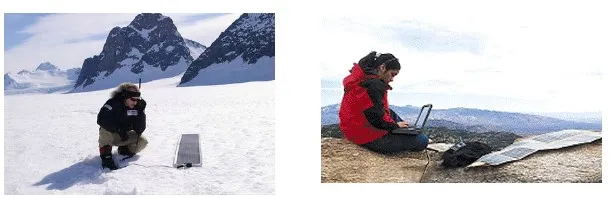
Then you need to define which support is best suited to your needs, hiking, boat, camper, mobile home, etc.: foldable solar panel (attachment on a backpack or laid flat on the ground), flexible solar panel (attachment on a canopy, on the deck or along the lifelines for boats), semi-rigid solar panel (attachment on the deck of a boat) or rigid solar panel (attachment on a gantry for a boat or roof of a camper).
Note:
To make your task easier, there are specific kits already 'sized' according to your application including the solar panel, the regulator, the mounting elements, and the battery:
Solar panels can be mounted in parallel without any particular problem, in this case their power adds up.
The powers announced by manufacturers are conventionally calculated based on a level of sunlight on a flat horizontal surface of 1000 W/m². In reality, the useful power of the panel depends on the sunlight and its orientation.
Some regulation systems dynamically vary the output charge of the solar panel to optimize the power provided by it. These high-efficiency regulators allow for a gain of 15 to 30% in efficiency. This technology is called MPPT (Maximum Power Point Tracking).
The voltage of a solar panel is also dependent on temperature. The reference power is given for 25°C. For each degree lost, about 0.3% of power is lost. If the temperature increases, this power increases by 0.3% per degree.