

How to calculate the electrical production of solar panels?
The production of a photovoltaic cell obviously depends on the sun. Therefore, it is impossible to say in advance how much electricity a solar panel will produce: the production will vary depending on where you install it and even according to the position you give it.
The goal of this article is to help you assess the actual production at the location where you plan to install your solar panels.
Watt, peak watt, watt-hour?
The power of solar panels is expressed in peak watt: a 1kWp panel produces a power of 1kW under standard conditions, so the energy produced is 1kWh per hour under these same conditions. But be careful, this is only true in a laboratory; for a real installation, there is no direct link between peak watt, watt, and watt-hour!
The energy produced under real conditions will generally be significantly lower than what would have been produced under standard conditions. It will mainly depend on 3 factors:
- the daily global radiation, that is, the sunlight
- the position of the solar panels (orientation and tilt)
- the temperature
There are two ways to calculate the production:
- You can use a solar simulation software, for example, the one that the European Union offers for free to calculate the solar potential anywhere in Europe or Africa
- If you cannot find a tool that meets your needs or if you want to verify the results provided by software yourself, you must use the method below.
First step: the sun
To start, you need to find out what the amount of energy received daily from the sun is in your region. This amount is called daily irradiation or daily global radiation or integrated solar radiation, and it is expressed in watt-hour per square meter per day (Wh/m²/d) for a given tilt.
This data can be obtained from meteorological services or professionals (for example, your solar panel supplier).
Sunlight obviously varies depending on the season, so it is often provided as a monthly average. In practice, it is mainly the value of the worst month (in winter in temperate zones, during the rainy season in equatorial and tropical zones) that will interest us since the goal is to design a solar installation capable of covering energy needs throughout the year: if it can handle the worst, it can handle the least, and the sizing will generally be based on the worst month.
The value of the best month can also be interesting to get an idea of the maximum production of the installation.
The provided value also depends on the angle at which the measurement was taken. Generally, the measurement is taken horizontally. If you wish to obtain the irradiation at another angle, simply divide the horizontal value by the cosine of the angle you are interested in.
Losses related to the orientation of the panels
The angle formed by the sun's rays and the solar panel is called the angle of incidence (denoted α). Production is maximized if the sun's rays hit the panel's surface perpendicularly at noon (solar time).
Generally, the goal is to optimize production during the month with the least sunlight: therefore, the sun's rays should be perpendicular to the panel during this month.
For more information on this topic, see the article: Finding the optimal orientation and tilt for a solar panel
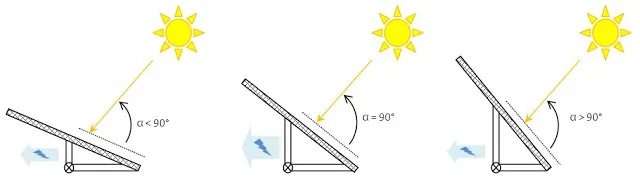
Losses related to temperature
The peak power is given for a temperature of 25°C. If the actual temperature is much higher than this value, it must be taken into account. The losses will then be 0.4% per degree for mono or polycrystalline cells (the most common) and 0.3% per degree for other technologies.
Attention: this refers to the temperature of the solar panel and not the ambient temperature. The panel's temperature is higher than the air temperature (for example, by 10°C).
In conclusion
The energy that will be provided for 1kWp installed is approximately:
Daily global radiation x sin(α) x (1 - (temperature - 25) x 0.004)