

Wind effort on a domestic wind turbine: understanding the constraints on the mast and fixings
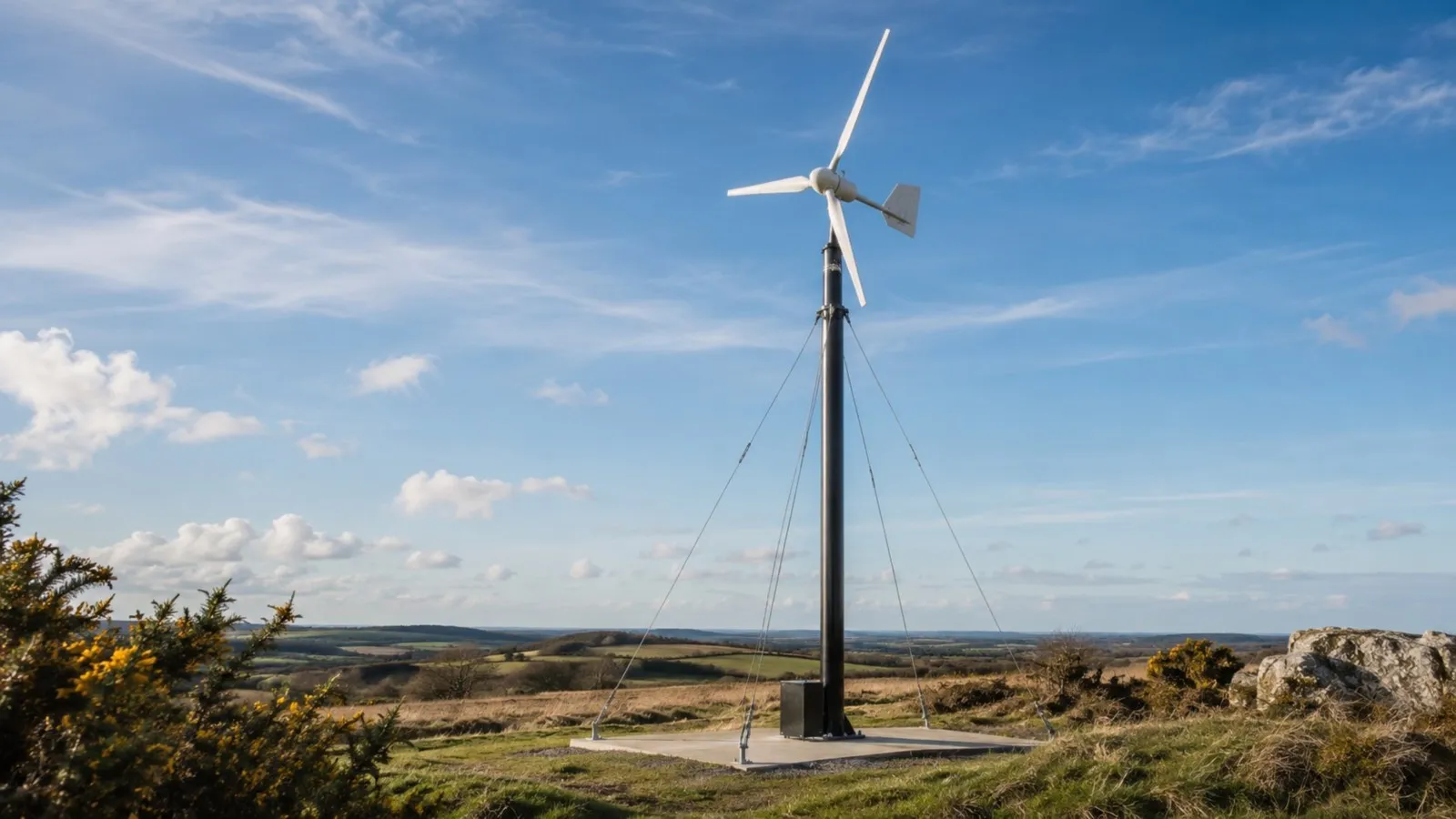
When installing a domestic wind turbine, people often think about power, rotor diameter, noise, efficiency, or electrical connection. However, another point is essential: the mechanical wind load on the turbine, mast, and fixings.
A wind turbine of 20, 30, or 50 kg may seem relatively light. But once placed at the top of a mast, it's not just its weight that matters. In strong winds, the horizontal wind load can become much more significant than the actual weight of the machine.
This article provides orders of magnitude to better understand the mechanical constraints. It does not replace a structural study, as the actual load depends on the exact model, diameter, type of rotor, mast height, support, fixing, terrain, and the wind speed considered.
Why it is impossible to provide a certified value without a study
An order of magnitude can be given, but not a certified value without precisely knowing the installation.
The loads depend notably on:
- the exact model of the wind turbine;
- the rotor diameter;
- the surface exposed to the wind;
- the type of wind turbine: horizontal, vertical, or AeroSpiral;
- the wind speed taken as a reference;
- the mast height;
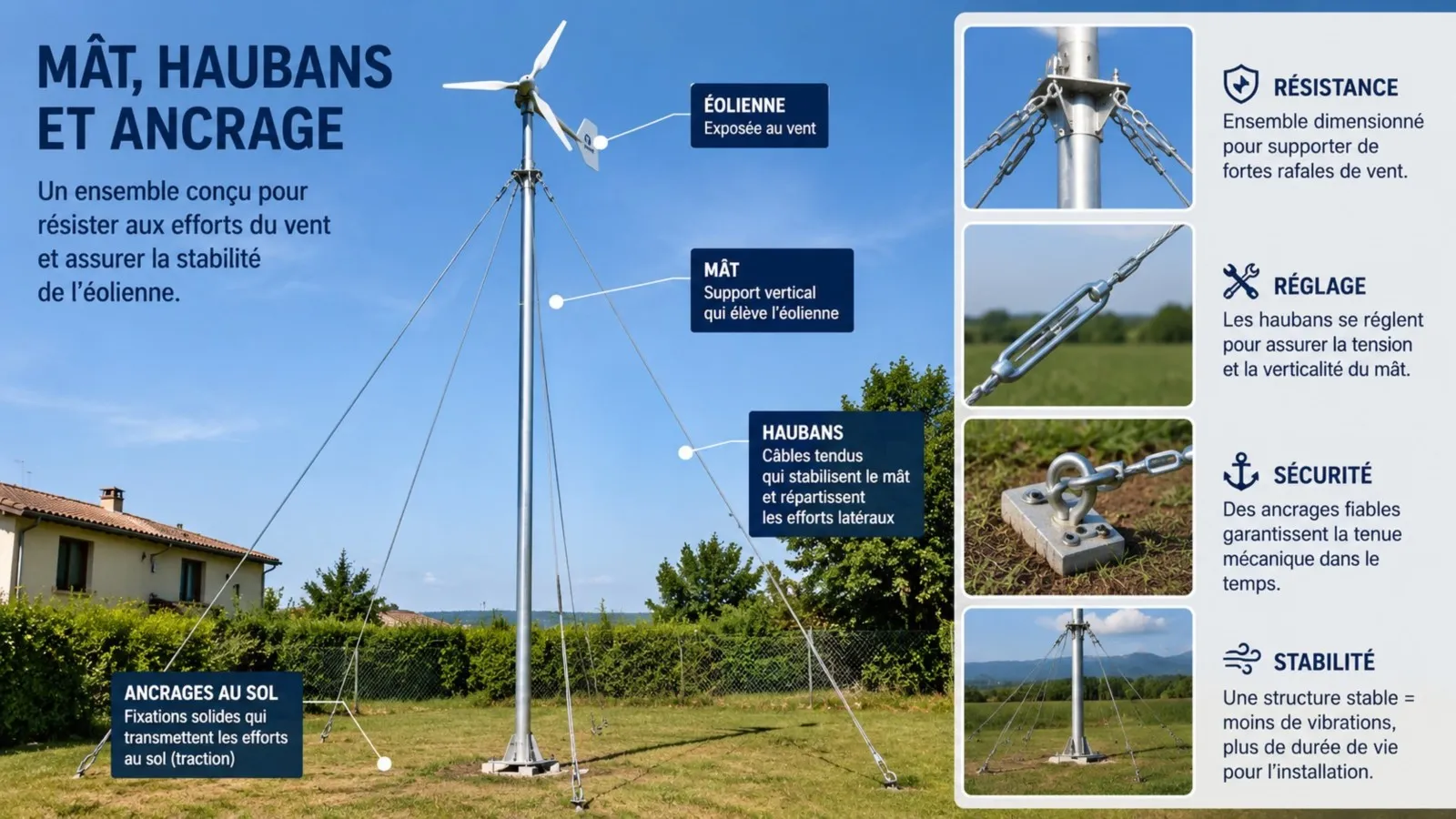
- the type of mast: guyed, tilting, tubular, or other;
- the presence or absence of guy wires;
- the nature of the anchorage;
- the fixing to the ground, on slab or on structure;
- the resistance of the support;
- the environment around the wind turbine;
- the presence of nearby trees, walls, roofs, or buildings;
- the behavior of the wind turbine in gusts;
- the braking or safety system.
A wind turbine installed on an independent mast in open terrain does not operate like a wind turbine placed near a wall, a roof, or a gable.
Also read:
https://www.comptoireolien.fr/eoliennes-de-pignon-attention.html
The weight of the wind turbine is not the only problem
The weight acts vertically.
The wind acts horizontally.
It is this horizontal thrust that creates the most significant constraints on:
- the top of the mast;
- the plate;
- the guy wires;
- the anchors or fastenings;
- the anchorages;
- the base of the mast;
- the structure that receives the installation.
A 30 kg wind turbine can therefore generate much greater forces than its actual weight when exposed to strong wind.
The correct reasoning is therefore not only:
“Can the support hold 30 kg?”
But rather:
“Can the support withstand wind forces, gusts, vibrations, and leverage?”
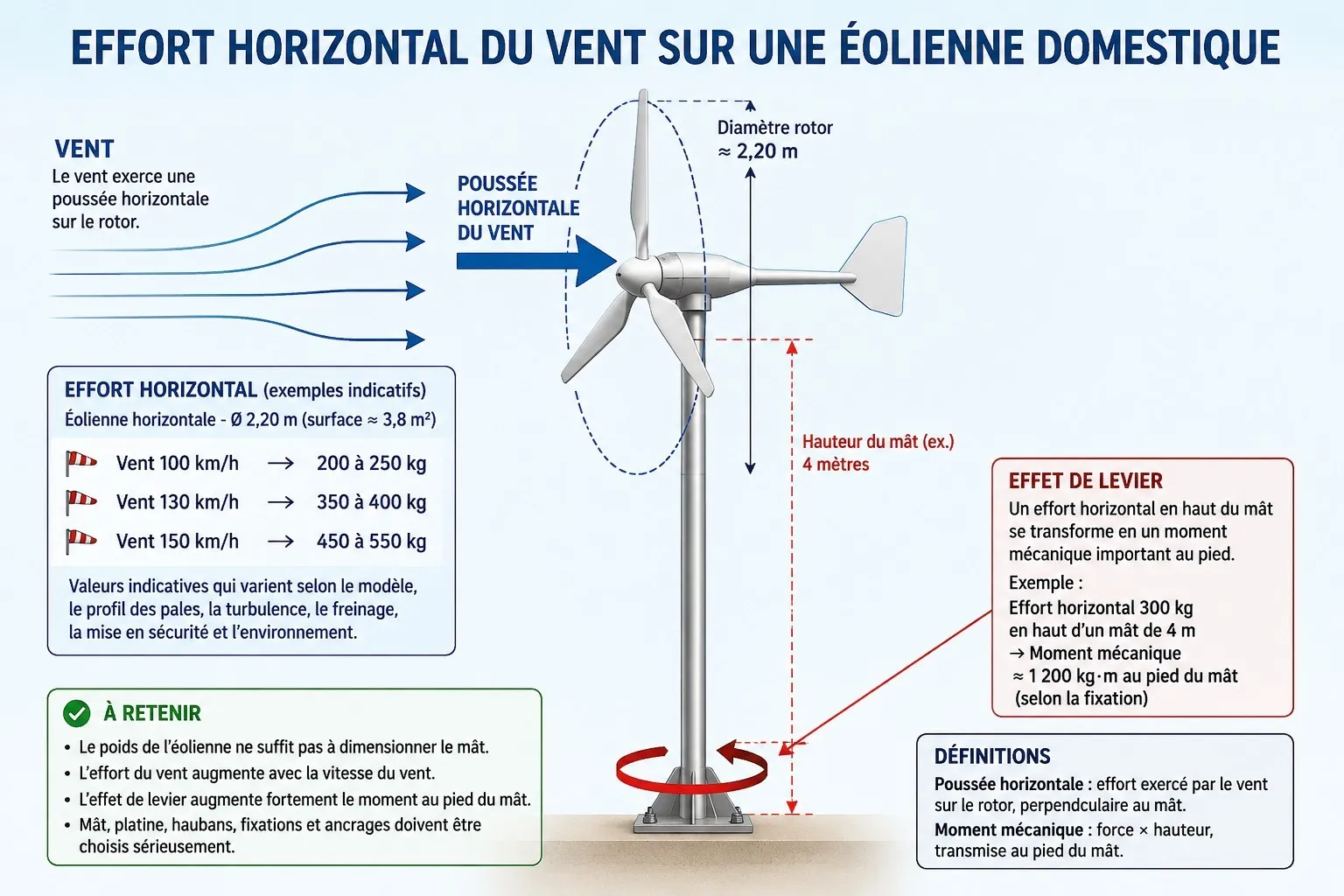
Simple example: a wind turbine with a diameter of 2.20 m
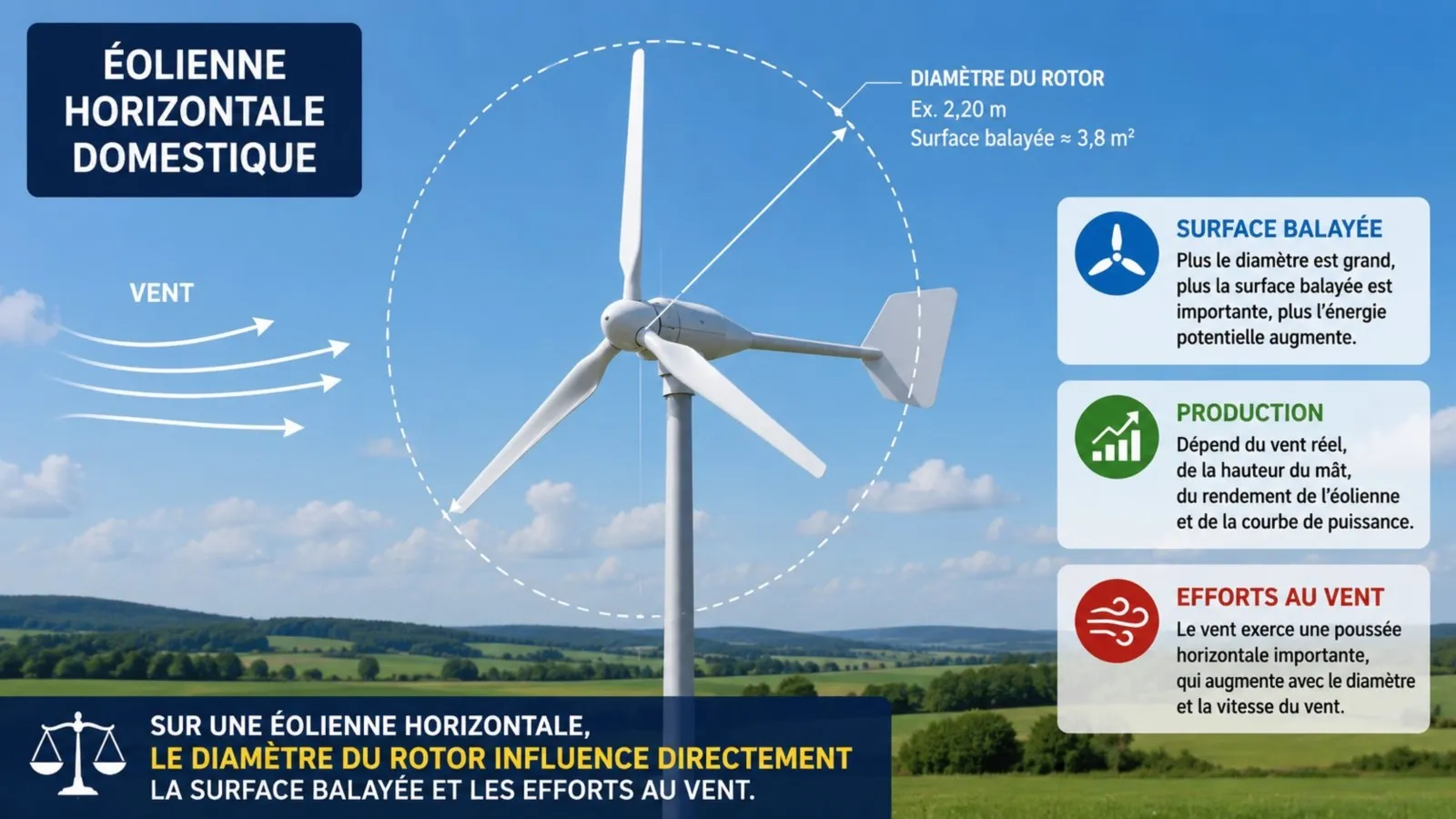
For a horizontal wind turbine about 2.20 m in diameter:
- the radius is about 1.10 m;
- the swept area is about 3.8 m²;
- this area directly receives the wind's energy;
- the stronger the wind, the more the thrust increases significantly.
In strong winds, the following orders of magnitude can be considered:
- at 100 km/h wind: about 200 to 250 kg of horizontal force;
- at 130 km/h wind: about 350 to 400 kg of horizontal force;
- at 150 km/h wind: about 450 to 550 kg of horizontal force.
These values remain indicative. They strongly depend on the wind turbine's profile, braking, blades, orientation, turbulence, and the machine's reaction in strong winds.
Why leverage is crucial
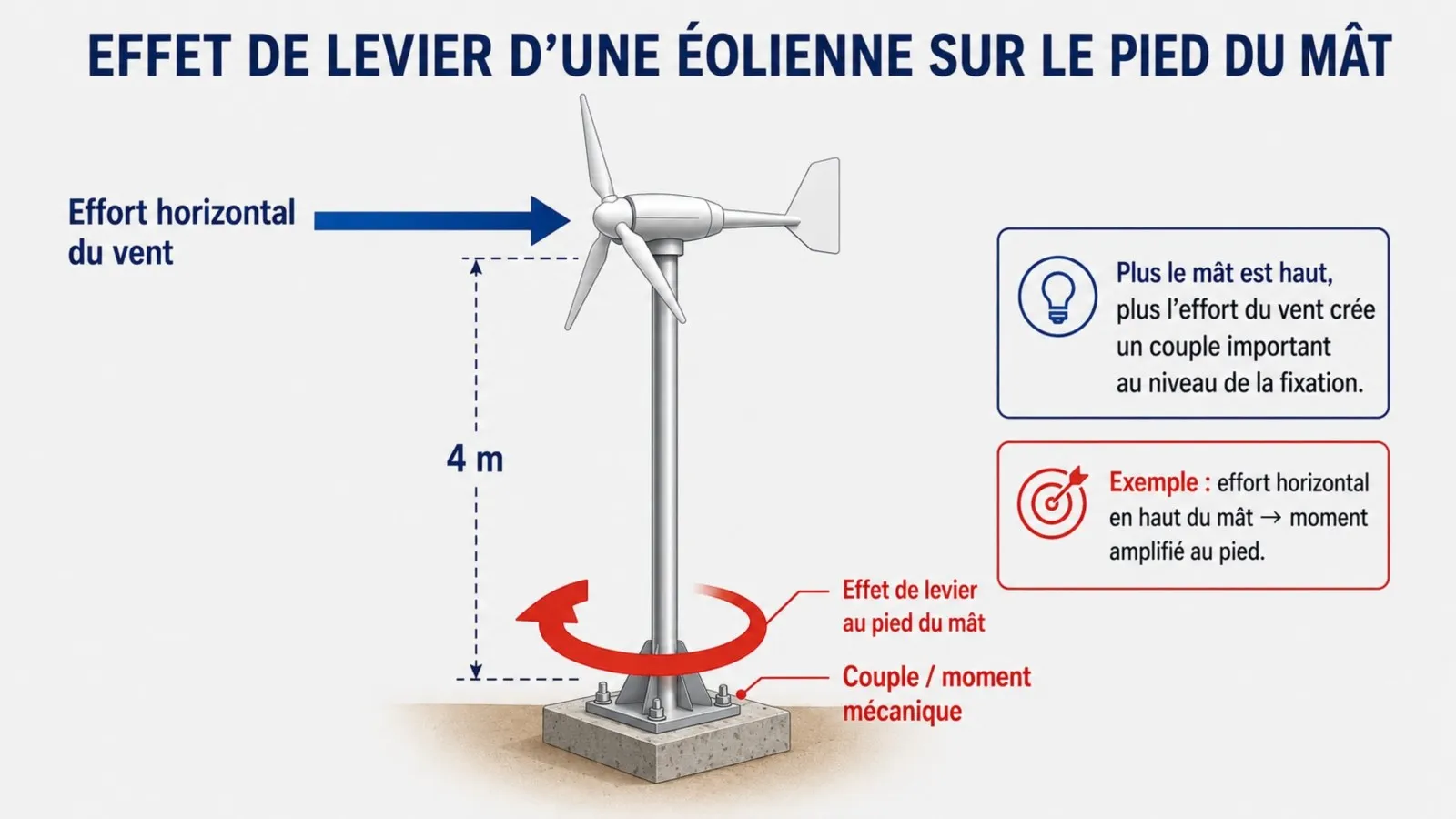
The horizontal force does not apply to the ground. It applies at height, at the level of the wind turbine.
That's where leverage appears.
Example:
- wind turbine placed on a 4 m mast;
- estimated horizontal force: 300 kg;
- height of the point of effort: 4 m;
- effect at the base of the mast: 300 × 4 = 1,200 kg·m.
In simple terms, a horizontal force of 300 kg at the top of a 4 m mast can represent more than a ton equivalent of leverage effect at the base of the mast, depending on the mounting geometry.
This is why a mast, a plate, or a mounting must be chosen carefully.
See masts and accessories:
https://www.comptoireolien.fr/mats-et-accessoires-pour-eoliennes.html
Gusts matter more than average wind
To estimate production, we look at the average wind.
To check mechanical safety, one must especially look at:
- the gusts;
- the storm winds;
- the turbulences;
- the rapid changes in direction;
- the braking;
- the vibrations;
- the repeated efforts over time.
A wind turbine can function very well in a correct average wind but experience strong constraints during a gust.
This is why one should not size a mounting solely based on the weight of the wind turbine.
The dynamic effects not to forget
A simple calculation gives an idea, but it does not show everything.
In real conditions, one must also anticipate:
- rotor vibrations;
- speed variations;
- the gusts;
- turbulence near the ground;
- turbulence near buildings;
- forces transmitted to the mast;
- tearing forces on the anchors;
- mechanical fatigue over time;
- automatic or electromagnetic braking;
- the wind turbine's reactions during safety activation.
These effects can increase the actual stresses compared to a simplified static calculation.
Case of a horizontal wind turbine
A horizontal wind turbine has a rotor facing the wind.
It is often advantageous in open areas because its efficiency is generally better than a vertical one with comparable announced power. But it also requires real mechanical vigilance.
Key points to remember:
- the larger the rotor, the higher the thrust can be;
- the taller the mast, the greater the leverage effect;
- the more turbulent the site, the more significant the vibrations can be;
- the higher the power, the more robust the mast and anchors need to be;
- a horizontal wind turbine should ideally be placed in clean and steady wind.
See horizontal wind turbines:
https://www.comptoireolien.fr/eoliennes-horizontales.html
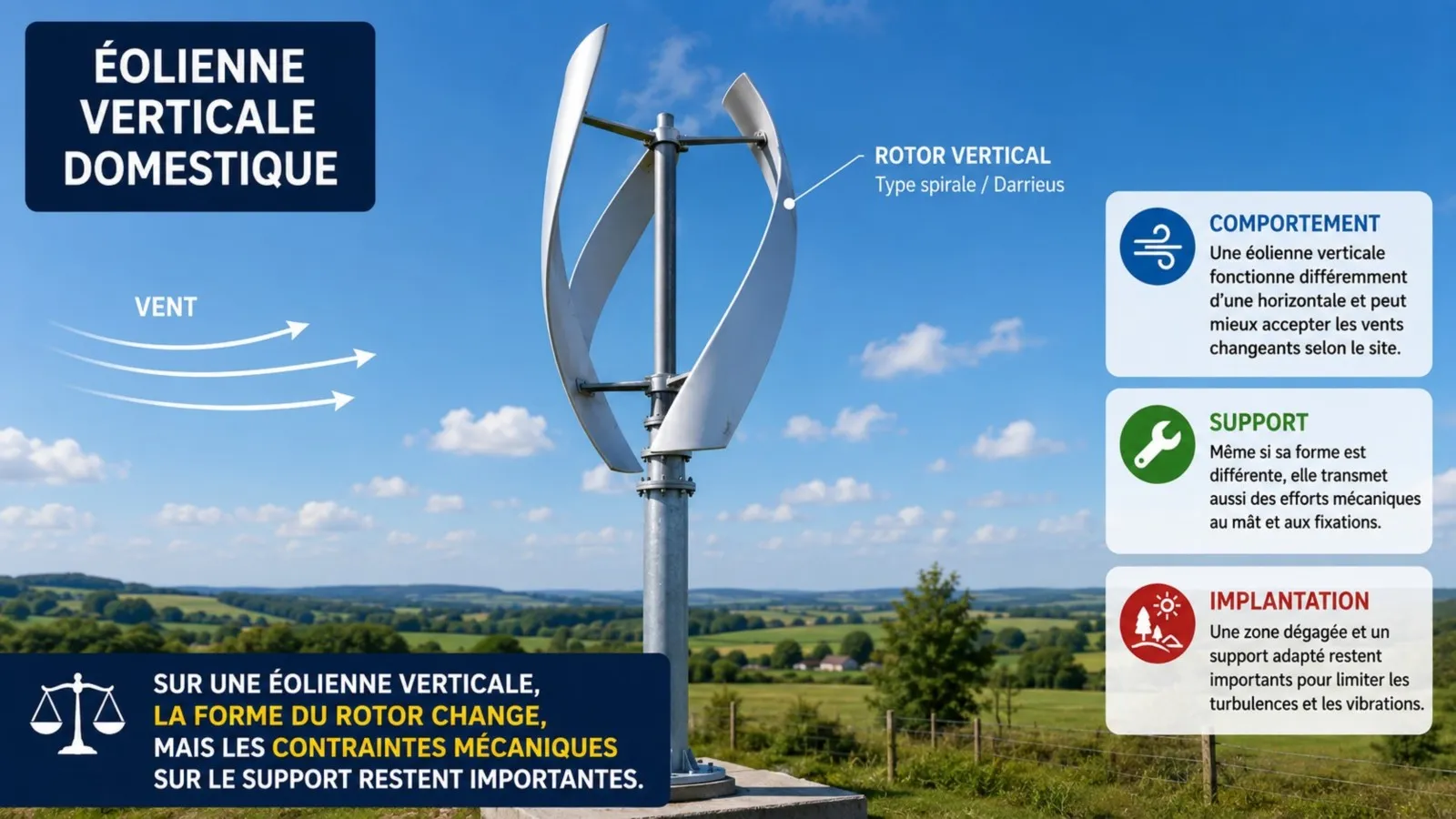
Case of a vertical wind turbine
A vertical wind turbine does not work exactly like a horizontal propeller.
It can be interesting for:
- design;
- discretion;
- certain changing winds;
- a priority given to silence;
- certain battery uses.
But it also transmits forces to the support:
- lateral thrust;
- vibrations;
- cyclic forces;
- constraints on the axis;
- forces at the base of the mast;
- need for a rigid support;
- need for suitable anchoring.
Therefore, a vertical wind turbine should not be considered as "constraint-free." It is different, but it must also be installed on a serious support.
See vertical wind turbines:
https://www.comptoireolien.fr/eoliennes-verticales.html
Case of an AeroSpiral wind turbine
An AeroSpiral has a more compact geometry than a large horizontal propeller.
This changes the way the wind acts on the machine, but does not eliminate the mechanical stresses.
You must always check:
- the weight of the model;
- the dimensions;
- the installation height;
- the mounting;
- the support;
- the exposure to gusts;
- the vibrations;
- the anchoring;
- the compatibility with the mast.
An AeroSpiral can be interesting when design, silence, and integration are priorities. But like any wind turbine, it must be installed on a structure capable of withstanding wind forces.
See the AeroSpiral range:
https://www.comptoireolien.fr/eoliennes-aerospiral-ultra-silencieuse-design.html
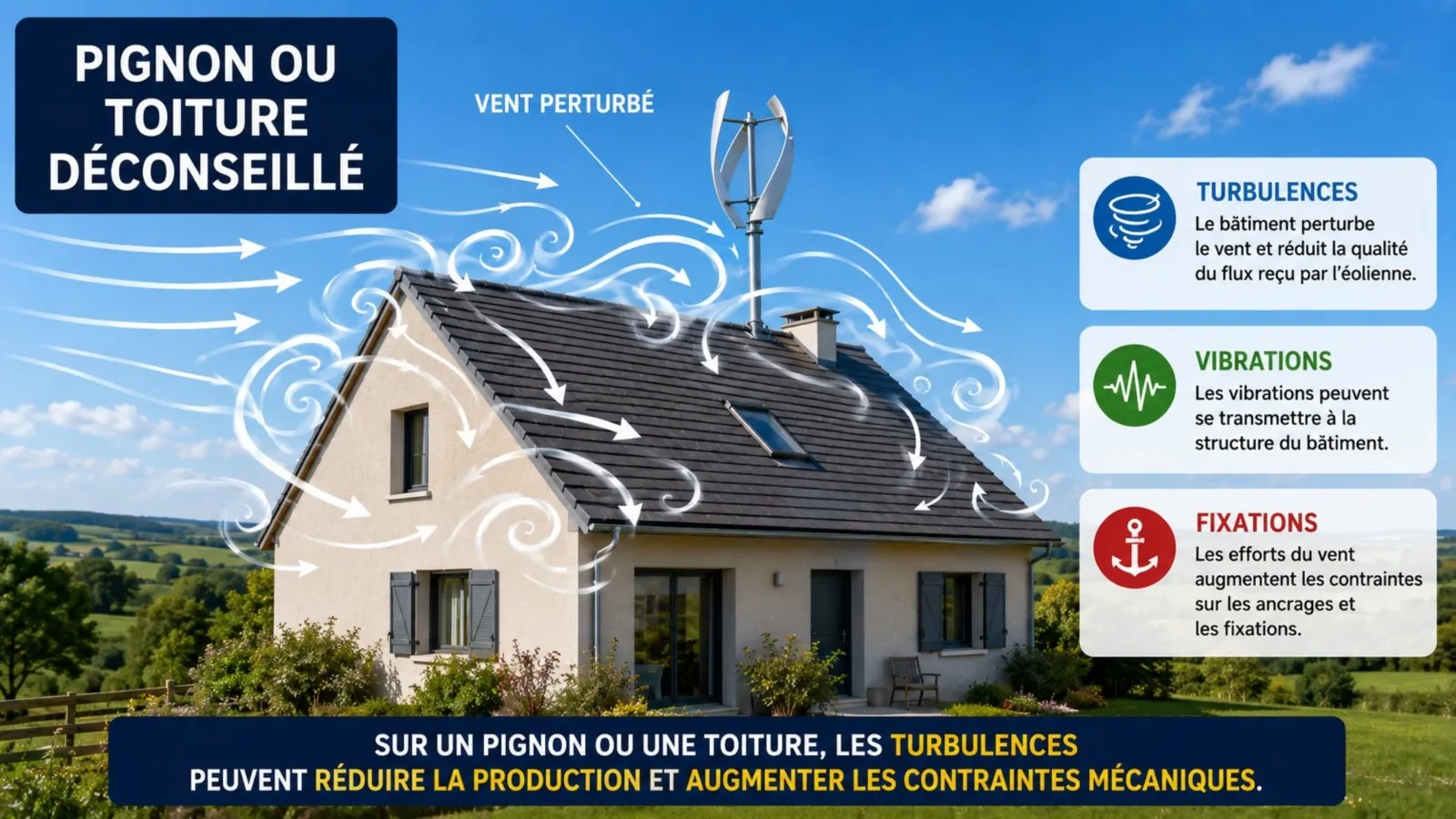
Why installation on gable, roof, or facade is often discouraged
Mounting on a building may seem practical, but it presents several risks.
The main problems are:
- the wind is often turbulent near a roof or wall;
- turbulence reduces production;
- vibrations can be transmitted to the structure;
- stresses can fatigue the mountings;
- tearing forces can be significant;
- the building was not always designed to accommodate a wind turbine;
- a fixture that holds the weight does not necessarily withstand gusts.
A support may seem solid when stationary, but the real test is its endurance against repeated stress over time.
Our advice remains to favor an independent mast, installed in a clear area, with suitable anchoring.
Dedicated article:
https://www.comptoireolien.fr/eoliennes-de-pignon-attention.html
What to check before installing a wind turbine
Before installation, you need to check:
- the weight of the wind turbine;
- the rotor diameter;
- the surface exposed to the wind;
- the height of the mast;
- the strength of the mast;
- the quality of the plate;
- the anchorages;
- the guy wires if necessary;
- the nature of the soil;
- the distance to obstacles;
- the presence of turbulence;
- the local wind speed;
- the possible gusts;
- the access for maintenance;
- local urban planning rules.
For regulations:
https://www.comptoireolien.fr/demarches-administratives-pour-linstallation-dune-eolienne.html
How to limit mechanical constraints
To limit risks, it is preferable to:
- choose a wind turbine suitable for the site;
- avoid unnecessarily oversizing the machine;
- install the wind turbine in an open area;
- avoid turbulent zones;
- choose a compatible mast;
- plan for guying if necessary;
- use a solid mounting;
- check the anchors;
- regularly check the screws;
- inspect the blades;
- inspect the mast after strong wind episodes;
- avoid improvised mountings on buildings.
Why measure the wind before choosing
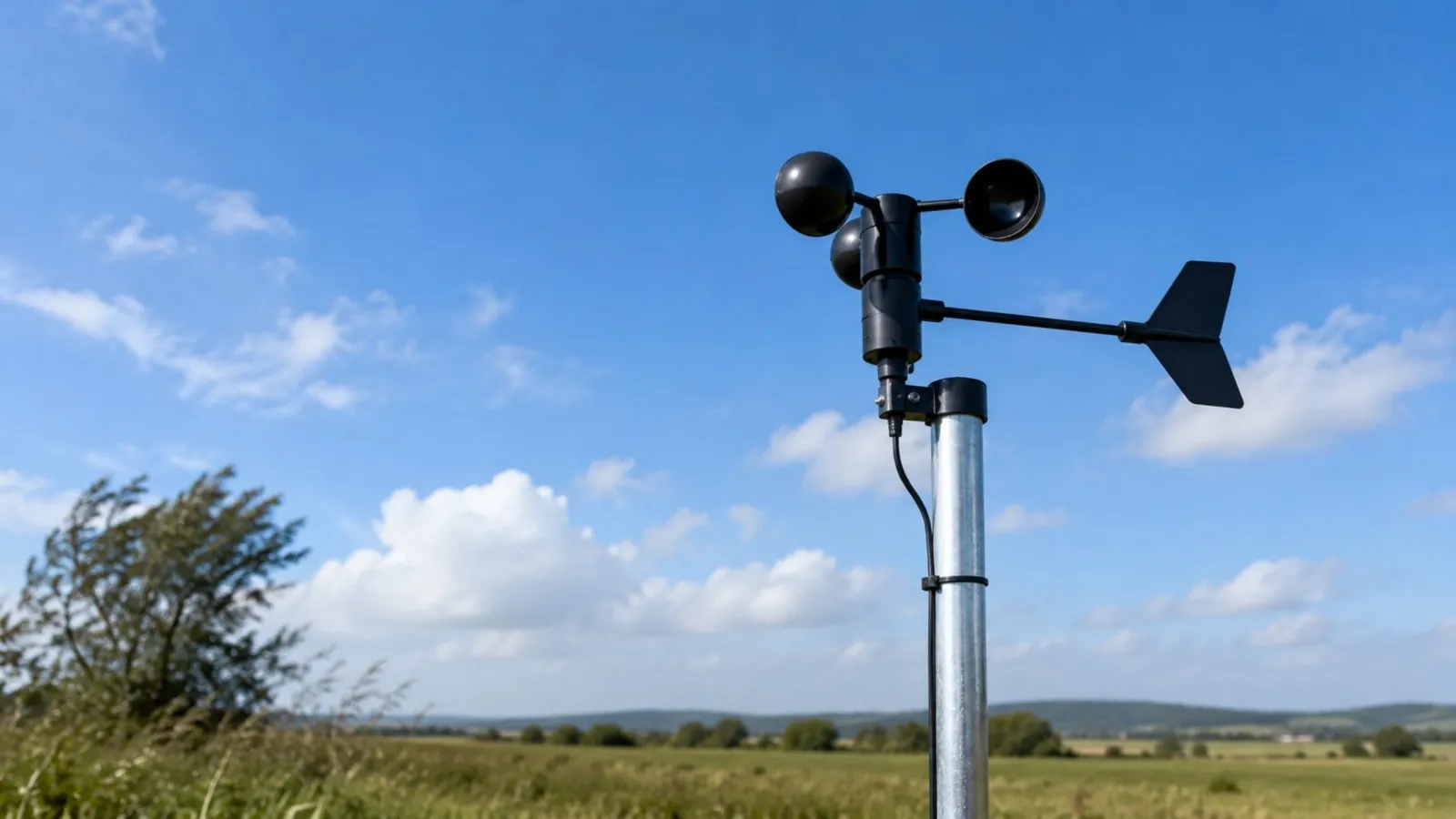
Wind measurement helps avoid two common mistakes:
- choosing a wind turbine too weak for the site;
- choosing a wind turbine too large when the support is not suitable.
An anemometer allows for better understanding of:
- the average wind;
- the gusts;
- the regularity of the wind;
- the windy periods;
- the turbulent zones.
See the measuring tools:
https://www.comptoireolien.fr/outils-de-mesure.html
Compact anemometer:
https://www.comptoireolien.fr/anemometre-17032024401480916.html
Professional anemometer:
https://www.comptoireolien.fr/anemometre-professionnel-mesure-du-vent-temperature-humidite-15728.html
To remember
The key points to remember:
- the weight of the wind turbine is not the only mechanical criterion;
- the horizontal wind force can become very significant;
- the leverage effect increases greatly with the height of the mast;
- a wind turbine with a diameter of 2.20 m can generate several hundred kilos of force in strong wind;
- a 4 m mast greatly amplifies the constraints at the base;
- gusts, vibrations, and turbulences must be taken into account;
- installations on gables, roofs, or facades are often discouraged;
- an independent mast in a clear area is generally preferable;
- the given values are orders of magnitude, not a certification;
- in case of doubt, the structure must be validated by a local professional.
Useful links
Horizontal wind turbines:
https://www.comptoireolien.fr/eoliennes-horizontales.html
Vertical wind turbines:
https://www.comptoireolien.fr/eoliennes-verticales.html
AeroSpiral wind turbines:
https://www.comptoireolien.fr/eoliennes-aerospiral-ultra-silencieuse-design.html
Masts and accessories:
https://www.comptoireolien.fr/mats-et-accessoires-pour-eoliennes.html
Gable wind turbines: caution:
https://www.comptoireolien.fr/eoliennes-de-pignon-attention.html
Measuring tools:
https://www.comptoireolien.fr/outils-de-mesure.html
Administrative procedures:
https://www.comptoireolien.fr/demarches-administratives-pour-linstallation-dune-eolienne.html
Conclusion
A domestic wind turbine should not be seen as a simple device of a few dozen kilos placed on a tube. In strong winds, it becomes a mechanical assembly subjected to horizontal forces, vibrations, gusts, and significant leverage effect.
For a wind turbine about 2.20 m in diameter, horizontal forces can reach several hundred kilos in strong winds. With a 4 m mast, these forces can represent more than a ton equivalent of leverage effect at the base of the mast.
The right reflex is therefore simple:
- choose a wind turbine suitable for the site;
- avoid improvised fixings;
- favor an independent mast;
- check the anchoring;
- limit turbulence;
- regularly check the installation;
- have the structure validated in case of doubt.
Le Comptoir Éolien sells equipment online and provides remote advice. We do not carry out on-site installations. For mounting on a building, gable, roof, shed, or existing structure, the simplest way is to have the installation validated by a local electrician or a renewable energy company in your region.