

Horizontal or Vertical Wind Turbine: Which to Choose to Produce Your Electricity?
Producing your own electricity through wind is a sustainable, economical, and complementary solution to solar. But one question often arises: should you choose a horizontal or vertical axis wind turbine?
In this article, we clearly explain the technical differences, actual performances, ideal installation conditions, and profitability criteria.
⚙️ 1. The horizontal axis wind turbine (HAWT)
It is the most widespread model in the world, identical to large park wind turbines but in a domestic version.
🔎 Main Features
- Rotor facing the wind
- Usually installed on a mast (3 to 12 m in residential areas)
- Automatic orientation via weather vane
- Proven technology
⚡ Performance
- Actual power coefficient: 0.30 to 0.45
- Start-up: 3 to 4 m/s
- Excellent efficiency in open areas
✅ Advantages
- Annual production higher than equivalent size
- Better return on investment in windy areas
- Ideal in open or rural terrain
⚠️ Points of Attention
- Requires height
- Sensitive to turbulence (urban areas not recommended)
👉 Conclusion: if your land is open and you can install a mast, the horizontal wind turbine is often the most profitable solution.

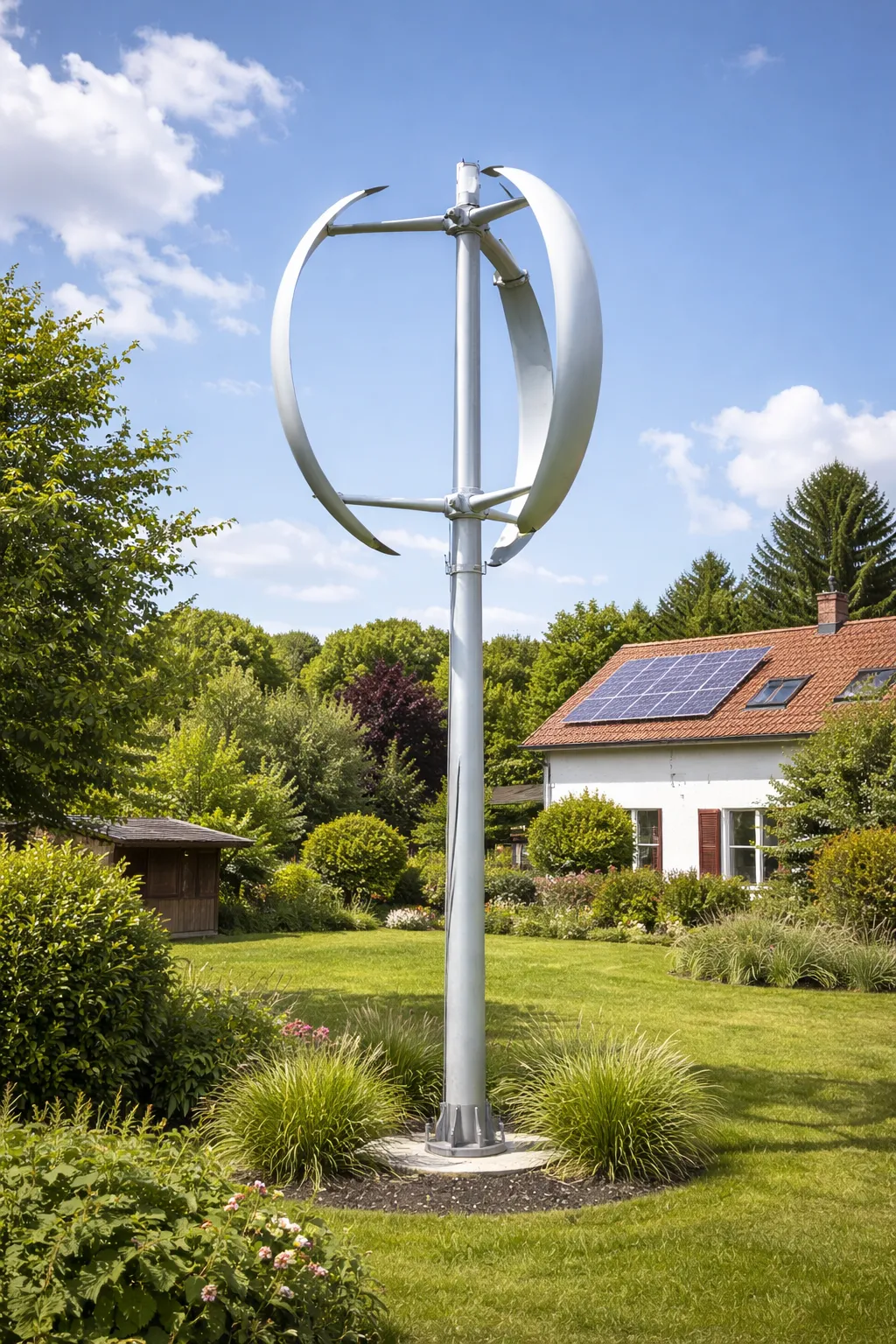
🔄 2. The Vertical Axis Wind Turbine (VAWT)
Vertical wind turbines rotate around a vertical axis. They mainly exist in two versions: Darrieus type (optimized efficiency) and Savonius (high torque, easy start-up).
🔎 Main Features
- Operates independently of wind direction
- Lowest possible installation
- Better tolerance to turbulent winds
⚡ Performance
- Power coefficient: 0.20 to 0.35
- Production often lower than an equivalent horizontal
- Suitable for semi-urban areas
✅ Advantages
- Generally quieter
- More aesthetic design
- Easier integration in urban environments
⚠️ Points of Attention
- Lower efficiency
- Longer ROI if the site is not windy
👉 Conclusion: ideal if height is limited or if the wind is turbulent.
🌍 The importance of the installation site
The performance of a wind turbine mainly depends on:
- The average annual wind speed
- The absence of turbulence
- The installation height
- The clearance around the rotor
A wind turbine placed 1.5 m above a ridge in an urban area will produce much less than a turbine installed on a mast in an open area.
💡 This is why a mini wind study over several months is strongly recommended before any investment.
🔋 Wind alone or hybrid system?
Wind power works particularly well in winter, when solar production decreases. Combining a wind turbine with a photovoltaic installation allows for:
- More regular production throughout the year
- Better energy autonomy
- Optimization of batteries in isolated sites
It's an ideal solution for:
- Isolated chalet
- Autonomous dwelling
- Bill reduction through self-consumption
🎯 How to make the right choice?
Ask yourself these 4 questions:
- Can I install a sufficiently tall mast?
- Is my land clear?
- Is the wind stable or turbulent?
- Is my goal maximum production or discreet integration?
🌱 Conclusion
There is no universal "best" wind turbine.
There is the best wind turbine for your site.
- Clear terrain + seeking efficiency → horizontal axis
- More turbulent area + aesthetic constraint → vertical axis
At Le Comptoir Éolien, we always prioritize the match between the chosen model and the reality of the terrain to ensure consistent, sustainable, and profitable production.