

Properly install your residential wind turbine
For it to operate at full efficiency, the residential wind turbine must be installed in an open area, where the average wind blows consistently and steadily.
To fully benefit from your domestic wind turbine, it is better to install it properly. During this step, several parameters come into play:
- the wind,
- the installation location.
On the other hand, it is now possible to install a wind turbine for individuals in the city. Although more complicated, due to the particularity of urban winds, this option is entirely feasible.
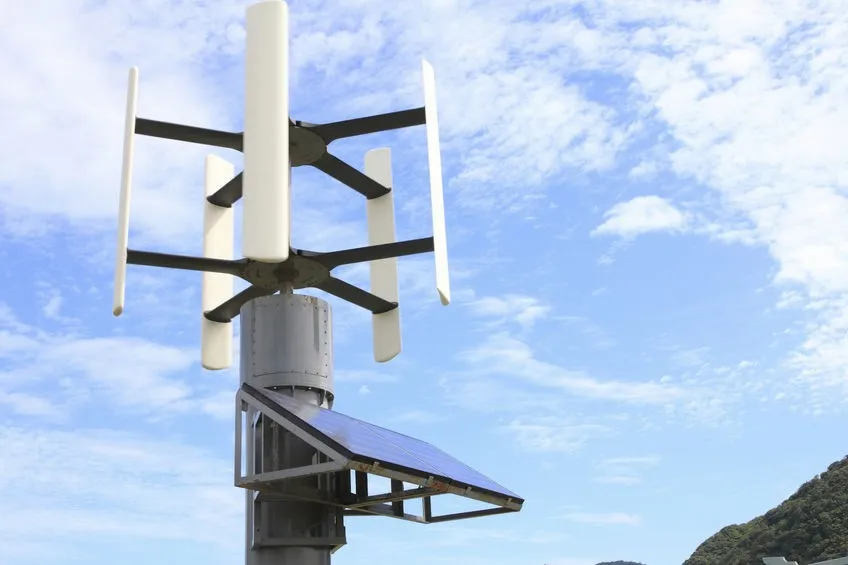
Wind turbine installation: preliminary wind study
Before installing the wind turbine for individuals, or even choosing its power, a wind study is essential.
It allows you to best size the wind turbine installation and adapt its power to your needs, as well as to the winds. This study helps determine the most exposed location.
To do this, you identify the site where you wish to install your wind turbine. Then a mast about 10 meters high is installed there for a month. On this mast are fixed:
- a weather vane,
- an anemometer,
- a data acquisition unit.
The data thus collected is recorded and correlated with historical data recorded by the nearest Météo France station to the installation site.
A report is then provided to you. It contains, for example:
- the average wind speed,
- a wind frequency curve,
- proposals for solutions for the installation of the wind turbine for individuals,
- the wind potential of the installation site...
On average, a wind turbine for individuals starts with winds of 10 to 15 km/h. It is therefore not recommended to install one if the average wind blowing at the installation site is below these values.
Wind turbine for individuals: installation location
A domestic wind turbine, even efficient and carefully designed, will not provide you with the electricity you need if it is not installed in a suitable location.
It must be able to capture as much wind as possible, without danger to people and installations around it. Thus, several parameters must be considered in choosing the installation location of the wind turbine for individuals:
- the wind,
- the height,
- the clearance,
- the presence of dwellings...
The wind turbine for individuals must be installed as high as possible, without modifying the size of the mast or tower. You can therefore start by using any reliefs present on the land.
Then, to capture the wind as much as possible, the blades of the wind turbine for individuals must be located in an open environment. Thus, it is generally considered that they must exceed the surrounding obstacles by at least 2 meters.
Example: the wind turbine will be located two meters above the house, a tree, a shed, a garage, a garden shed...
Finally, to ensure the safety of property and people, the space surrounding the wind turbine must also be clear. This safety perimeter around the installation is equal to the height of the mast.
Installing a wind turbine for individuals in the city
Those who do not live in rural areas, or who do not have a garden in the city, can also benefit from wind energy for individuals.
Although still limited, this option is nevertheless conceivable. But several issues come into play:
- the presence of dwellings around the wind turbine for individuals,
- weak and turbulent winds.
Wind turbine manufacturers are currently working to improve existing systems to meet urban demand.
The ideal choice today is the vertical wind turbine. Indeed, it can be easily and safely installed on a roof, and captures weak, even turbulent winds well.
However, one can opt for a horizontal wind turbine and fix it on the edge of the facade, making it protrude from the roof. The same type of system used for a satellite dish is then used. The wind turbine is fixed on a mast, itself fixed on the facade with wall mounts, or on the chimney with a banding. But this solution is less profitable and less safe.
Proof of this enthusiasm, the installation in April 2010 of two mini wind turbines on the Maison de l'air in Paris. They can produce up to 275 kWh. The surplus electricity will be sold to EDF.