

How to choose a 12 - 220 Volts converter?
✔ Principles and use
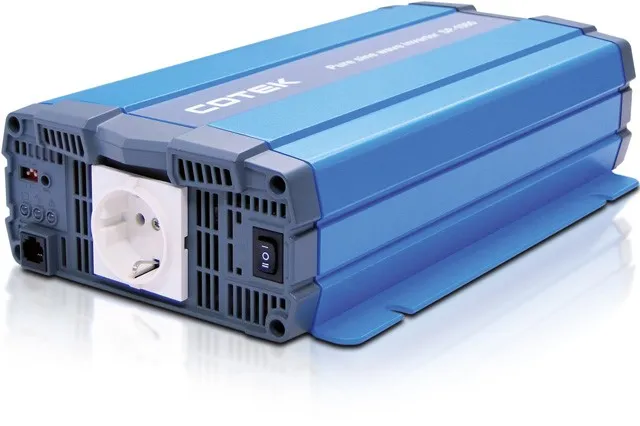
A voltage converter (or inverter) allows you to switch from direct current (for example, a 12V voltage, that of a car or camper battery) to alternating current of 220V (mains current), it is very useful in case of a power outage as it functions like a generator.
It therefore allows you to use devices designed to operate on the "classic" mains while traveling (or in a fixed location).
✔ Uses
A converter, as seen above, will allow you to use devices designed to operate on 220V. The only limitation will be the power required by the device, which must match the power of your converter.
These can be low-consumption devices, such as camera or phone chargers, etc., or more energy-intensive devices, like lamps, coffee makers, kettles, etc.
✔ Case of laptops
Laptops often have a voltage around 19 volts, so they cannot be powered directly by 12V. So either you use the classic mains charger plugged into a 12/220 converter, or you use a special converter that will increase the 12V battery voltage to the required voltage (19V, as seen above), and which will plug into the cigarette lighter socket (some will also be compatible with 220V).
You can make your choice among different models at this address.
✔ Nominal and Maximum Power
The so-called nominal power is the one displayed on your converter (example: 300 watts). It can be considered as the power that the converter can deliver throughout its operation.
The peak power (or maximum power), often twice as high as the nominal power, is the power that the converter can deliver over a short period of time, which may be necessary, for example, when starting a motor, which at startup has a significant electrical consumption peak (sometimes up to three times the nominal power).
For example, if you have a converter with 600W nominal and 1200W peak, and you use a device with a motor rated for 300W, it is possible that your device consumes 900W for a few seconds. Your converter going up to 1200W, no problem. But if you had settled for a 300W / 600W peak converter, problem!
In conclusion: assess the consumption of the devices you want to connect, and allow for a safety margin.
✔ Signal Quality
A "perfect" alternating current is represented by a "smooth" sinusoidal curve. The worse the signal (waveform), the more the curve is "stepped."
A "pure sine" signal therefore represents the most perfect form of signal. Conversely, the worst signal is a so-called "square" signal. Between the two, it is called a pseudo-sine signal (or modified sine)
In terms of converters, when nothing is specified, it is often a current with a trapezoidal signal (modified sine). Then come the converters with a so-called "quasi-sine" signal, followed by the "pure sine" ones. The price is obviously increasing.
It is considered imperative to use pure sine converters if using "sensitive" devices, such as televisions, etc...
I therefore advise you to opt for pure sine, if you have the budget!
NOTE: Le Comptoir Eolien being a member of a number of Facebook groups on caravanning, etc... we read a lot of feedback about "simple" devices being fried by "quasi-sine". Well, as always, those for whom it works do not complain, but we prefer to inform you. So yes, if you have the budget, go for pure sine.
Technically, the Total Harmonic Distortion (THD) quantifies the signal quality. It is expressed as a percentage, the closer it is to zero, the better. Unfortunately, it is not often indicated in the descriptions. For example, on a converter worth 800 euros, it is less than 3%.
✔ Efficiency
The efficiency of a converter is given as a percentage (or as a decimal number, for example 0.83 = 83%). In our example, a compressor with 83% means it will consume 100W, to return 83. Logically, the higher the efficiency, the better! It is also one of the criteria that affects the price.
✔ Useful Options
Whatever the model or power of your converter, it can be very useful to have one or more USB outputs, to charge a phone, GPS, or other directly...
It is also interesting to have multiple power outlets on the converter, but it is not essential.
Furthermore, an on/off switch must be present (no models with non-stop operation without a switch).
Similarly, if your converter needs to deliver high power, it must be connected via crocodile clips to the battery, or via direct wiring, but definitely not through the cigarette lighter socket.
✔ Choosing a Model
To recharge camera, camcorder batteries, or directly via the USB port of smartphones, GPS, etc..., a low-power converter (150W for example) will be more than sufficient. It will cost you about twenty euros. The signal will be of low quality, but sufficient for these applications. Make sure the chosen model includes a USB port!
In any case, I advise against models that plug directly into the cigarette lighter without a cable.
That said, you may need to try several models, as I have noticed that cigarette lighter sockets have slightly different dimensions, which means some connectors "swim" in the socket and therefore do not make proper contact.
For more intensive applications, I therefore recommend a pure sine wave inverter, which you can find by clicking here.
Regarding power, it's up to you depending on your budget! Don't go below 600 watts, it would be a shame.
Try, if possible, to aim for the 1000 / 2000 watts range.
✔ Location
When the inverter is permanently connected to the auxiliary battery, it is ideal to position it relatively close to the battery (to avoid potential current losses), but isolated from it by a partition. It is better to avoid proximity if any vapors may be emitted from the battery. Ideally, the battery should be placed in a ventilated compartment (or even ventilated via a 12-volt fan that activates when the battery is charging), and the inverter against this compartment, on the outside.
✔ And the battery, in all this?
Remember that your inverter will draw its electrical energy from your battery, whether it is the starter battery or an additional battery (cell battery).
So, to have enough autonomy, consider investing in large batteries (at least 100 ah, batteries with AGM or GEL technology are our favorites, like these ones).
The higher the battery capacity (high number of ah), the higher the autonomy will be when it is not charging (via solar panels for example).
✔ Any questions?
For any questions regarding this type of equipment, do not hesitate to contact us via the contact form or leave a message below in the comments section!