

Domestic wind turbines: beware of overly enticing production promises
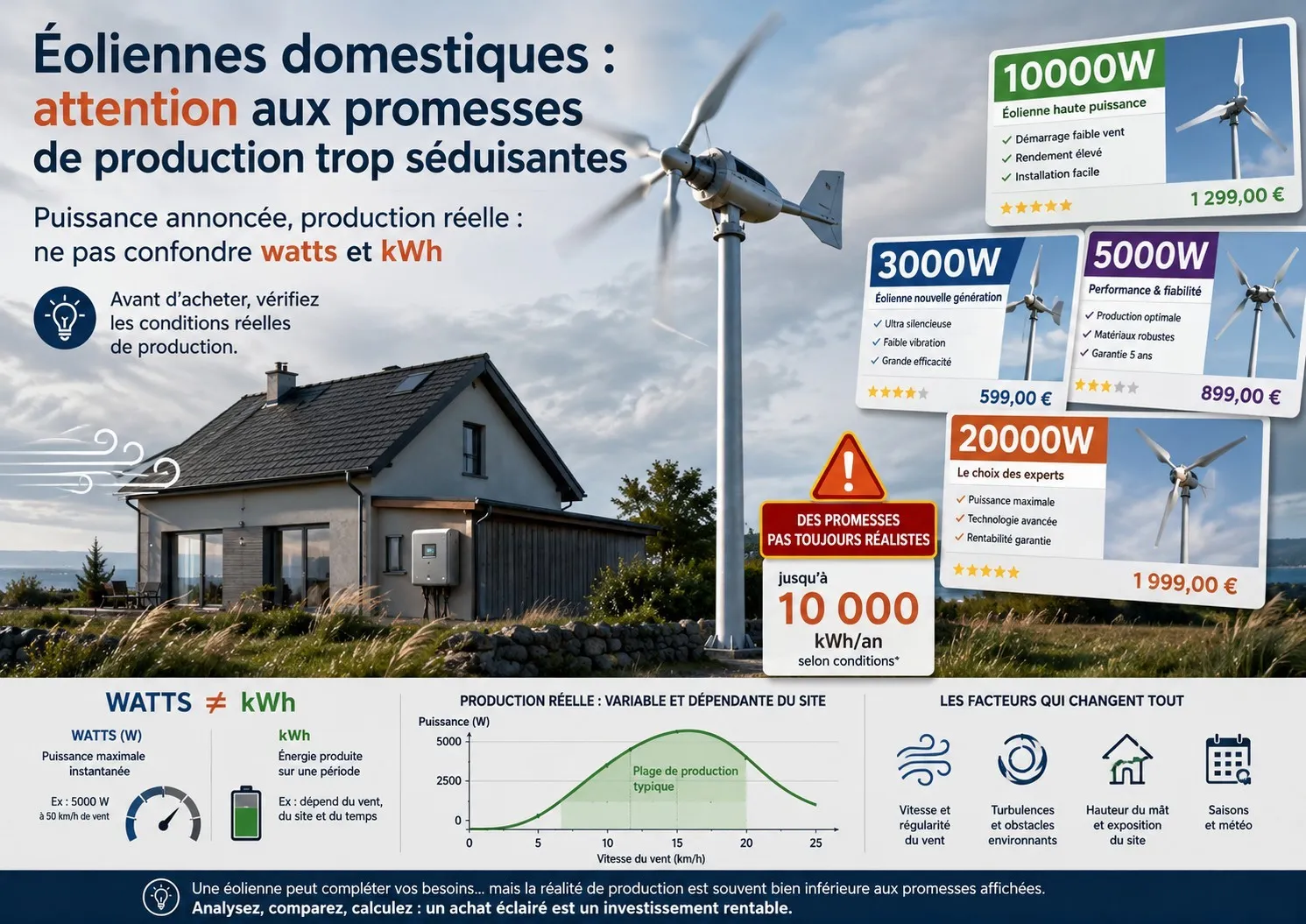
Today, on many generalist marketplaces — Amazon, ManoMano, AliExpress, eBay, or others — domestic wind turbines are listed at 3000W, 4000W, 5000W, 6000W, 7000W, 8000W, 9000W, 10000W, or even 20000W.
Some advertisements also highlight productions such as: “up to 10,000 kWh per year”.
On paper, these figures may impress. But before buying a domestic wind turbine, one essential thing must be understood: the power announced in watts is not the actual production you will get at home.
A wind turbine does not produce its nominal power continuously. Its production depends on the actual wind, installation height, turbulence, obstacles, the diameter or swept area of the rotor, the type of generator, the regulator, the inverter, any batteries, and the wiring.
Watts and kWh: two concepts not to be confused
A wind turbine rated at 1000W, 3000W, or 10000W displays a maximum or nominal power, generally reached under specific wind conditions.
The kWh, on the other hand, corresponds to the energy actually produced over time.
Simple example:
a 1000W wind turbine that actually produces 1000W for 1 hour would produce 1 kWh. But in reality, it does not stay at 1000W all day. It can produce little, a lot, or nothing at all depending on the wind.
That's why an announcement that only indicates power in watts, without a power curve, without nominal wind speed, and without test conditions, is not enough to estimate annual production.
“Up to 10,000 kWh/year”: what does this figure represent?
10,000 kWh per year is approximately:
- 27.4 kWh per day
- 1.14 kW of average power 24/7, 365 days a year
To reach 10,000 kWh/year, it would be necessary to produce on average about 1,140 W continuously throughout the year.
- Wind turbine rated at 3,000 W: it would need to produce 1,140 W on average, which is about 38% of the nominal power.
- Wind turbine rated at 5,000 W: it would need to produce 1,140 W on average, which is about 23% of the nominal power.
- Wind turbine rated at 10,000 W: it would need to produce 1,140 W on average, which is about 11% of the nominal power.
- Wind turbine rated at 20,000 W: it would need to produce 1,140 W on average, which is about 6% of the nominal power.
This calculation does not prove that an announcement is false. It simply shows that an annual figure must always be justified by specific conditions: average wind speed, mast height, power curve, rotor diameter or area, system efficiency, and electrical losses.
Without this information, the promise remains difficult to verify.

The swept area: the detail many announcements forget
A wind turbine does not generate energy “by magic.” It captures a portion of the energy contained in the wind.
Production depends notably on:
- the wind speed;
- the area swept by the blades;
- the aerodynamic efficiency;
- the mechanical and electrical losses;
- the regulation and the inverter.
The smaller the rotor, the less wind it intercepts. A compact vertical wind turbine, even if displayed with high power, should be viewed with caution if its actual area is small.
For horizontal wind turbines, rotor diameter is often discussed. For vertical wind turbines, the area swept by the useful height and diameter of the rotor is considered. In both cases, the smaller the area, the more significant wind is needed to achieve high production.
Vertical wind turbine: useful, but not miraculous
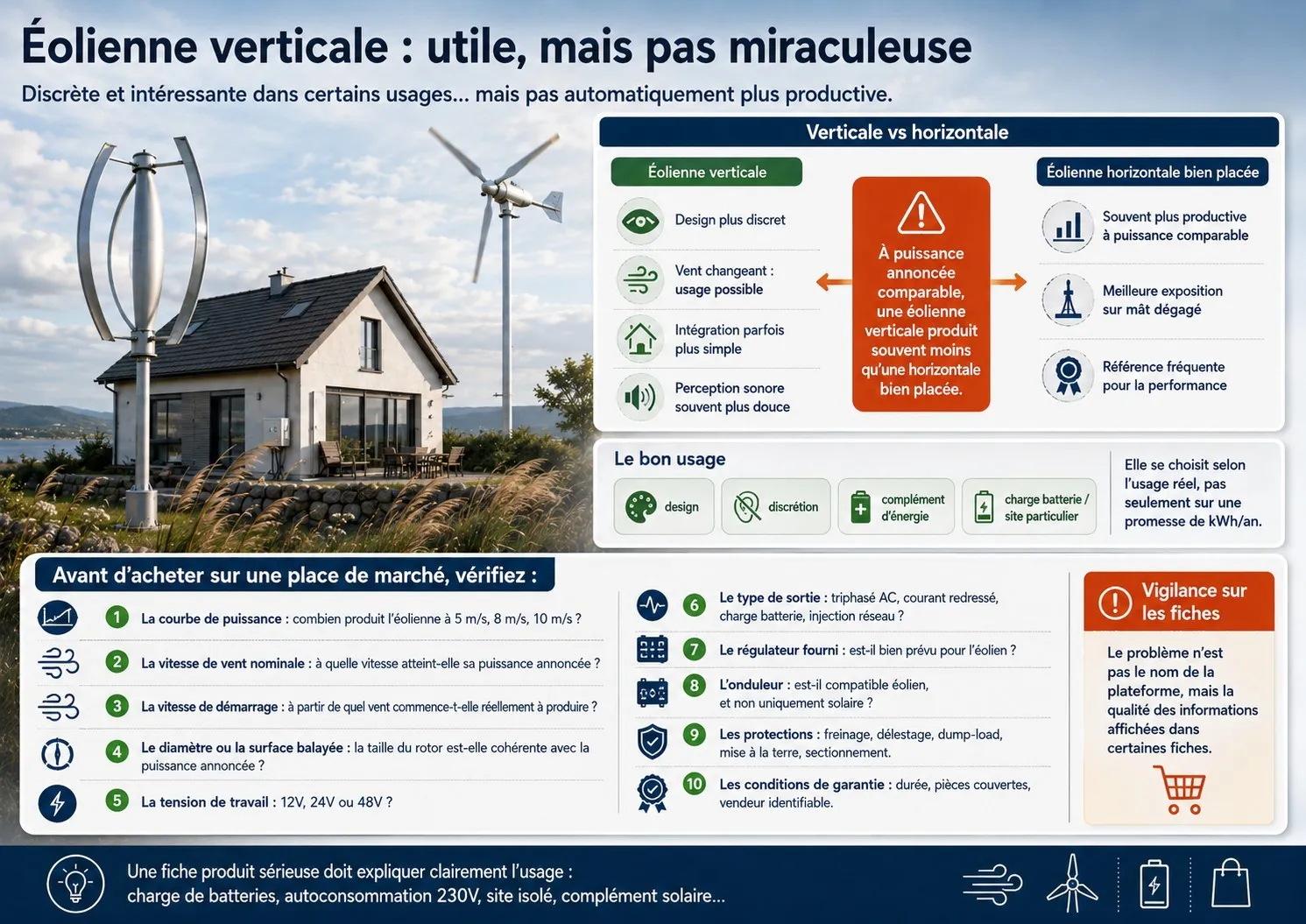
Vertical wind turbines have real advantages: more discreet design, possible operation with changing winds, sometimes simpler integration, often softer sound perception depending on the models.
But they are not automatically more productive. At comparable announced power, a vertical wind turbine often produces less than a well-placed horizontal wind turbine on a clear mast.
This does not mean that a vertical wind turbine is a bad choice. It means it should be chosen for the right use: design, discretion, energy supplement, battery charging, specific site... and not solely on a very high kWh/year promise.
Why marketplaces require particular vigilance
Large marketplaces bring together many third-party sellers. The issue is not the platform's name, but the quality of the information displayed in certain listings.
Before buying a domestic wind turbine, always check:
- The power curve: how much does the wind turbine produce at 5 m/s, 8 m/s, 10 m/s, etc.?
- The nominal wind speed: at what speed does it reach its announced power?
- The starting speed: from what wind does it actually start producing?
- The diameter or swept area: is the rotor size consistent with the announced power?
- The working voltage: 12V, 24V, or 48V?
- The type of output: three-phase AC, rectified current, battery charging, grid injection?
- The supplied regulator: is it well-suited for wind power?
- The inverter: is it compatible with wind power, and not only solar?
- The protections: braking, load shedding, dump load, grounding, disconnection.
- The warranty conditions: duration, covered parts, identifiable seller.
A serious product sheet should allow understanding how the wind turbine is used: battery charging, 230V self-consumption, isolated site, solar complement, etc.
Beware of simplified connections
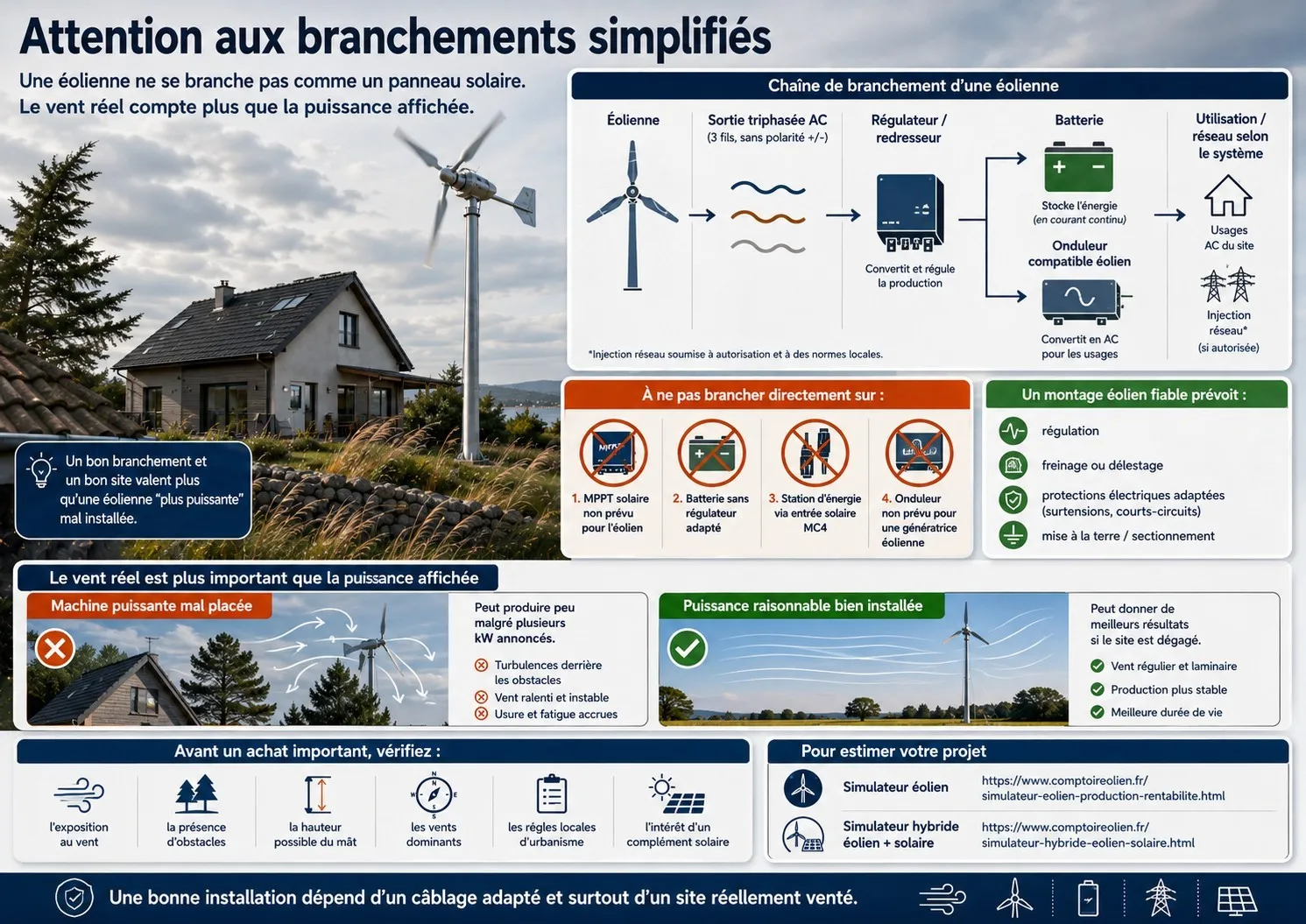
A wind turbine is not connected like a solar panel.
It produces variable voltage and current depending on the wind. Many wind generators output in three-phase AC, with 3 wires, without +/- polarity. A regulator, rectifier, inverter, or suitable charging system is then needed.
A wind turbine should not be directly connected to:
- a solar MPPT not designed for wind power;
- a battery without a suitable regulator;
- an energy station via a solar MC4 input;
- an inverter not designed for a wind generator.
A reliable wind setup must include regulation, braking or shedding of excess energy, as well as suitable electrical protections.
The actual wind is more important than the rated power
The best way to avoid mistakes is to measure or correctly estimate the wind at your site.
A wind turbine placed too low, behind a house, near trees, on a gable exposed to turbulence, or in a low-wind area will produce little, even if the sheet claims several kilowatts.
Conversely, a more reasonably powered wind turbine, installed in an open area on a suitable mast, can yield better results than a very powerful machine poorly placed.
Before a major purchase, it is advisable to check:
- exposure to wind;
- the presence of obstacles;
- the possible height of the mast;
- the prevailing winds;
- local urban planning rules;
- the interest of a solar complement.
You can use our simulator for a first estimate:
https://www.comptoireolien.fr/simulateur-eolien-production-rentabilite.html
For a wind + solar project:
https://www.comptoireolien.fr/simulateur-hybride-eolien-solaire.html
Regulation: do not forget the location
The installation of a domestic wind turbine must also consider local rules.
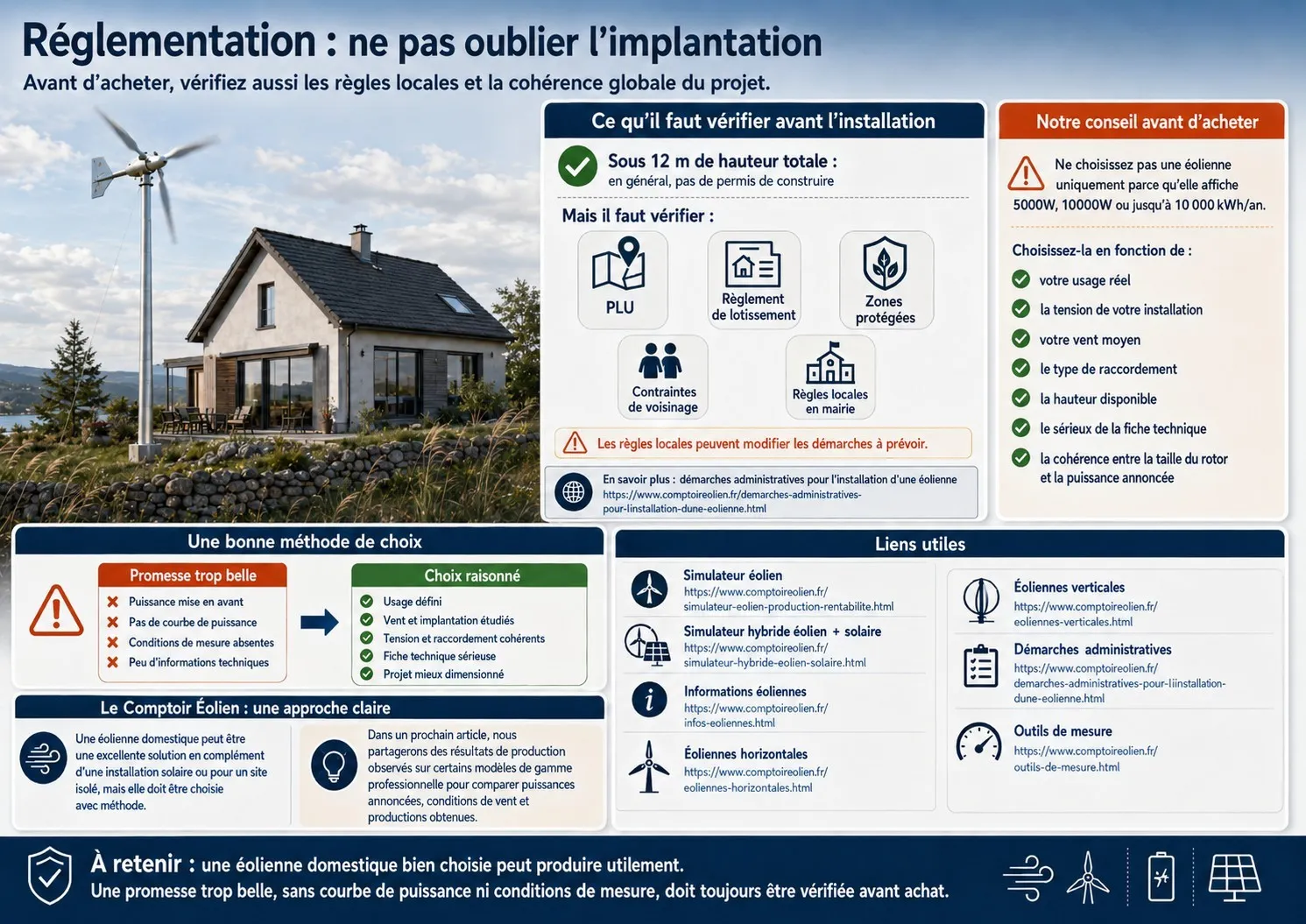
In general, under 12 meters of total height, there is no building permit required, but you must check the PLU, the subdivision regulations, protected areas, neighborhood constraints, and any local rules at the town hall.
To learn more:
https://www.comptoireolien.fr/demarches-administratives-pour-linstallation-dune-eolienne.html
Our advice before buying
Do not choose a wind turbine just because it displays “5000W”, “10000W” or “up to 10,000 kWh/year”.
Choose it based on:
- your actual usage;
- the voltage of your installation;
- your average wind;
- the type of connection;
- the available height;
- the seriousness of the technical sheet;
- the consistency between the rotor size and the stated power.
At Le Comptoir Éolien, we prefer to clearly state the limits: a domestic wind turbine can be an excellent solution to complement a solar installation or for an isolated site, but it must be chosen methodically.
In a future article, we will share production results observed on certain professional range models. This will allow for a more concrete comparison of the stated powers, actual wind conditions, and obtained productions.
To remember: a well-chosen domestic wind turbine can produce usefully. A promise too good, without a power curve or measurement conditions, must always be verified before purchase.
Recommended internal links to insert in the article
- Wind turbine simulator: https://www.comptoireolien.fr/simulateur-eolien-production-rentabilite.html
- Hybrid wind + solar simulator: https://www.comptoireolien.fr/simulateur-hybride-eolien-solaire.html
- Wind turbine information: https://www.comptoireolien.fr/infos-eoliennes.html
- Horizontal wind turbines: https://www.comptoireolien.fr/eoliennes-horizontales.html
- Vertical wind turbines: https://www.comptoireolien.fr/eoliennes-verticales.html
- Administrative procedures: https://www.comptoireolien.fr/demarches-administratives-pour-linstallation-dune-eolienne.html
- Measurement tools: https://www.comptoireolien.fr/outils-de-mesure.html