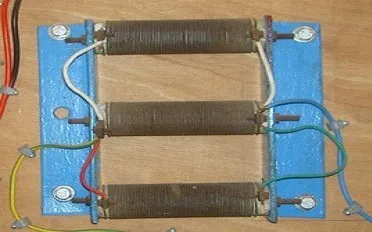

The overflow resistance of a wind turbine
The overflow resistor contains the electrical excesses of the wind turbine during strong winds.
A simple safety element, the overflow resistor simply converts excess electrical energy into heat. It is also called a discharge resistor, load shedding resistor, or dump load (in English).
Without it, already full batteries would be saturated with electricity and their voltage would rise to dangerously high values. In this case, for open batteries with liquid electrolyte, the acid simply starts to boil and evaporates rapidly. This is a sought-after effect to equalize the cells of a battery and prolong its lifespan, but only for a short period. It is essential to avoid this situation when it is not controlled. Without an overflow resistor, a few days of strong winds are enough to overload batteries and irreparably damage them.
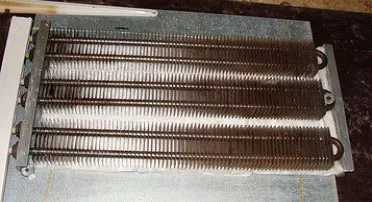
The overflow resistor of a wind turbine is a large element, placed in the open air and often equipped with fins or a ceramic core to promote heat dissipation. Like the diode bridge radiator, the fins of the resistor must be arranged vertically for natural air convection. Therefore, all space above the resistor must be left free.
The temperatures reached during strong winds are sometimes high, and a protective grid may be necessary. Similarly, the overflow resistor is isolated from any flammable support.
The resistors operate at very low voltage (below 50V), so the currents are very high, even for low power. The ohmic resistance must therefore reach a low value while maintaining a strong heat dissipation capacity. It is sometimes necessary to put several elements in parallel to distribute the heating.
A resistor is characterized by two values, its resistance in Ohms, and its power in Watts, which is the amount of heat that can be dissipated without damage.
Let's do a small sizing exercise with a 1000W wind turbine at 24V. The maximum power of 1000W is increased by 25% as a safety factor, giving us 1250W. This is the dissipation power of our resistor.
The ohmic resistance is calculated first by determining the current. We divide the max power by the voltage at full batteries: 1250 / 28 = 44 Amps.
With Ohm's law, we can determine the resistance to install to consume 44A at 28V. U = RI so R = U/I so R = 28/44 = 0.64 Ohms.
We will therefore in this case need to use a 1250 Watt - 0.64 Ohm resistor (or close) with a 45A or higher regulator to control the battery charge in all situations.
In the context of self-construction, to save money, it is possible to size and manufacture a wind turbine dump load resistor yourself from resistive wire. It is sold in coils or by the meter at a modest price. The length of the wire gives the ohmic resistance: the shorter it is, the lower the resistance and the stronger the current drawn. Be careful not to exceed the allowable temperature of the wire due to a length that is too short. It must be long and thick enough to dissipate its heat into the air.