
The different types of wind turbines
There are onshore wind turbines (an American term meaning on the ground, that is, on continents) and offshore wind turbines (on the sea). The latter have advantages in terms of noise pollution since they are far from homes and in terms of winds because marine winds are more numerous and stronger than continental winds. However, they are much more difficult to install and therefore much more expensive.
There are two main types of wind turbines:
- Vertical axis wind turbines
- Horizontal axis wind turbines
Nowadays, there are several types of wind turbines among these two main categories.
Horizontal axis wind turbines
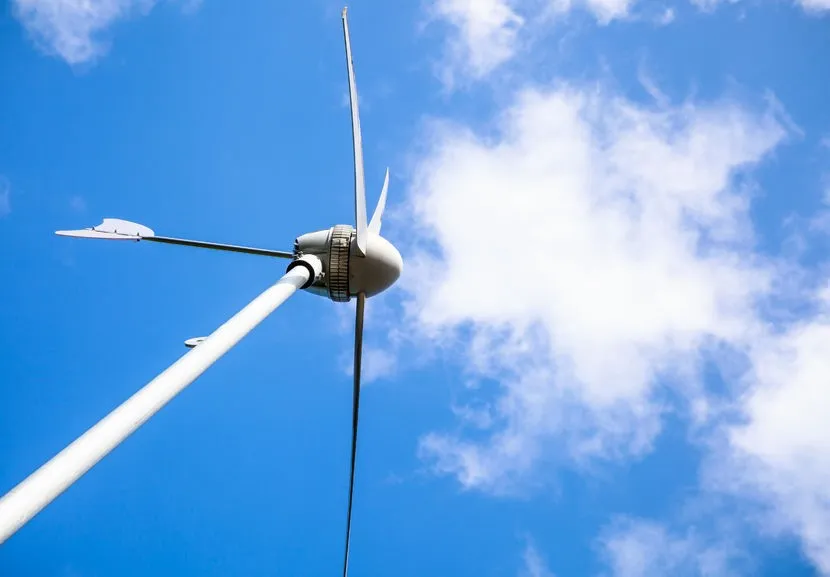
Modern classic three-blade wind turbines: a design that has prevailed in the global market for reasons of structural stability. There are also two-blade and single-blade wind turbines, but they are less reliable.
The total height of these wind turbines varies between 25 and 180m for a power ranging from 100 Kw to 5 MW.

Domestic wind turbines
Their size does not exceed 12m and they have a power ranging from 100W to 20Kw.
Their installation in France is still very low, about 600. (Much less than in some other European countries).
Horizontal or domestic wind turbines can be of the "downwind" or "upwind" type. In most cases, they are "upwind" turbines, meaning the wind blows directly on the turbine blades. This requires the use of very rigid blades as they are very exposed to the wind.
The "downwind" configuration is used particularly for small wind turbines that are equipped with more fragile blades.
Vertical axis wind turbines
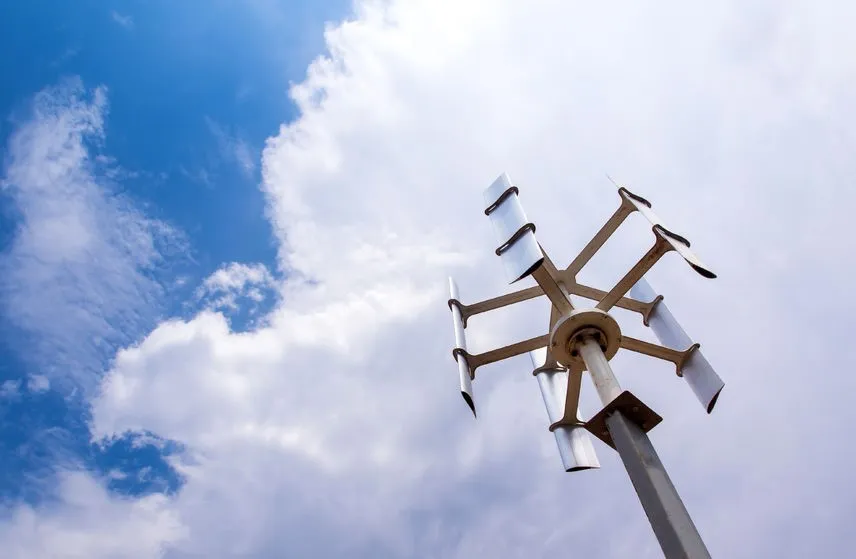
Vertical axis wind turbines are more expensive than horizontal axis wind turbines and more complex in design but adapt more easily to areas with irregular wind. A vertical axis wind turbine is especially useful in places where there is not much space: in the city, on the roof of a building, for example.
There are two models of vertical axis wind turbines: Savonius and Darrieus
Darrieus:
They are compact, do not require orientation systems, and are easy to install. However, they have low efficiency and do not start on their own.
Savonius:
This wind turbine also has low efficiency compared to a conventional wind turbine but has the advantage of operating with all wind directions. The turbine is compact and being on a vertical axis reduces vibrations, which can be very constraining on a building.
Hydro turbines
Hydro turbines are specific wind turbines that operate underwater using the energy of marine currents. They are underwater wind turbines or marine aerogenerators.
The development of hydro turbines is very recent and already very promising. While the manufacturing of land-based wind turbines is much less complex than that of hydro turbines, the latter can deploy much greater power for a much smaller size. This is because the energy of marine currents is 800 times greater than that of the wind. Variations within marine currents are also much smaller than wind variations.
The major disadvantage of hydro turbines is their impact on the marine environment: although the blades turn slowly enough and create less disturbance than a boat's propellers, hydro turbines still create larger turbulence zones preventing the development of marine fauna and flora over large perimeters.
Since hydro turbines are underwater, erosion is very strong and for now, the lifespan of hydro turbines is quite limited. The installation of hydro turbines, particularly at tidal currents, remains a very interesting path for the production of new energy.
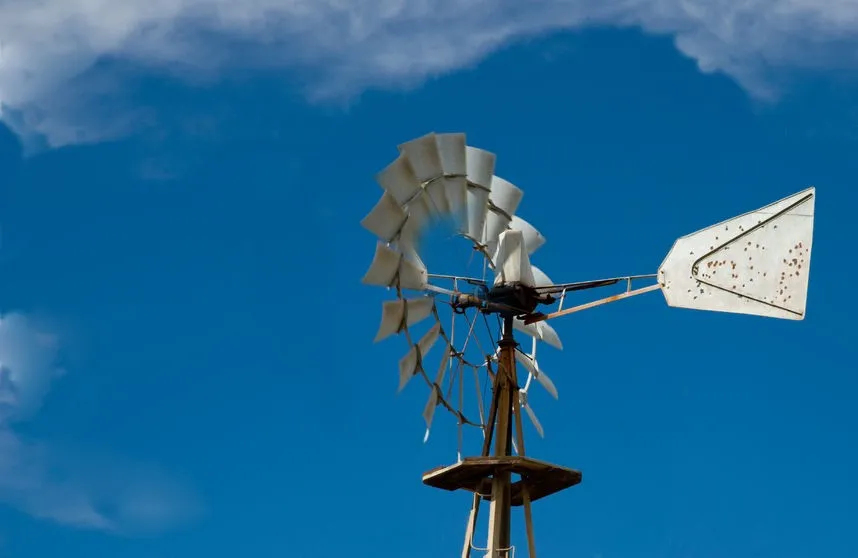
Pumping wind turbine
Created in the 1930s, "Oasis" wind turbines are designed to use the driving force of the wind to operate a water pump. Acquired by the thousands by French farmers, they are used for many purposes:
- livestock feeding,
- irrigation of vegetable crops,
- firefighting (supplying water reserves),
- drainage and drying of wetlands,
- oxygenation of ponds,
- fish farming,
- forestry,
- pumping seawater for salt marshes,
- creating water points for game...