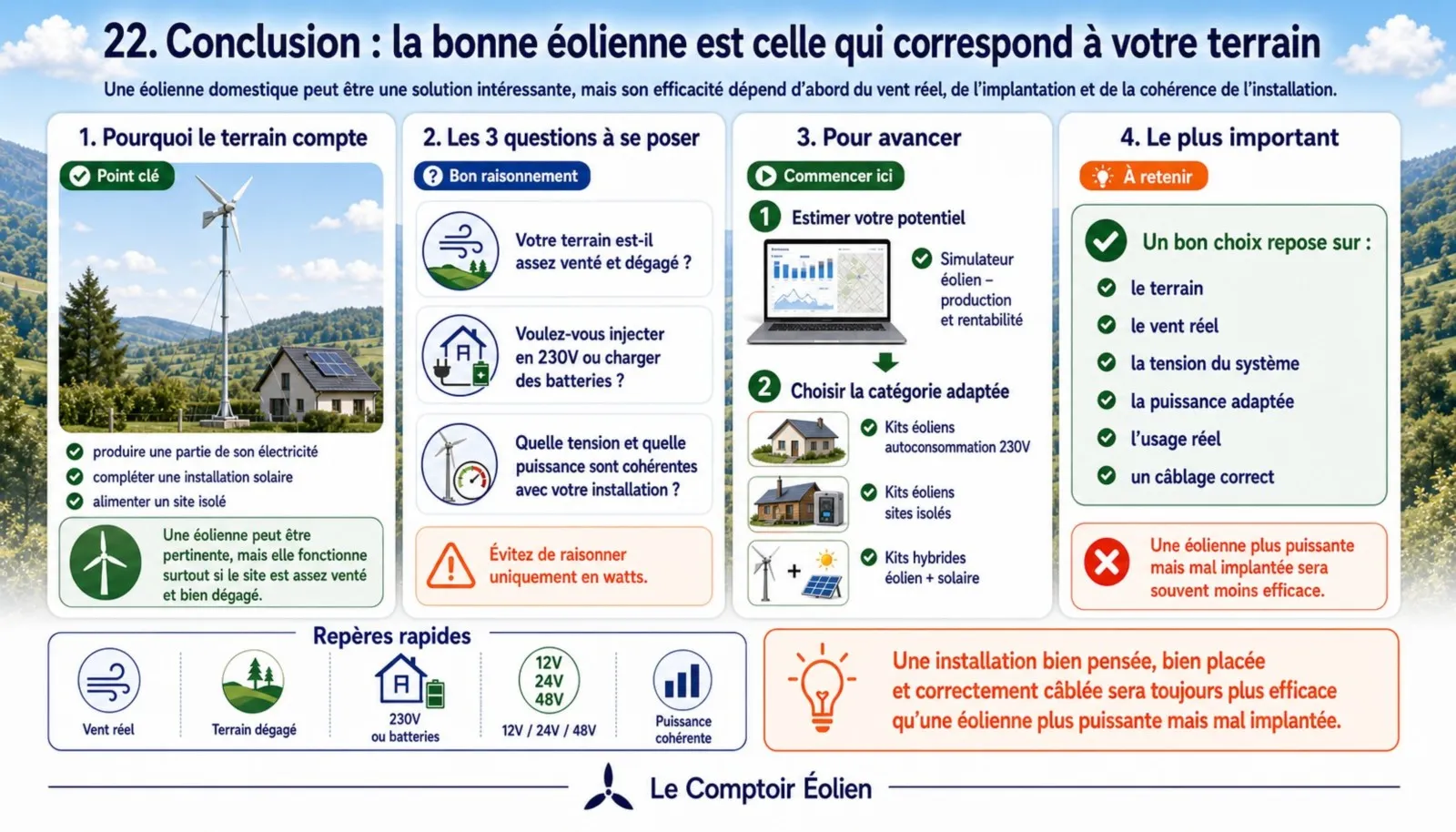

Domestic wind turbine for individuals: how to choose an installation truly suited to your terrain?
Installing a domestic wind turbine allows you to produce part of your electricity using the wind. For an individual, the goal may vary depending on the project: reduce part of their grid consumption, complement a solar installation, power an isolated site, charge batteries, secure an electrical supply, or simply better utilize the natural potential of an exposed terrain.
But a wind turbine is not chosen solely based on a power rating in watts. The right choice mainly depends on the actual wind, location, mast height, presence or absence of batteries, type of electrical network, and the intended use.
Le Comptoir Éolien offers controlled and selected wind solutions to meet different needs: 230V self-consumption, installation with 12V, 24V, or 48V batteries, isolated site, single-phase or three-phase network, or even hybrid wind + solar system.
Before choosing a kit, the simplest way is to start by estimating the potential of your terrain with our simulator:
To be used as a priority:
Wind Turbine Simulator – Production and Profitability
For a project combining solar and wind:
Hybrid Wind + Solar Simulator
1. What is the purpose of a domestic wind turbine?
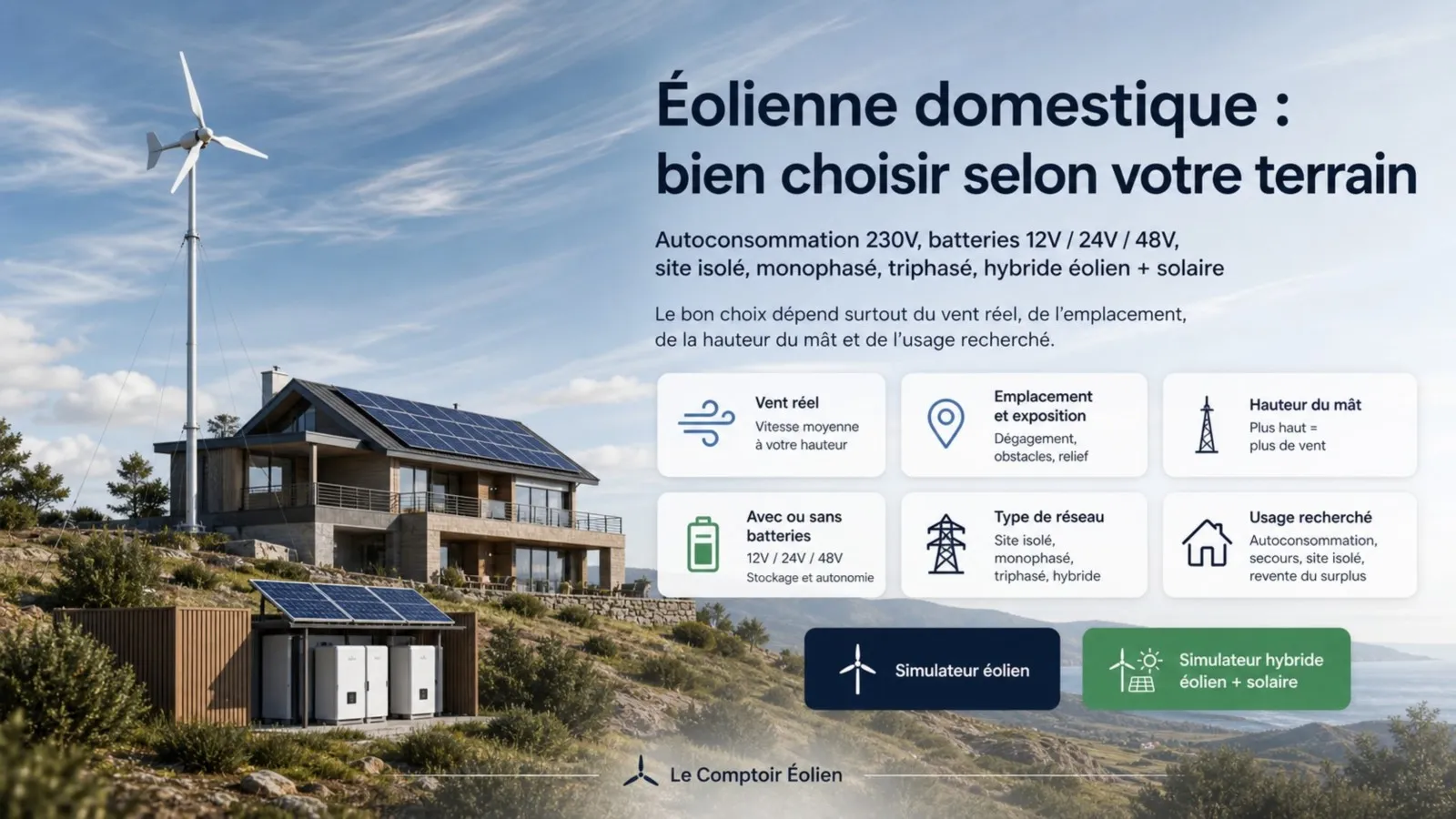
A domestic wind turbine converts wind energy into electricity. This electricity can then be used in several ways.
The first possibility is 230V grid self-consumption. In this case, the wind turbine produces variable energy, then an inverter converts it into 230V alternating current to inject it into the house's electrical system. The energy produced is consumed as a priority by the devices operating at the same time.
The second possibility is off-grid site with batteries. This solution is for locations not connected to the electrical grid: chalet, cabin, autonomous land, boat, van, camper, technical room, shelter, telecommunications, or pumping. In this case, the wind turbine charges one or more batteries via a suitable wind regulator. The stored energy can then power a 230V converter.
The third possibility is the hybrid wind + solar system. The wind can complement solar panels, especially when the wind is present in the evening, at night, in winter, or in cloudy weather. This combination is interesting to improve a site's autonomy or to smooth production over several periods of the year.
2. 230V self-consumption or batteries: the most important choice
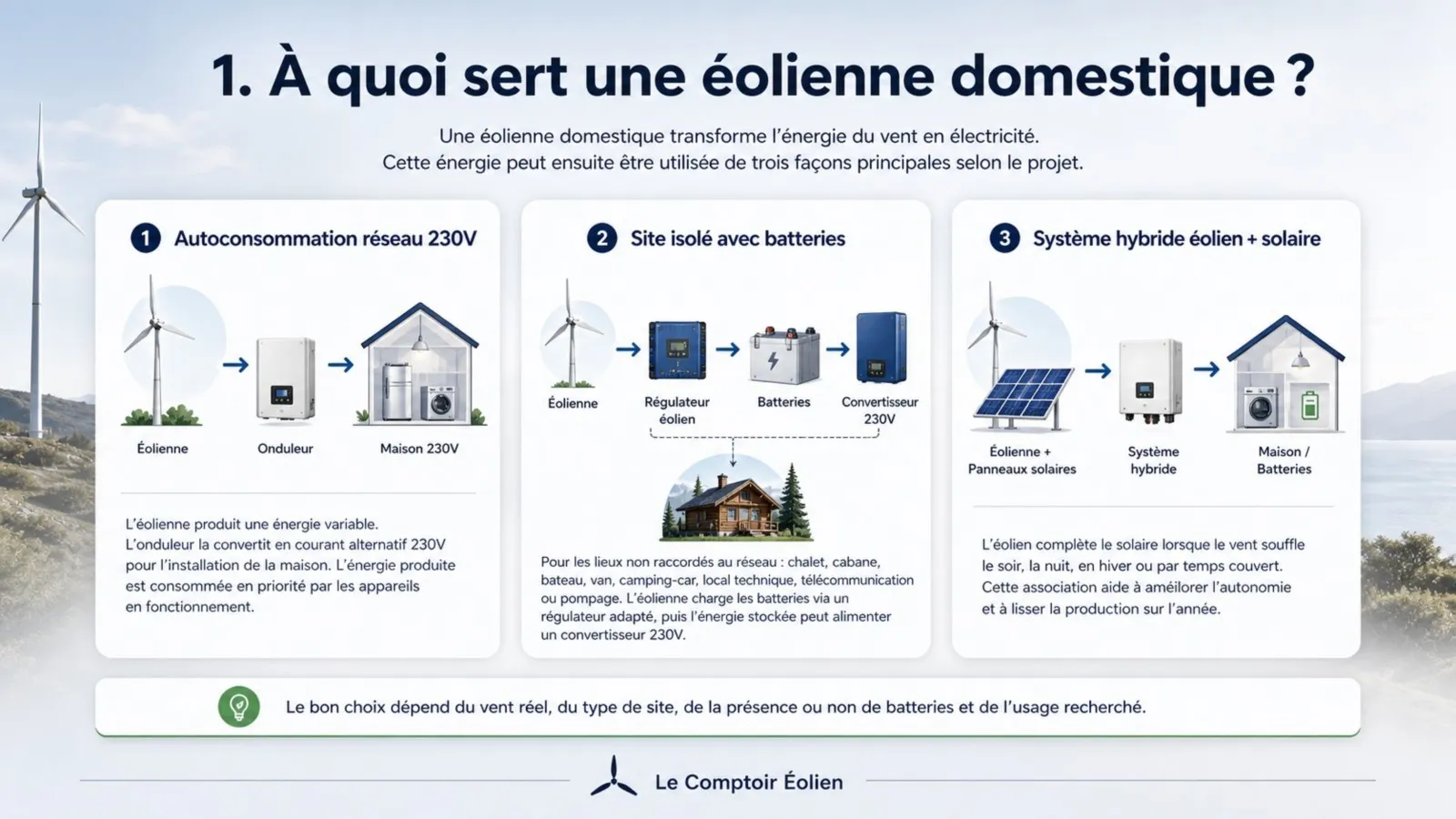
Before choosing a power, you must determine the system architecture.
Wind turbine in 230V self-consumption
A wind turbine in 230V self-consumption is suitable for a house or building already connected to the electrical grid. The kit generally includes a wind turbine, a grid-tie inverter, and the necessary elements depending on the model.
This solution is often the simplest to reduce part of your electricity consumption without creating a battery bank. The inverter transforms the produced energy into 230V and injects it into the domestic installation.
To consult:
- 230V Self-consumption Wind Turbine Kits
- 230V Self-consumption Wind Turbine Kits without Mast
- 230V Self-consumption Wind Turbine Kits with Mast
Attention: even if some inverters connect on the 230V side, a wind turbine kit is not “plug and play” in the sense of “I unpack, I set up, and it runs”. You must plan for a suitable location, a mast or support, cable routing, fixing, protections, and necessary electrical checks.
Wind turbine for 12V, 24V, or 48V batteries
For an off-grid site, a wind turbine generally needs to charge batteries. The classic setup is:
Wind Turbine → Wind Regulator → Batteries → 230V Converter
A wind turbine should not be connected directly to a converter, an energy station, or an MPPT solar input designed for solar panels. Wind energy produces variable voltage and current: a wind regulator capable of managing the load, braking, or shedding is required.
To consult:
- Isolated site wind kits
- Wind Regulators
- Batteries
- 230V Hybrid Inverters
- Solar and Wind Connection Diagrams
3. Actual wind matters more than the advertised power
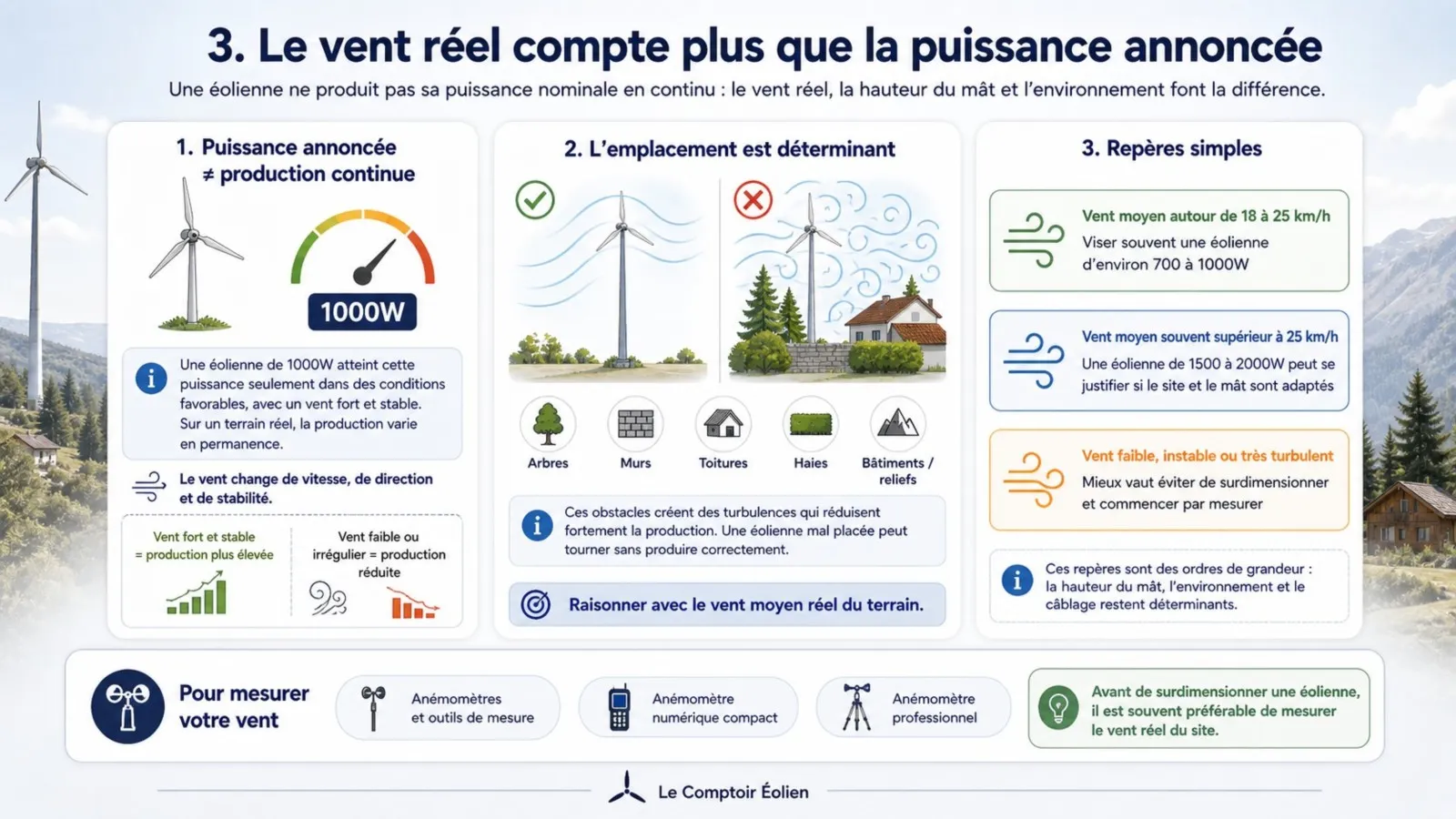
A 1000W wind turbine does not produce 1000W continuously. The indicated power generally corresponds to a maximum achievable power under favorable conditions, with strong and stable wind. In real terrain, production varies constantly.
The wind changes speed, direction, and stability. Trees, walls, roofs, hedges, buildings, or terrain create turbulence that significantly reduces production. A poorly placed wind turbine may spin without producing properly.
That's why it's better to consider the actual average wind of your site.
Simple benchmarks:
- average wind around 18 to 25 km/h: often aim for a wind turbine of about 700 to 1000W;
- average wind often above 25 km/h: a wind turbine of 1500 to 2000W may be justified if the site and mast are suitable;
- weak, unstable, or very turbulent wind: it's better to avoid oversizing and start by measuring.
These benchmarks are orders of magnitude: the height of the mast, the environment, and the wiring remain crucial.
To measure your wind:
4. Maximum power, actual production, and efficiency
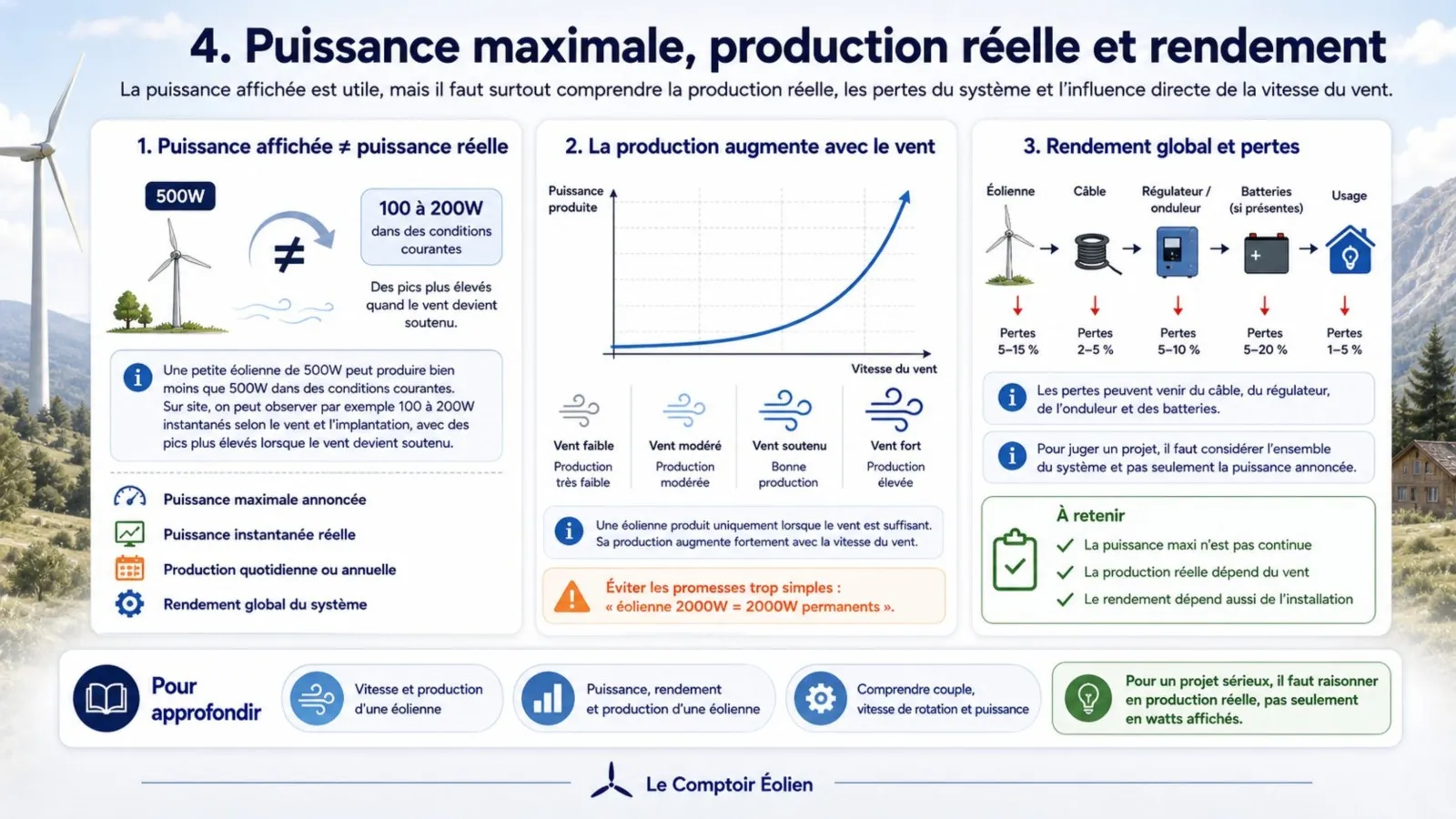
The power displayed on a wind turbine is an important figure, but it is not enough. A small 500W wind turbine may produce much less than 500W under common conditions. On site, one might observe instantaneous powers around 100 to 200W depending on the wind and placement, with higher peaks when the wind becomes strong.
It is therefore necessary to distinguish:
- the maximum announced power;
- the actual instantaneous power;
- the daily or annual production;
- the overall system efficiency;
- the losses related to the cable, the regulator, the inverter, and the batteries.
For a serious project, it is necessary to avoid overly simple promises like “2000W wind turbine = 2000W permanent”. A wind turbine only produces when the wind is sufficient, and its production increases significantly with wind speed.
To learn more:
- Wind speed and wind turbine production
- Power, efficiency, and wind turbine production
- Understanding torque, rotational speed, and power
5. Horizontal, vertical wind turbine, 5 blades or AeroSpiral: what to choose?
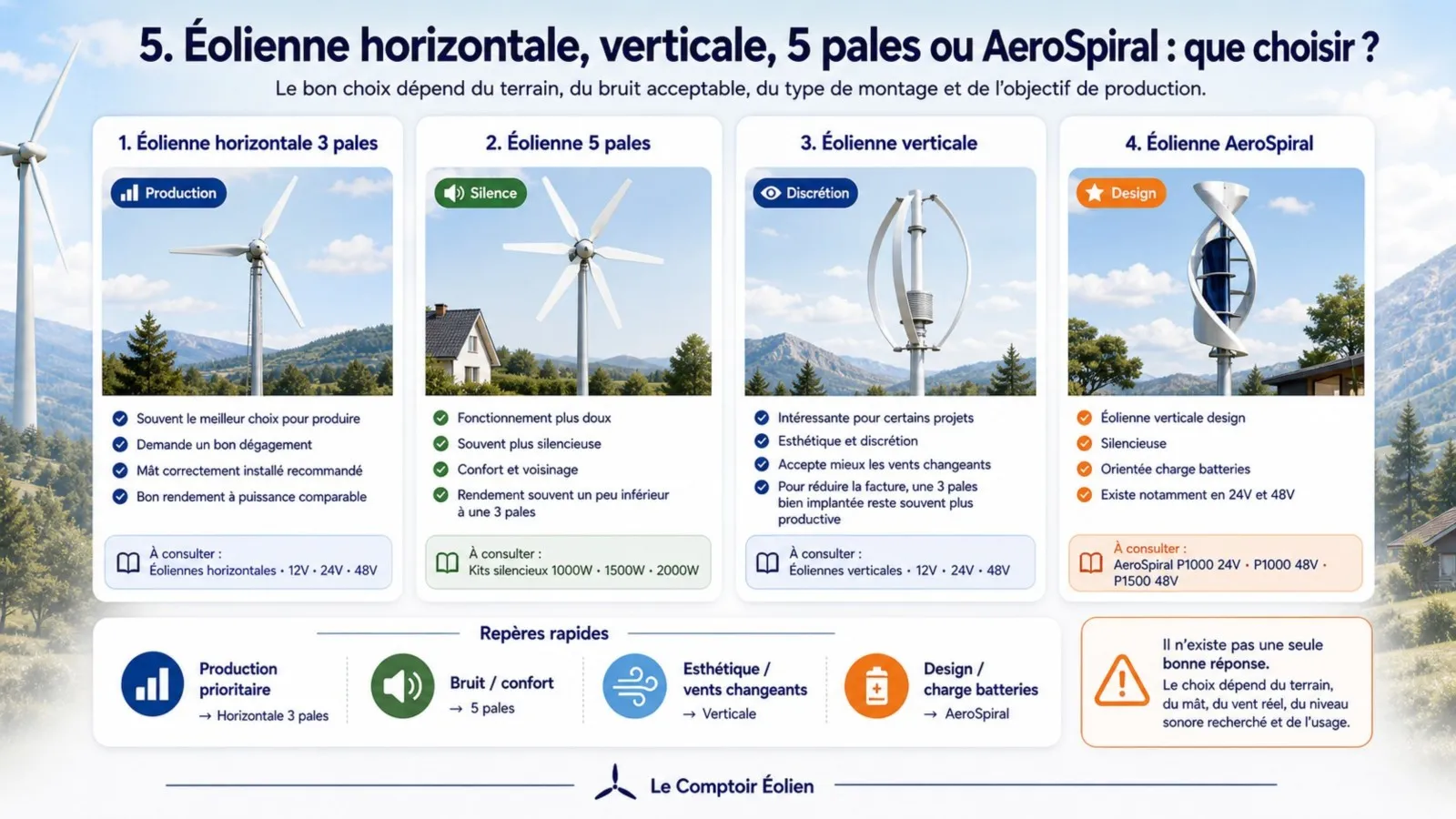
There are several families of domestic wind turbines. The right choice depends on the terrain, acceptable noise, type of installation, and production goal.
3-blade horizontal wind turbine
The 3-blade horizontal wind turbine is often the best choice when the main goal is production. It requires good clearance and a properly installed mast, but it generally offers better efficiency at comparable power.
To consult:
- Horizontal wind turbines
- Horizontal wind turbines 12V
- Horizontal wind turbines 24V
- Horizontal wind turbines 48V
5-blade wind turbine
A 5-blade wind turbine is often chosen for smoother and quieter operation. On the other hand, it may have slightly lower efficiency than a 3-blade one under equivalent conditions. It can be relevant when noise, comfort, or neighborhood are important criteria.
To consult:
Vertical wind turbine
The vertical wind turbine is interesting for certain projects: aesthetics, space, discretion, acceptance of changing winds. However, to reduce an electricity bill, a well-placed 3-blade horizontal one often remains more productive.
To consult:
- Vertical wind turbines
- Vertical wind turbines 12V
- Vertical wind turbines 24V
- Vertical wind turbines 48V
AeroSpiral wind turbine
AeroSpiral models are designed for projects seeking a stylish, quiet vertical wind turbine focused on battery charging. They are available in 24V and 48V depending on the models available. The catalog indicates, for example, the AeroSpiral P1000 24V, P1000 48V, and P1500 48V models.
To consult:
- AeroSpiral wind turbines
- AeroSpiral P1000 – 1000W 24V
- AeroSpiral P1000 – 1000W 48V
- AeroSpiral P1500 – 1500W 48V
6. The mast: an element as important as the wind turbine
The mast is often underestimated. Yet, it directly influences the production, safety, and lifespan of the installation.
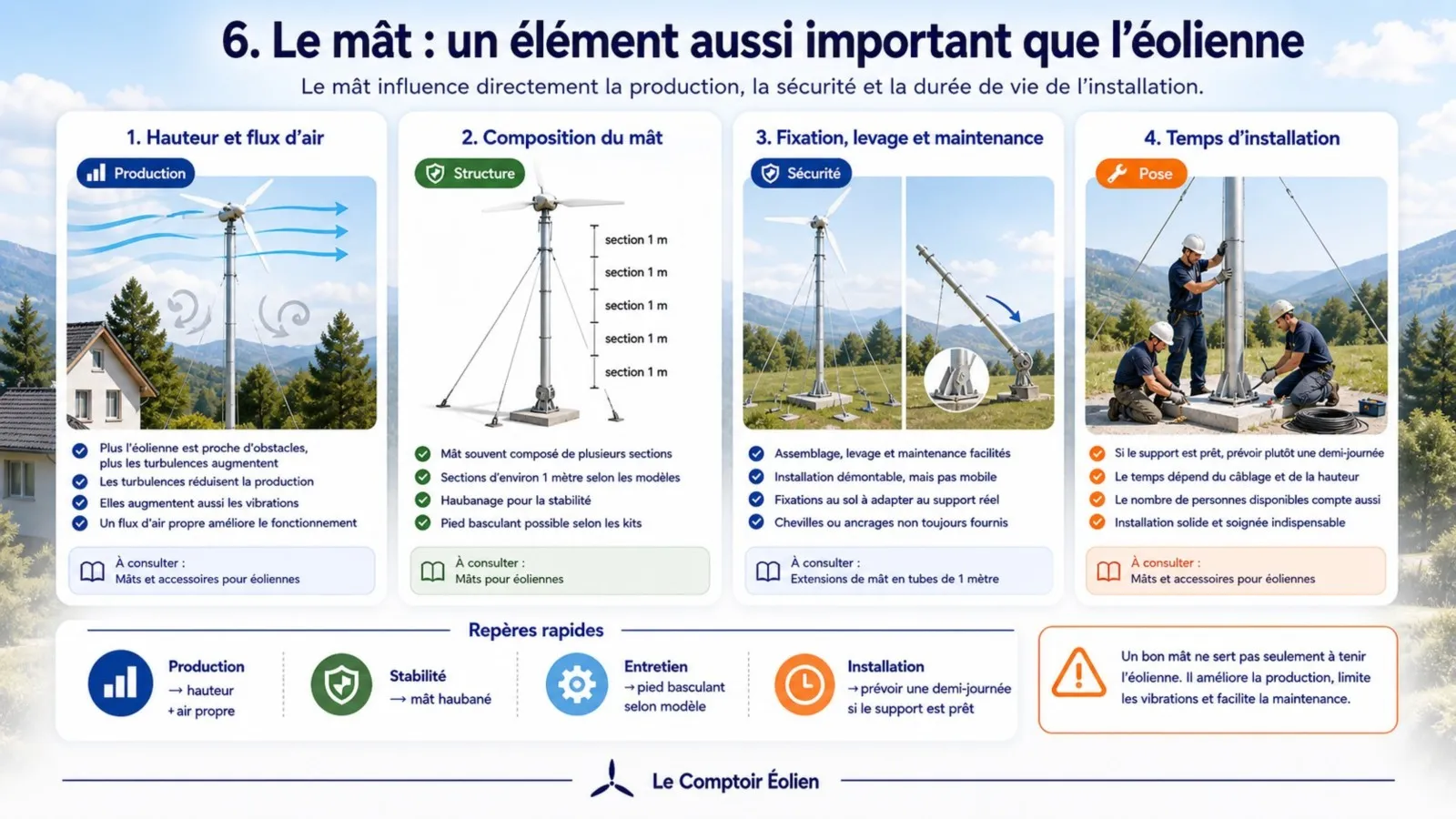
A wind turbine must be placed in the cleanest possible airflow. The lower it is or the closer to obstacles, the more it experiences turbulence. Turbulence decreases production and increases vibrations.
The masts offered according to the kits are generally made up of several sections, often in parts of about 1 meter, with guying and sometimes a tilting base depending on the models. This design facilitates assembly, lifting, maintenance, and dismantling if the installation needs to be moved during a relocation. These are not "mobile" wind turbines in the sense of equipment to be moved regularly: they are dismantlable installations that must be securely fixed.
On some kits, the specifications indicate a multi-part mast to be screwed together, a tilting base, a sling support, and fixing cables. The dowels or ground anchor fixings are not always provided and must be adapted to the actual support.
To consult:
If the slab, support, or anchors are already ready, you should rather plan for a half-day installation depending on the model, wiring, height, and number of people available.
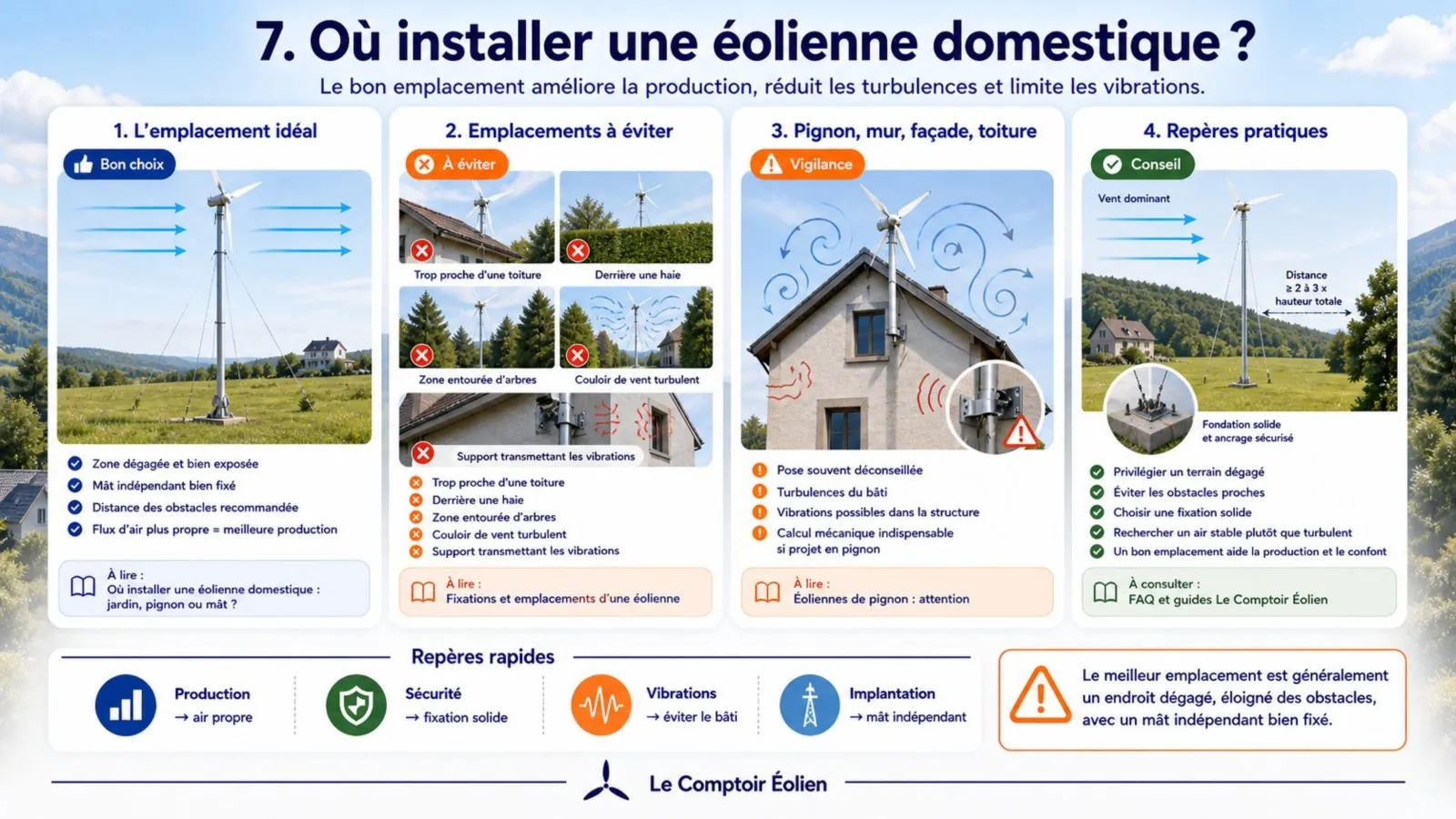
7. Where to install a domestic wind turbine?
The best location is generally an open area, away from obstacles, with a well-secured independent mast.
You should avoid as much as possible:
- installation too close to a roof;
- installation on a gable without mechanical calculation;
- a location behind a hedge;
- an area surrounded by trees;
- a very turbulent wind corridor;
- a support that would transmit vibrations to a building.
Installation on a wall, facade, gable, or roof is often discouraged. Even if it may seem practical, it exposes the wind turbine to building turbulence and can transmit significant vibrations to the structure. The Wind Turbine Counter FAQ recommends favoring an open area and solid fixation.
To read:
- Gable wind turbines: caution
- Where to install a domestic wind turbine: garden, gable, or mast?
- Fixings and locations of a wind turbine
8. Regulations: what to check before installing?
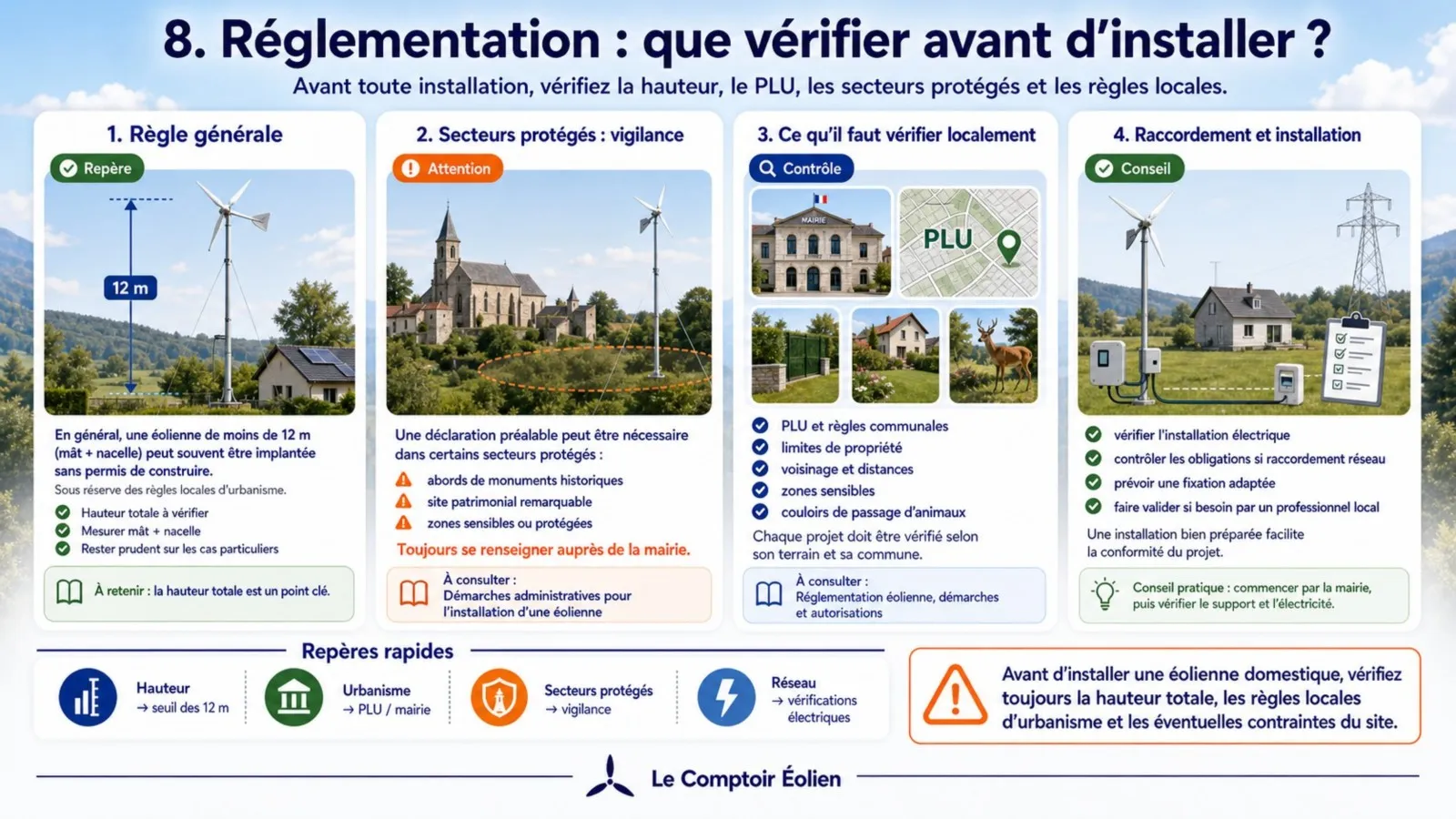
In France, a wind turbine less than 12 meters, mast + nacelle, can generally be installed without prior authorization or building permit. However, the project must comply with local urban planning rules, and a prior declaration may be necessary in certain protected areas, particularly near historical monuments or in remarkable heritage sites. Therefore, it is always necessary to inquire at the town hall before installation.
To consult:
- Administrative procedures for installing a wind turbine
- Wind turbine regulations, procedures, and authorizations
It is also necessary to consider the neighborhood, property boundaries, sensitive areas, animal passage corridors, PLU constraints, and any obligations related to an electrical installation connected to the grid.
9. Single-phase or three-phase self-consumption
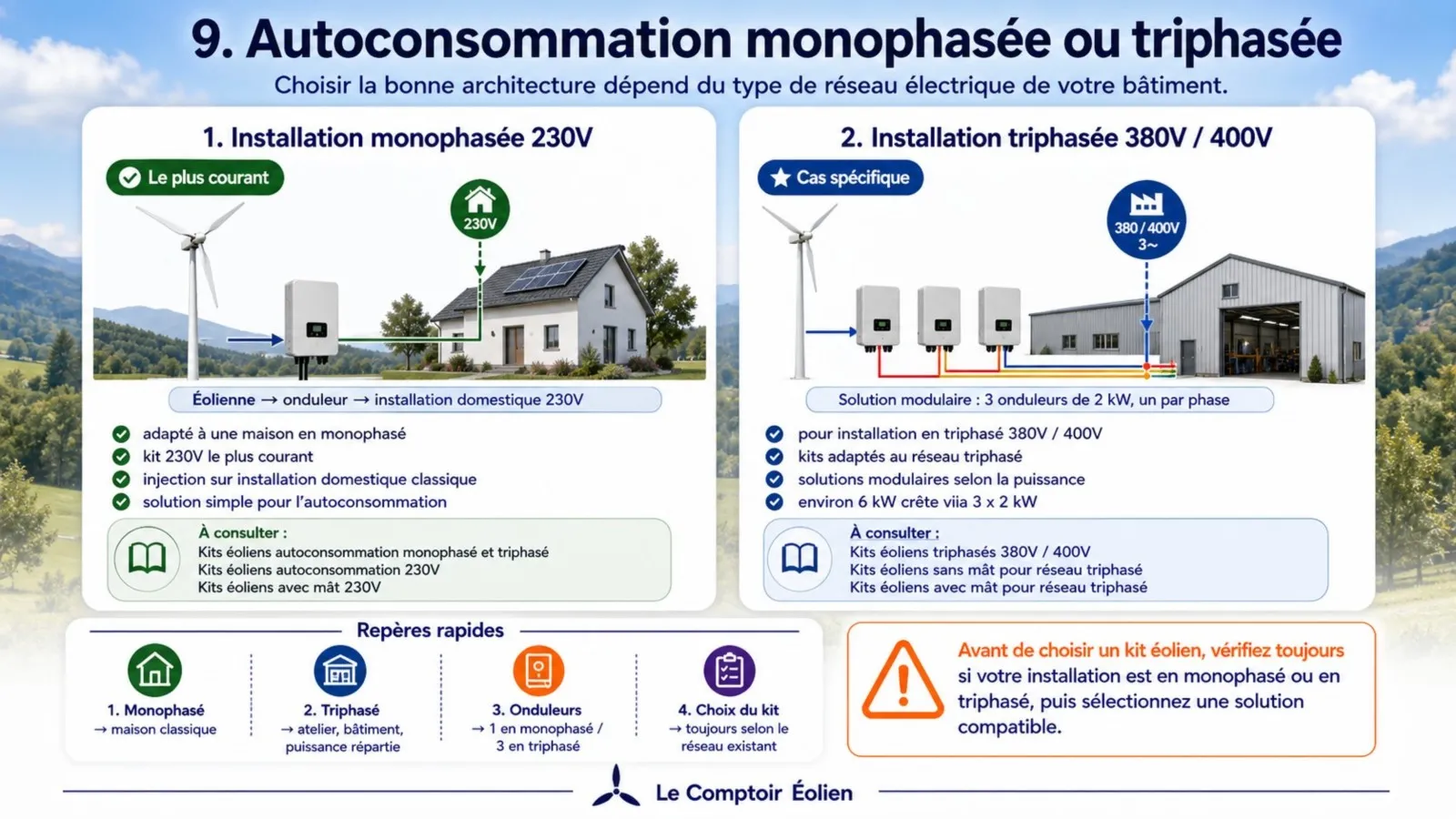
For a single-phase house, 230V kits are the most common. They are intended to inject the wind turbine's production into a classic domestic installation.
For a three-phase 380V/400V installation, an appropriate kit must be chosen. The three-phase solutions from Comptoir Éolien can be modular, for example with several inverters distributed per phase according to power. The FAQ indicates that the proposed three-phase solutions are limited to about 6 kW peak, typically via three 2 kW inverters, one per phase.
To consult:
- Single-phase and three-phase self-consumption wind kits
- Three-phase 380V/400V wind kits
- Wind kits without mast for three-phase network
- Wind kits with mast for three-phase network
10. Wind + solar: a combination often relevant
Solar mainly produces during the day and depends on sunlight. Wind, on the other hand, can produce at other times: at night, in winter, in cloudy weather, or during windy periods.
This is why the wind + solar combination can be interesting for:
- an isolated site;
- a house with batteries;
- a partial autonomy project;
- a technical room;
- a chalet;
- an off-grid habitat;
- a winter production supplement.
The key point is to remain consistent with the system's voltage. For a battery installation, avoid mixing incompatible components: 24V wind turbine, 48V batteries, and 12V regulator, for example. The simplest approach is to choose a complete architecture in 12V, 24V, or 48V depending on the power and cable distances.
At equal power, 48V often allows for reduced current, thus reducing losses and heating in the cables.
To consult:
- Hybrid wind + solar kits
- Hybrid kits for isolated sites
- Hybrid self-consumption kits
- Wind turbine + solar: hybrid system

11. Noise, safety, and maintenance
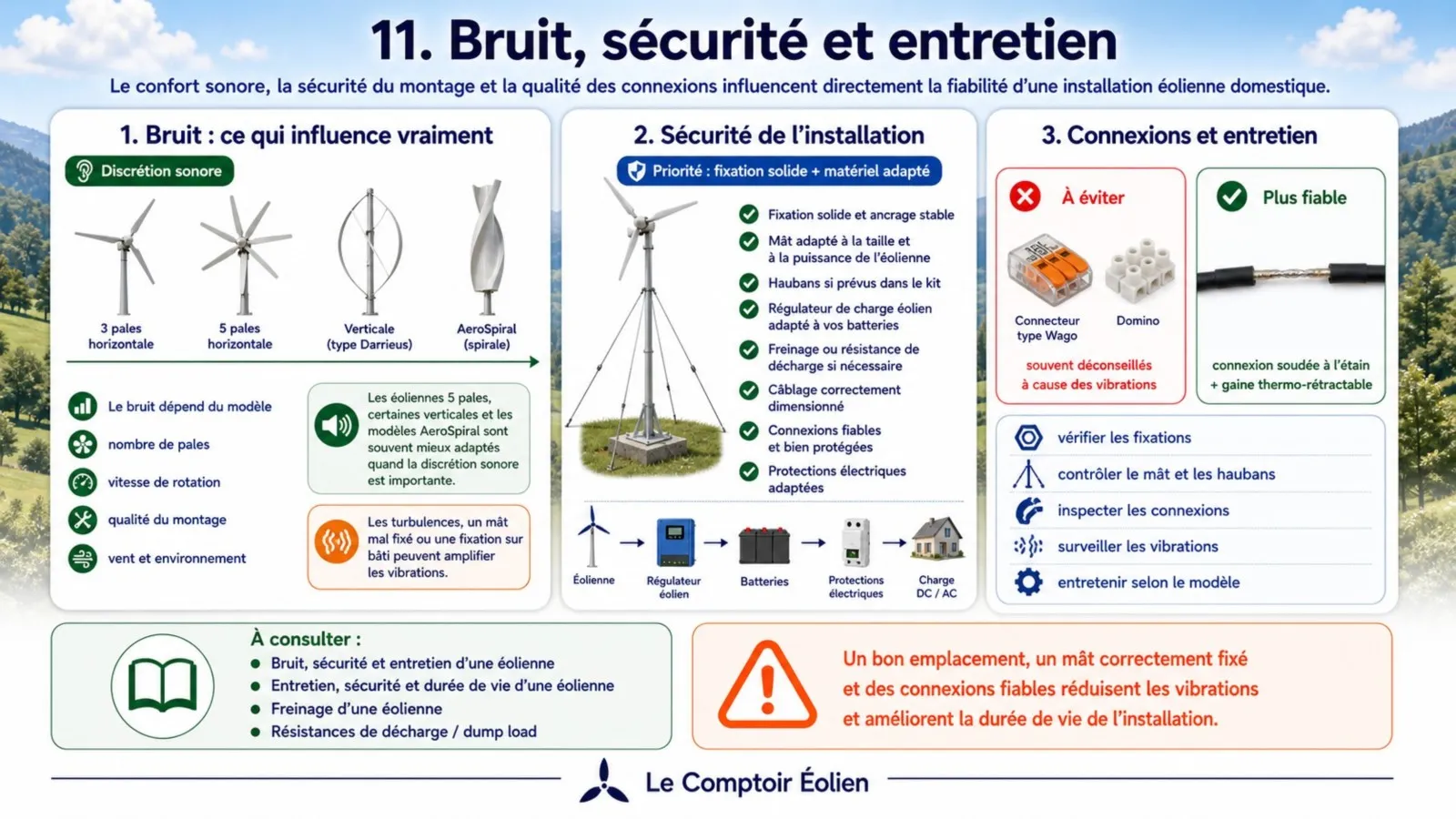
Noise depends on the model, the number of blades, the rotation speed, the mounting, the wind, and the environment. Five-blade wind turbines, some vertical ones, and AeroSpiral models are generally more suitable when sound discretion is important.
But noise is not just a matter of model. A poor location, turbulence, a poorly fixed mast, or a mounting on a structure can amplify vibrations.
Regarding safety, you should plan for:
- a solid mounting;
- an appropriate mast;
- guy wires if the kit provides them;
- a wind regulator suitable for battery charging;
- a braking or load-shedding system when necessary;
- properly sized wiring;
- reliable connections;
- suitable electrical protections.
For wind turbine connections, Wago or terminal block type connectors are often discouraged due to vibrations. A soldered connection with tin and heat-shrink tubing is more reliable over time.
To consult:
- Noise, safety, and maintenance of a wind turbine
- Maintenance, safety, and lifespan of a wind turbine
- Braking of a wind turbine
- Dump load resistors
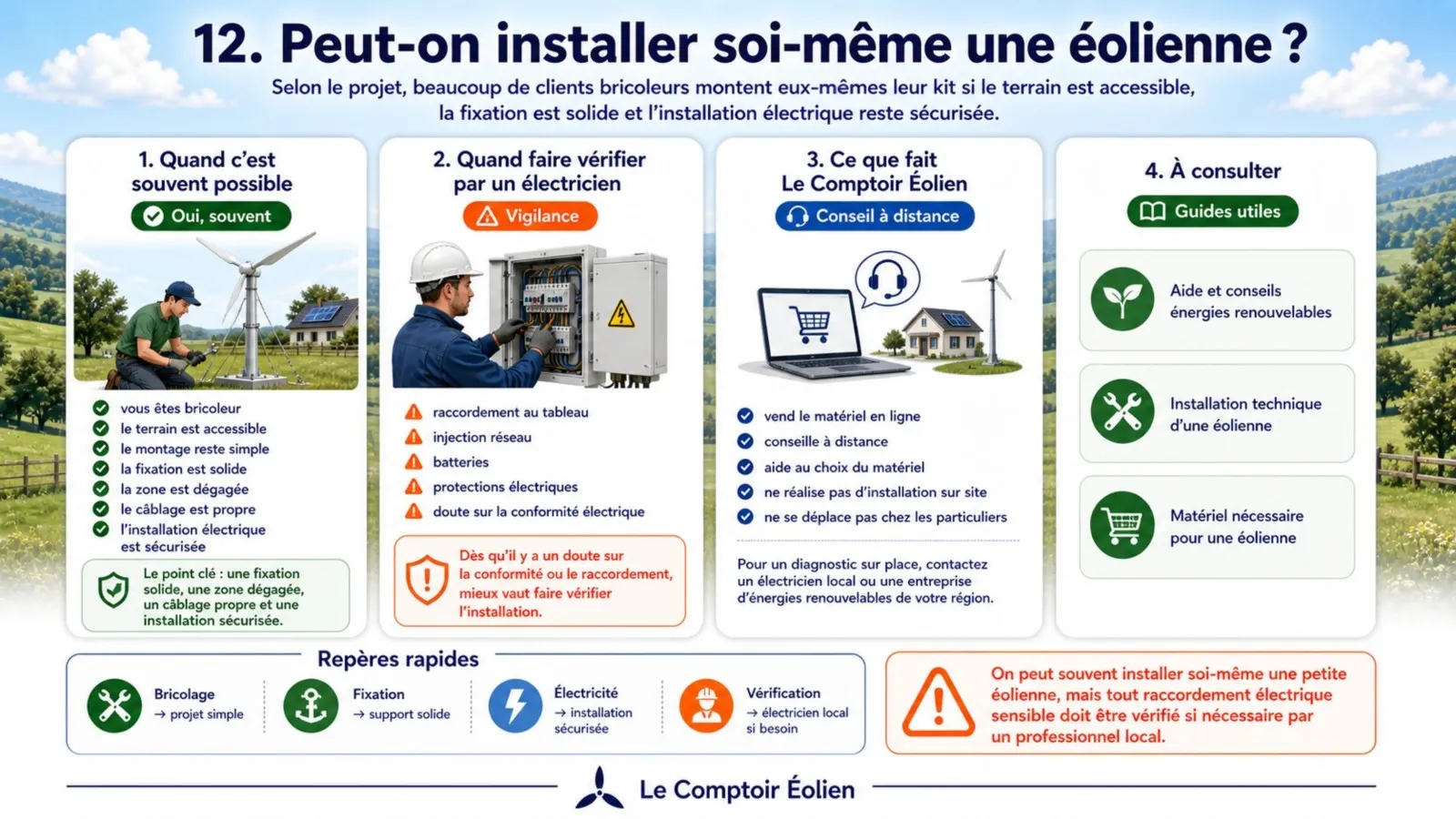
12. Can you install a wind turbine yourself?
Many customers install their own kit when they are handy, the site is accessible, and the assembly remains simple. The key point is to have a solid mounting, a clear area, clean wiring, and a safe electrical installation.
As soon as there is a connection to the panel, grid injection, batteries, protections, or doubt about electrical compliance, it is preferable to have the installation checked by a local electrician.
Le Comptoir Éolien sells equipment online and provides remote advice but does not perform installations or travel to private homes. For an on-site diagnosis, you need to contact a local electrician or a renewable energy company in your area.
To consult:
- Renewable energy help and advice
- Technical installation of a wind turbine
- Necessary equipment for a wind turbine
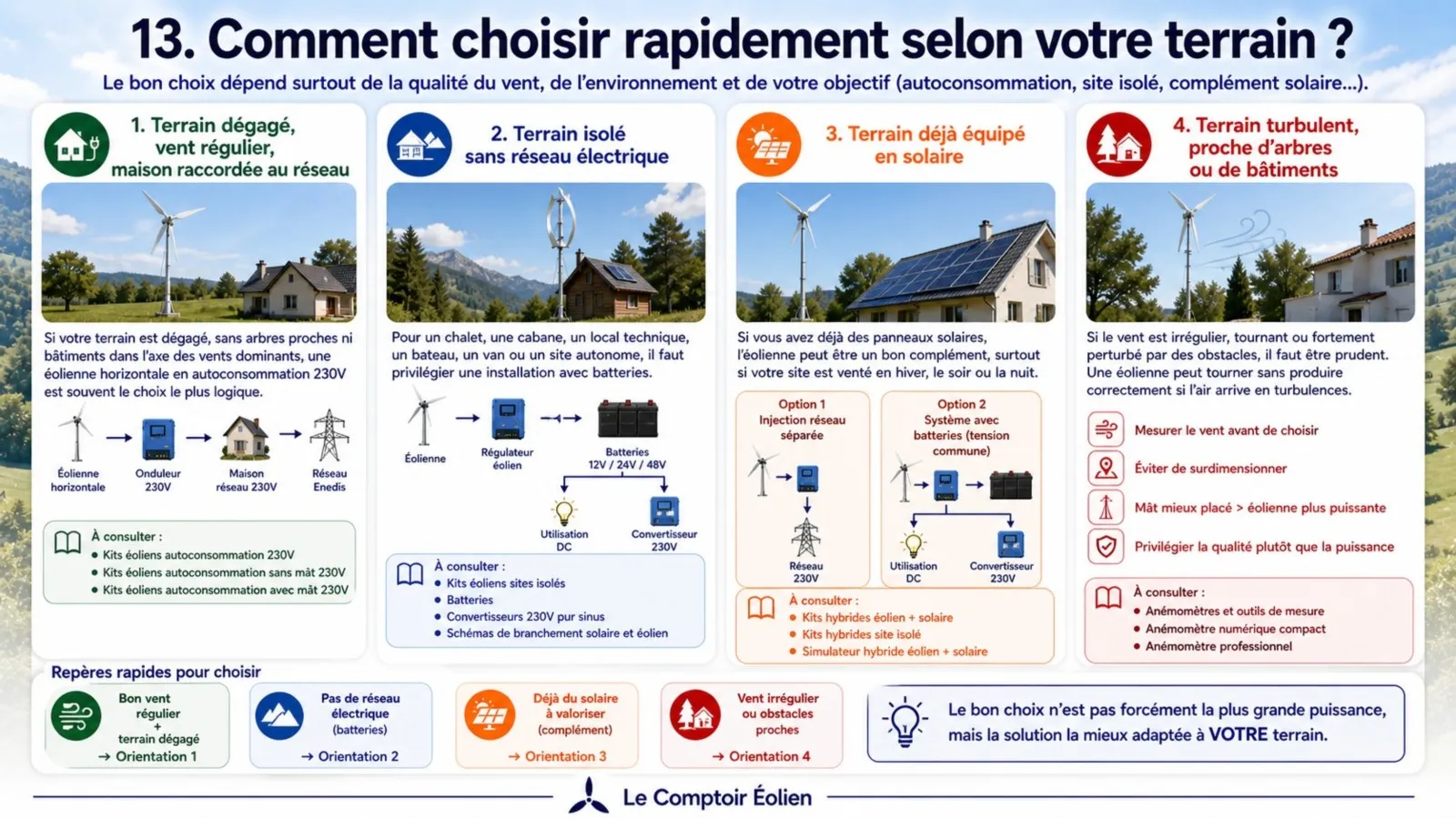
13. How to quickly choose according to your site?
The choice of a domestic wind turbine depends less on the displayed power than on the quality of the wind available on your site. Two sites located in the same municipality can yield very different results depending on exposure, obstacles, and mast height.
Clear site, regular wind, house connected to the grid
If your site is clear, with no nearby trees or buildings in the path of prevailing winds, a horizontal wind turbine for self-consumption at 230V is often the most logical choice.
It allows production when the wind is present, then injects the energy into the house's electrical installation via a suitable inverter.
To consult:
- 230V Self-consumption Wind Turbine Kits
- 230V Self-consumption Wind Turbine Kits without Mast
- 230V Self-consumption Wind Turbine Kits with Mast
Isolated site without electrical grid
For a cabin, shed, technical room, boat, van, or autonomous site, an installation with batteries should be prioritized. The wind turbine must charge a battery bank via a suitable wind regulator, then the energy can be used in 12V, 24V, 48V, or converted to 230V with an inverter.
To consult:
Site already equipped with solar
If you already have solar panels, the wind turbine can be a good complement, especially if your site is windy in winter, in the evening, or at night. In this case, you need to choose a coherent architecture: either separate grid injection or a battery system with common voltage.
To consult:
Turbulent terrain, near trees or buildings
If the wind is irregular, swirling, or heavily disrupted by obstacles, caution is advised. A wind turbine may spin without properly producing if the air arrives in turbulence.
In this case, it is better to measure the wind, avoid oversizing, and consider a better-placed mast rather than a more powerful wind turbine.
To consult:
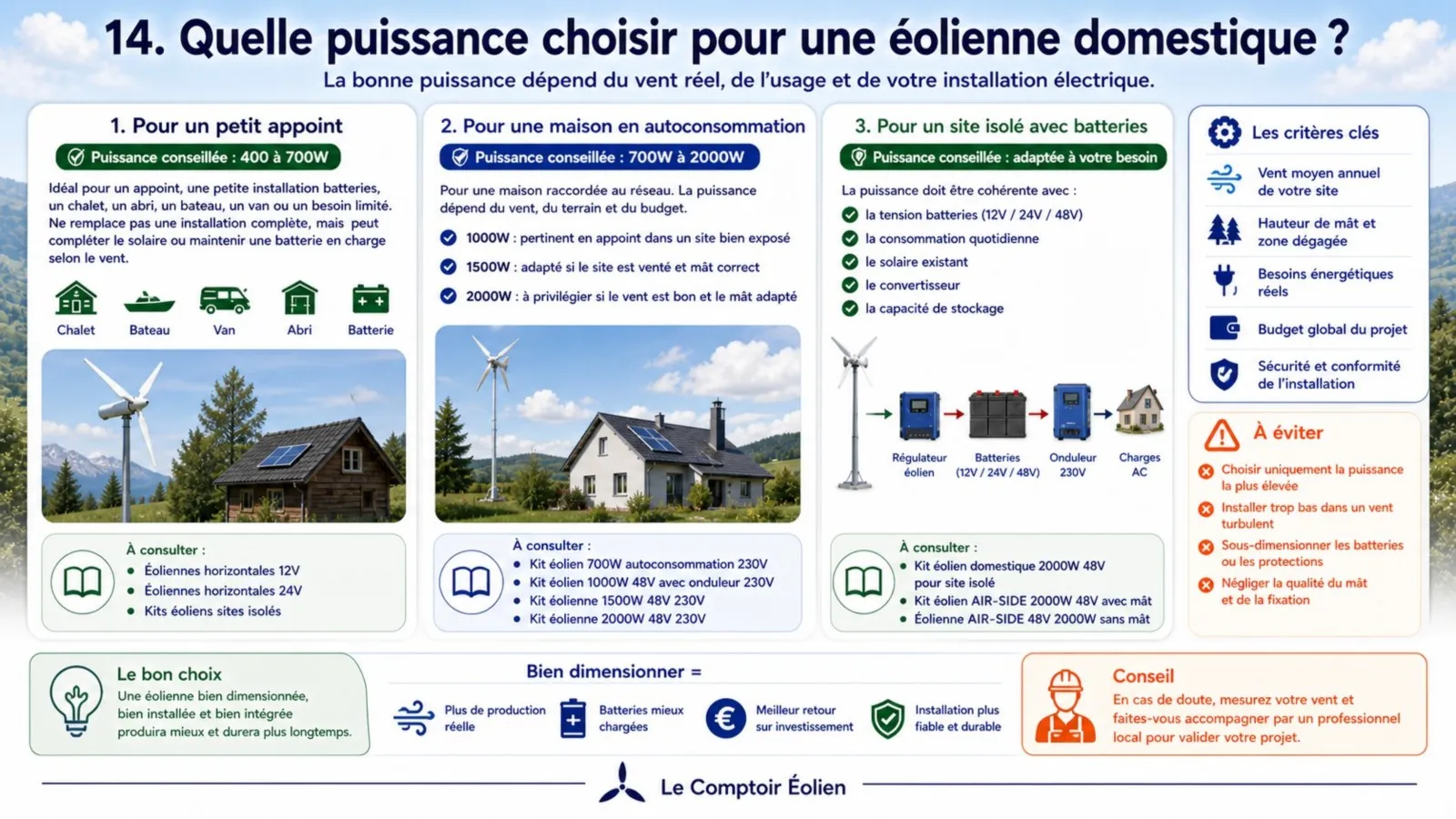
14. What power to choose for a domestic wind turbine?
It is tempting to directly choose the most powerful wind turbine. However, this is not always the best choice.
A 2000W wind turbine installed too low, in turbulent wind, may produce less than a 700W or 1000W wind turbine placed on a clear mast. Therefore, the power must be adapted to the actual wind, usage, and electrical architecture.
For a small supplement
A 400 to 700W wind turbine may be suitable for a supplement, a small battery installation, a cabin, a shelter, a boat, a van, or a limited need. It does not replace a complete installation, but it can complement solar or maintain a battery charge depending on the wind.
To consult:
For a self-consumption house
For a grid-connected house, common power levels are often between 700W and 2000W depending on the wind, terrain, and budget. A 1000W installation may be relevant as a supplement on a properly exposed site. A 1500W or 2000W installation is justified mainly if the site is truly windy and if the mast is suitable.
To consult:
- 700W Wind Kit Self-consumption 230V
- 1000W Wind Kit 48V with 230V Inverter
- 1500W Wind Turbine Kit 48V 230V
- 2000W Wind Turbine Kit 48V 230V
For an isolated site with batteries
In an isolated site, the power must be consistent with the battery voltage, daily consumption, existing solar, converter, and storage capacity. A 48V installation often becomes more relevant as the power increases or cable lengths become significant.
To consult:
- 2000W Domestic Wind Kit 48V for Isolated Site
- AIR-SIDE 2000W Wind Kit 48V with Mast
- AIR-SIDE 48V 2000W Wind Turbine without Mast
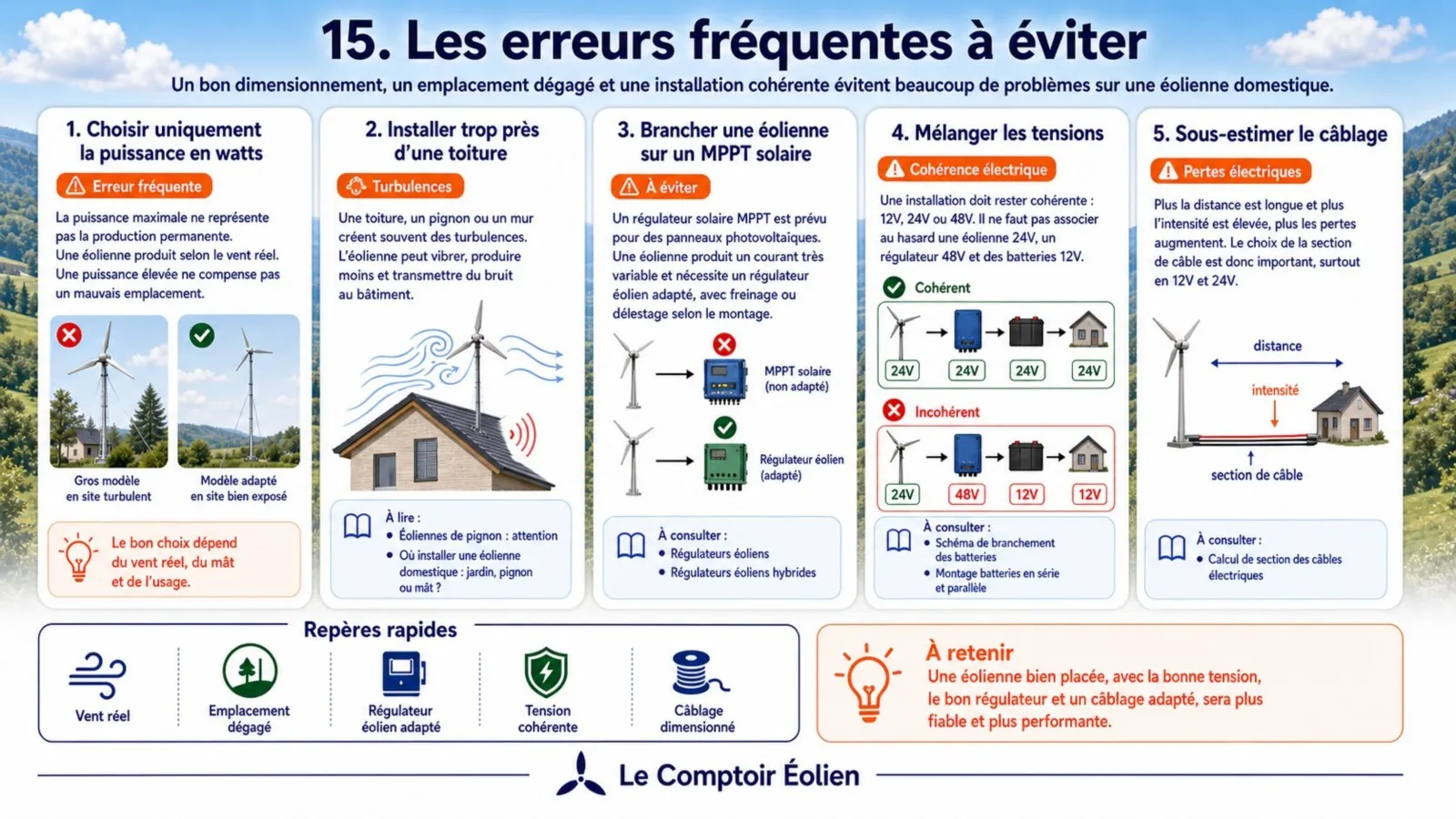
15. Common Mistakes to Avoid
Choosing Only the Power in Watts
The maximum power does not represent permanent production. A wind turbine produces according to the actual wind. High power does not compensate for a poor location.
Installing Too Close to a Roof
A roof, gable, or wall often creates turbulence. The wind turbine may vibrate, produce less, and transmit noise to the building.
To read:
Connecting a Wind Turbine to a Solar MPPT
A solar MPPT regulator is designed for photovoltaic panels. A wind turbine produces a very variable current and requires a suitable wind regulator, with braking or load shedding depending on the setup.
To consult:
Mixing Voltages
An installation must remain consistent: 12V, 24V, or 48V. You should not randomly associate a 24V wind turbine, a 48V regulator, and 12V batteries.
To consult:
Underestimating the Wiring
The longer the distance and the higher the intensity, the greater the losses. Choosing the cable section is therefore important, especially in 12V and 24V.
To consult:
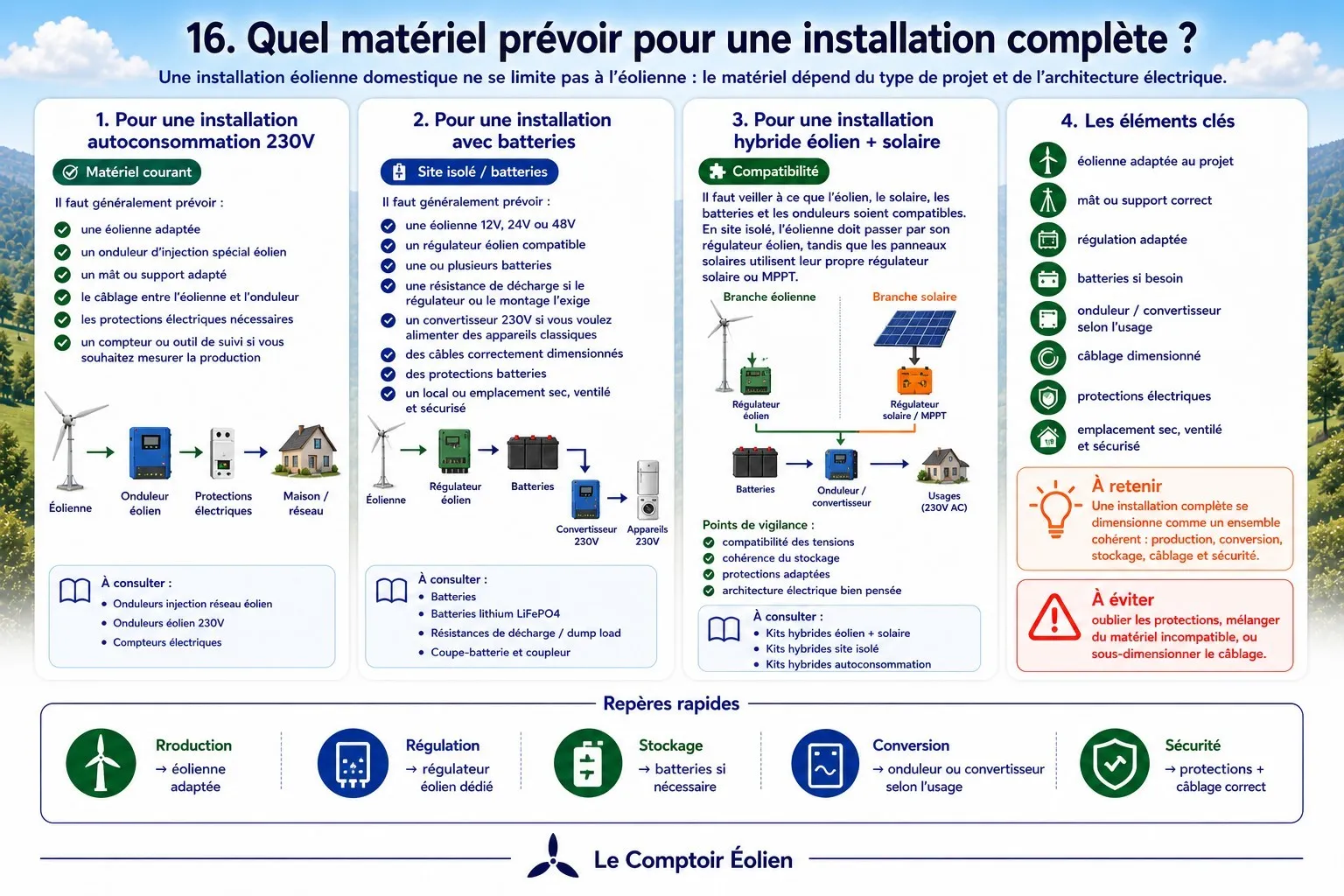
16. What Equipment to Plan for a Complete Installation?
A domestic wind installation is not limited to the wind turbine. The equipment depends on the type of project.
For a 230V Self-consumption Installation
You generally need to plan for:
- a suitable wind turbine;
- a special wind injection inverter;
- a suitable mast or support;
- the wiring between the wind turbine and the inverter;
- the necessary electrical protections;
- a meter or monitoring tool if you wish to measure the production.
To consult:
For an installation with batteries
You generally need to plan for:
- a 12V, 24V, or 48V wind turbine;
- a compatible wind regulator;
- one or more batteries;
- a discharge resistor if the regulator or setup requires it;
- a 230V converter if you want to power standard devices;
- properly sized cables;
- battery protections;
- a dry, ventilated, and secure location or space.
To consult:
For a hybrid wind + solar installation
Ensure that the wind, solar, batteries, and inverters are compatible. In an isolated site, the wind turbine must go through its wind regulator, while the solar panels use their own solar or MPPT regulator.
To consult:
17. How to monitor the production of a wind turbine?
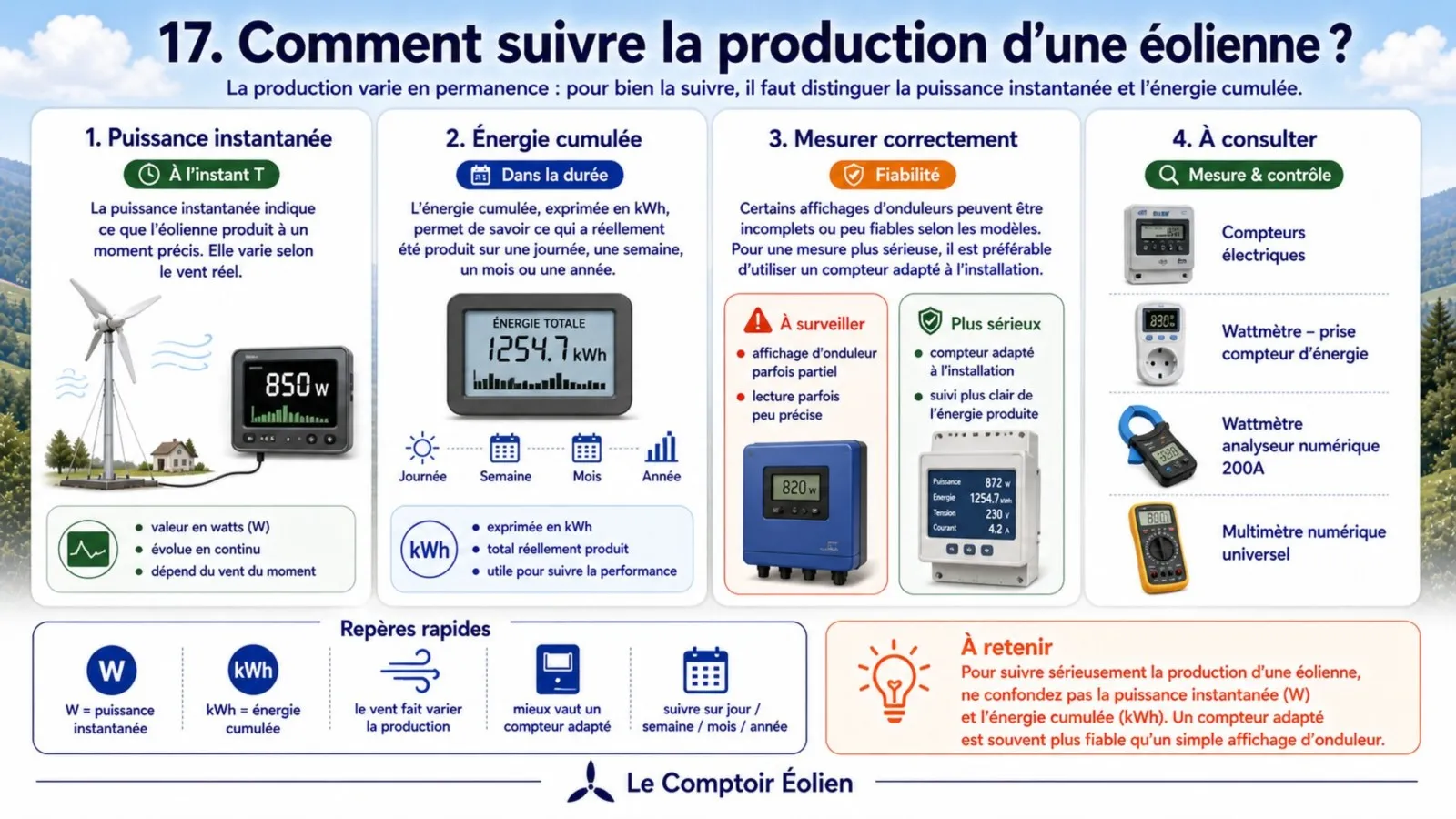
The production of a wind turbine varies constantly. To accurately track the energy produced, it is necessary to distinguish between instantaneous power and cumulative energy.
Instantaneous power indicates what the wind turbine produces at a specific moment. Cumulative energy, expressed in kWh, allows you to know what has actually been produced over a day, a week, a month, or a year.
Some inverter displays may be incomplete or unreliable depending on the models. For a more accurate measurement, it is preferable to use a meter adapted to the installation.
To consult:
- Electric Meters
- Wattmeter – energy meter plug
- Digital analyzer wattmeter 200A
- Universal digital multimeter
18. Domestic wind turbine: how much can you expect to produce?
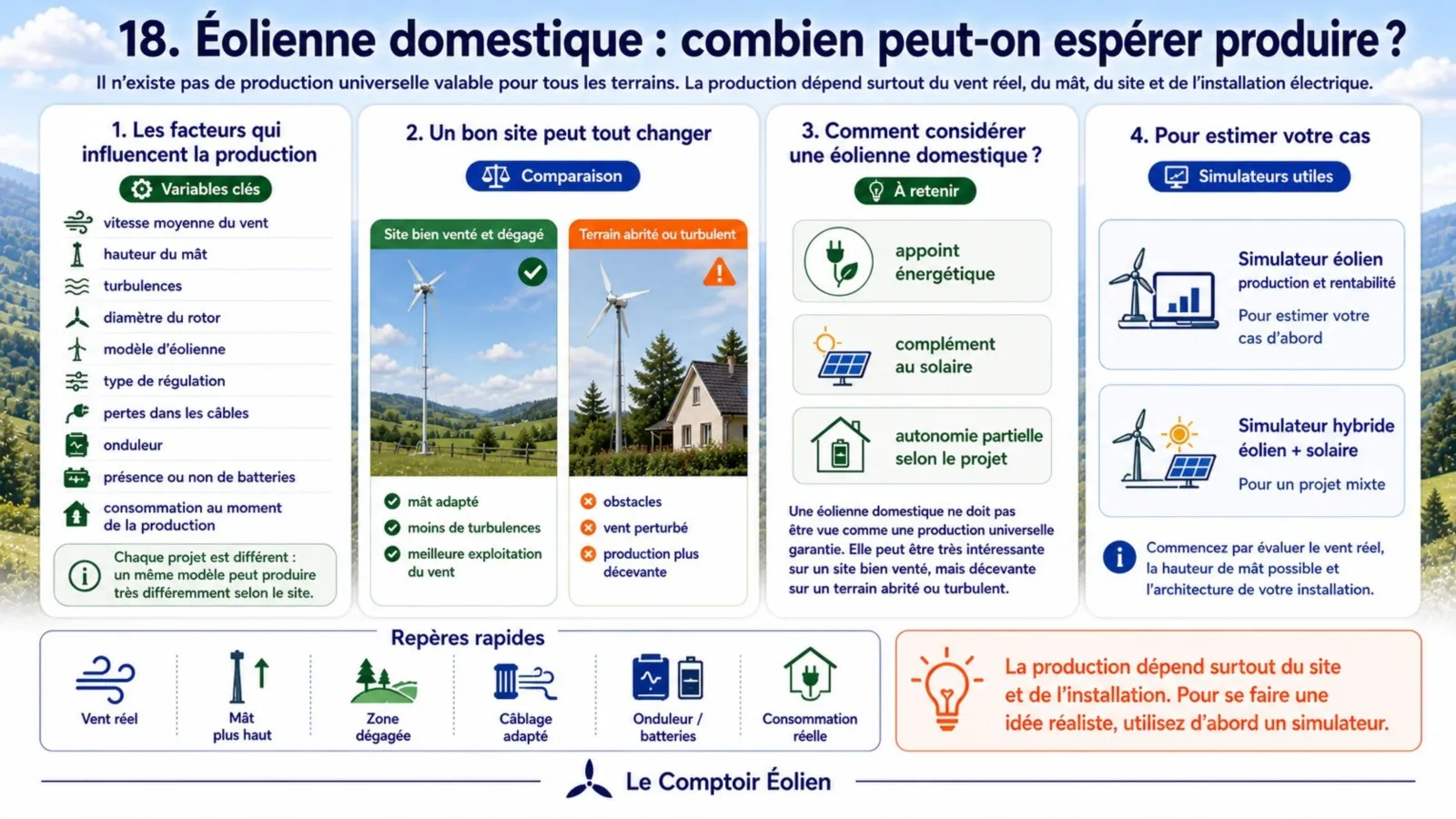
There is no universal production valid for all terrains. Production mainly depends on:
- the average wind speed;
- the mast height;
- turbulence;
- the rotor diameter;
- the wind turbine model;
- the type of regulation;
- losses in the cables;
- the inverter;
- the presence or absence of batteries;
- consumption at the time of production.
A domestic wind turbine should therefore be considered as an energy supplement, a complement to solar, or a partial autonomy solution depending on the project. It can be very interesting on a well-winded site but disappointing on a sheltered or turbulent terrain.
To estimate your case, first use:
For a mixed project:
19. Which wind turbine to choose according to your priority?
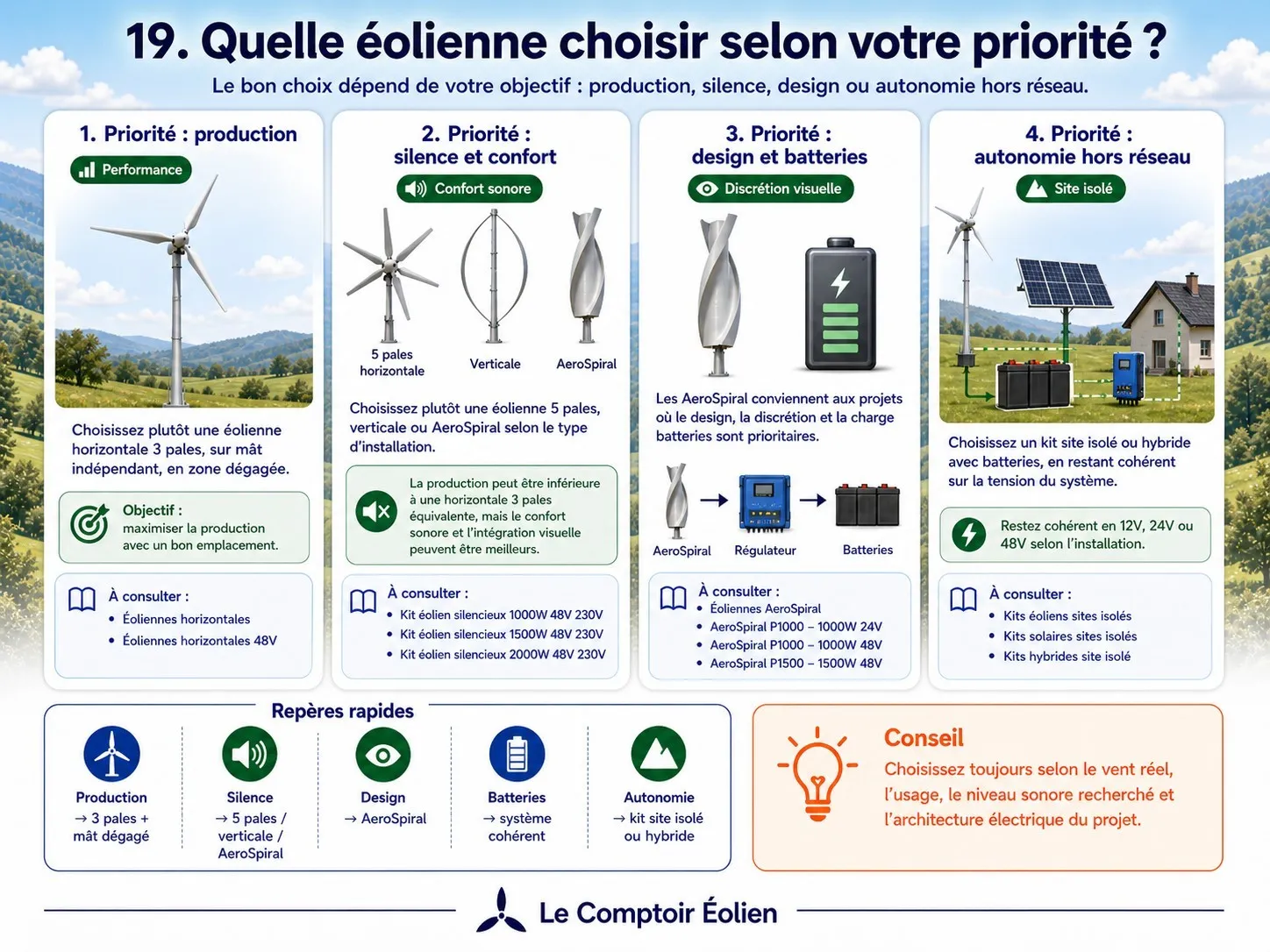
Priority: production
Preferably choose a horizontal 3-blade wind turbine, on an independent mast, in a clear area.
To consult:
Priority: silence and comfort
Preferably choose a 5-blade wind turbine, vertical or AeroSpiral depending on the type of installation. The production may be lower than an equivalent 3-blade horizontal, but the sound comfort and visual integration may be better.
To consult:
Priority: design and batteries
AeroSpiral is suitable for projects where design, discretion, and battery charging are priorities.
To consult:
- AeroSpiral wind turbines
- AeroSpiral P1000 – 1000W 24V
- AeroSpiral P1000 – 1000W 48V
- AeroSpiral P1500 – 1500W 48V
Priority: off-grid autonomy
Choose an isolated or hybrid site kit with batteries, while remaining consistent with the system voltage.
To consult:
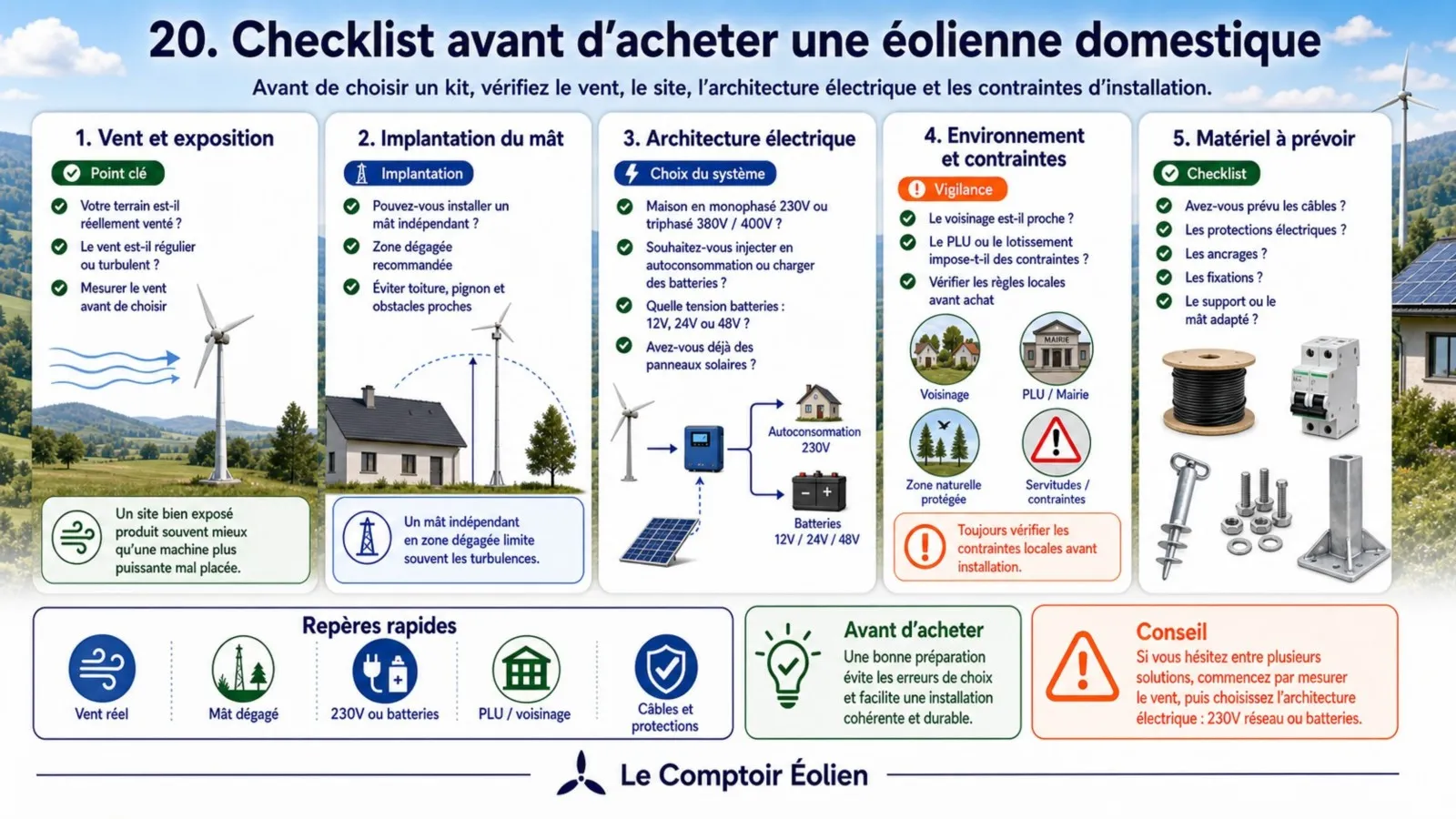
20. Checklist before buying a domestic wind turbine
Before choosing a kit, check these points:
- Is your land really windy?
- Is the wind regular or turbulent?
- Can you install an independent mast?
- Is your house single-phase 230V or three-phase 380V/400V?
- Do you want to inject for self-consumption or charge batteries?
- What battery voltage do you want to use: 12V, 24V, or 48V?
- Do you already have solar panels?
- Is the neighborhood close by?
- Does the PLU or the subdivision impose constraints?
- Have you planned for cables, protections, anchors, and fixings?
If you are hesitating between several solutions, start by measuring the wind, then choose the electrical architecture: 230V grid or batteries.
21. Quick FAQ on domestic wind turbines
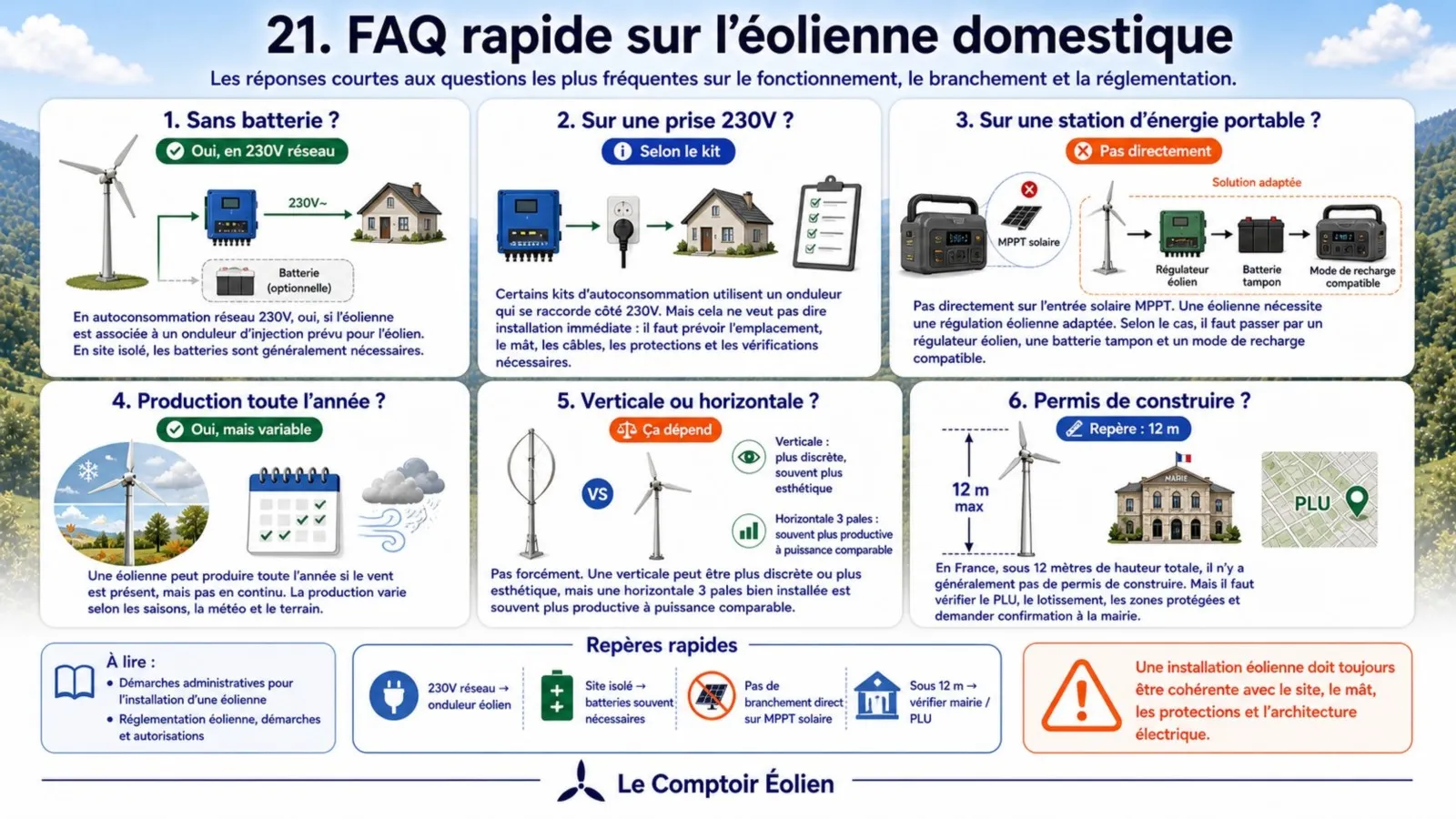
Can a domestic wind turbine operate without a battery?
Yes, in 230V grid self-consumption, if it is associated with an inverter designed for wind power. However, for an isolated site, batteries are generally necessary.
Can a wind turbine be plugged into a 230V outlet?
Some self-consumption kits use an inverter that connects to the 230V side depending on the kit. But this does not mean that the complete installation is immediate: you need to plan for the location, the mast, the cables, the protections, and the necessary checks.
Can a wind turbine be connected to a portable power station?
Not directly to the MPPT solar input. A wind turbine requires suitable wind regulation. Depending on the case, you need to go through a wind regulator, a buffer battery, and a compatible charging mode.
Does a wind turbine produce all year round?
It can produce all year round if the wind is present, but not continuously. Production varies according to seasons, weather, and terrain.
Is a vertical wind turbine better than a horizontal one?
Not necessarily. A vertical one can be more discreet or more aesthetic, but a well-installed 3-blade horizontal one is often more productive at comparable power.
Is a building permit required?
In France, under 12 meters of total height, there is generally no building permit required, but you need to check the PLU, the subdivision, protected areas, and confirm with the town hall.
To read:
- Administrative procedures for installing a wind turbine
- Wind turbine regulations, procedures, and authorizations
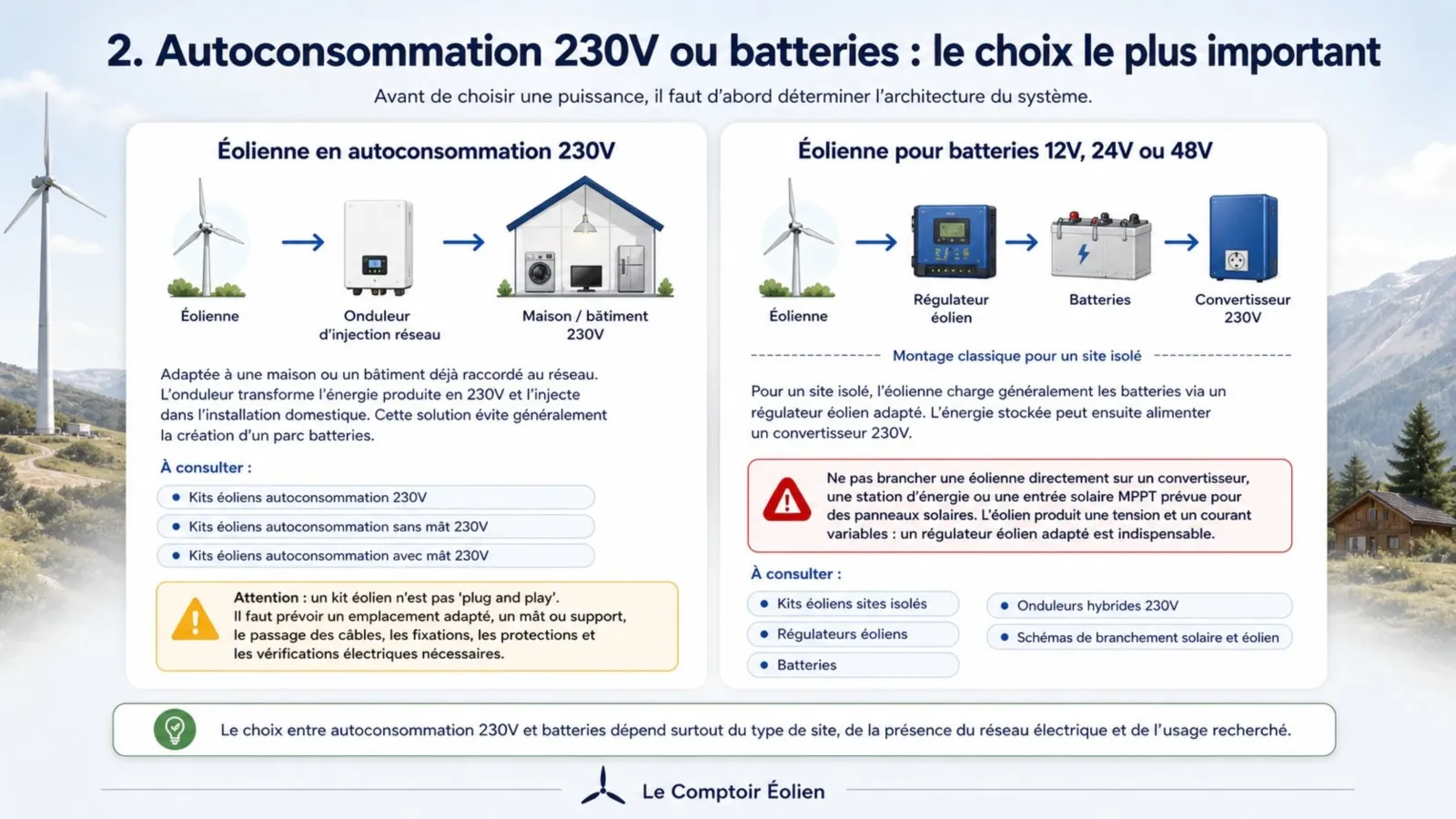
22. Conclusion: the right wind turbine is the one that suits your terrain
A domestic wind turbine can be an interesting solution to produce part of your electricity, complement a solar installation, or power an isolated site. But its efficiency primarily depends on the actual wind and the location.
Before buying, you should avoid reasoning solely in watts. The right choice is to answer three simple questions:
- is your land windy and clear enough?
- do you want to inject at 230V or charge batteries?
- what voltage and power are consistent with your installation?
To proceed, start by estimating your potential with the simulator, then choose the appropriate category:
- Wind simulator – production and profitability
- 230V Self-consumption Wind Turbine Kits
- Isolated site wind kits
- Hybrid wind + solar kits
The most important: choose a wind turbine suited to the terrain, wind, system voltage, and actual use. A well-designed, well-placed, and properly wired installation will always be more efficient than a more powerful but poorly located wind turbine.