

Battery connection in parallel or series: complete guide
Understanding batteries: more complex than it seems
To an untrained eye, a battery may seem simple to use. However, its operation is based on sometimes unknown electrochemical principles. To avoid connection errors or premature wear, here are the essential concepts to know about batteries, their capacity, their mounting (in parallel or in series), and their behavior over time.
🔌 Series mounting: increase voltage
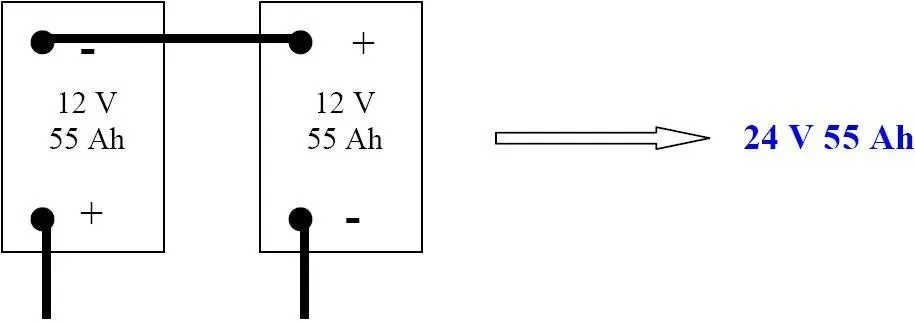
In a series connection, the positive pole (+) of one battery is connected to the negative pole (–) of the next. This type of connection allows adding the voltages while maintaining the same capacity (Ah).
👉 Example: two 12V 55Ah batteries connected in series will provide 24V 55Ah.
This setup is ideal for achieving higher voltages (24V, 48V…) while using standard batteries.
🔋 Parallel connection: increase capacity
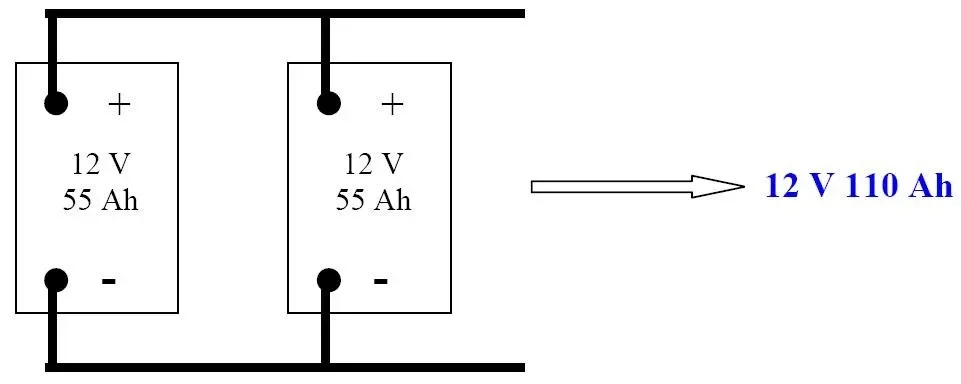
In a parallel connection, all the positive poles are connected together, as are the negative poles. This connection allows maintaining the same voltage while adding the capacities (Ah) of the batteries.
👉 Example: two 12V 55Ah batteries in parallel provide 12V 110Ah.
⚠️ Important: the cables used must have the same length and cross-section to avoid any imbalance in charging or discharging between the batteries.
⚡ Series-parallel connection: combine voltage and capacity
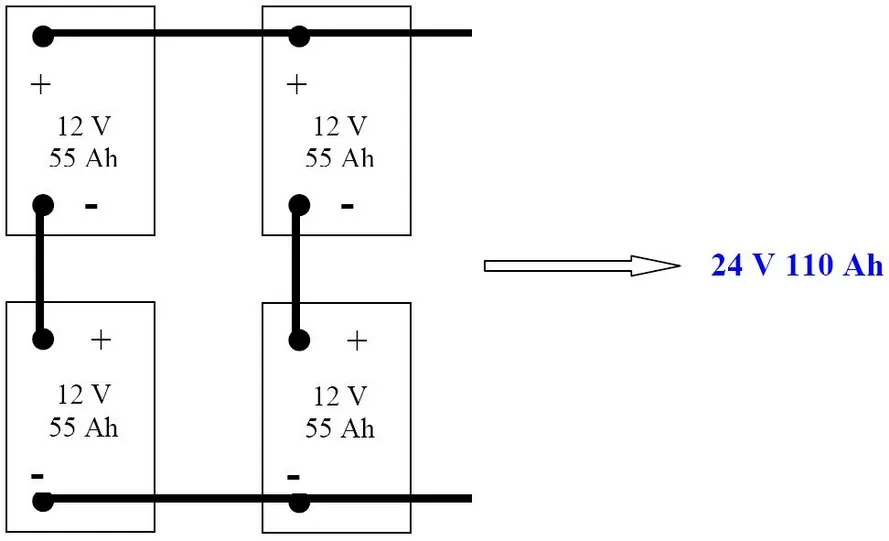
This type of connection combines the advantages of series connection (increased voltage) and parallel connection (increased capacity).
👉 Example: two groups of 12V 55Ah batteries connected in series, then linked together in parallel, provide a voltage of 24V and a capacity of 110Ah.
This setup is common for installations requiring both high autonomy and a higher operating voltage (24V, 48V…).
🌡️ The effects of temperature on batteries
Temperature strongly influences the behavior of a battery, which remains a sensitive electrochemical component. Excessive heat or intense cold can alter:
- the speed of chemical reactions,
- the charging and discharging voltage,
- the gassing voltage,
- the loss of electrolyte,
- and overall performance such as capacity, self-discharge, and lifespan.
➡️ To preserve your batteries, it is essential to use them within a stable temperature range, neither too low nor too high.
💧 Stratification: a harmful internal imbalance
Stratification refers to poor mixing of the electrolyte in the battery. Over time, sulfuric acid tends to concentrate at the bottom, while the lighter water remains on the surface. This imbalance can lead to:
- a reduction in lifespan,
- a risk of surface freezing,
- internal corrosion and oxidation.
➡️ To avoid this phenomenon, it is recommended to regularly perform an equalization charge (or regeneration), which causes slight bubbling and allows for the homogeneous mixing of the electrolyte.
⚠️ Sulfation: a silent enemy of batteries
Sulfation is a common electrochemical phenomenon that occurs when batteries are:
- partially discharged too often,
- or subjected to high temperatures.
It results in the formation of lead sulfate crystals on the plates, which:
- reduces the battery's capacity,
- increases its internal resistance,
- and decreases its overall efficiency.
➡️ A periodic equalization charge can, in some cases, partially reverse sulfation by forcing the chemical reactions to reactivate properly.
💨 Gassing voltage: a threshold to monitor
During the charging of a battery, its voltage gradually increases. Once a certain value is reached, rapid chemical reactions cause the release of gas (oxygen and hydrogen) inside the battery: this is the gassing voltage.
➡️ It is therefore important to set a maximum charging voltage, below this threshold.
However, slight controlled gassing at the end of the charge can be beneficial, as it helps to reduce stratification and limit sulfation.
Why oversize your battery bank?
The more a battery is intensely used (rapid or deep discharge), the faster it ages. Conversely, a well-sized battery bank allows:
- to limit recharging efforts,
- to increase lifespan,
- and to gain daily autonomy.
👉 A slow discharge is always preferable to a sudden discharge.
Actual capacity vs theoretical capacity of a battery
The capacity of a battery (expressed in Ah, ampere-hours) is not used like a simple water tank. It varies according to the discharge rate: the harder you draw, the less energy the battery delivers.
🔎 Example:
A 12V battery of 250Ah C/100 will deliver:
- 250Ah if discharged over 100h (2.5A/h),
- 230Ah over 20h (11.5A/h),
- and 180Ah over 5h (18A/h).
💡 Remember: the faster the discharge, the more the usable capacity decreases. To avoid premature wear, adjust the discharge rate to your actual need, or opt for batteries with greater capacity.
⏳ Battery usage limits: preserving its lifespan
The lifespan of a battery is inversely proportional to the intensity of its use. The faster or deeper it is used, the quicker it wears out.
➡️ A battery used moderately (for example at 1/10 of its capacity) can reach up to 1800 cycles of charge/discharge, or about 5 to 6 years of longevity, provided it is recharged immediately after use.
⚠️ Conversely, a battery emptied to 100% every day without full recharge can wear out in just a few months. This type of abusive use is not covered by the manufacturer's warranty.
Understanding the units: Volts, Amperes, Watts, Wh, Ah
Two elements characterize a battery:
- its voltage (6V, 12V, 24V...), expressed in Volts (V),
- its capacity, expressed in ampere-hours (Ah).
The power (in Watts) corresponds to the voltage multiplied by the current:
Watts = Volts × Amperes
But the actual consumption depends on time:
- One watt-hour (Wh) = 1 watt consumed for 1 hour.
- A 12V 250Ah battery contains 3000 Wh theoretically.
⚠️ Warning: this value is often overestimated if the discharge rate is neglected.
Actual capacity vs theoretical capacity: the effect of C/xx
The "C/xx" indicates the theoretical discharge time.
- A 250Ah C/100 battery will deliver 250Ah over 100h,
- 230Ah over 20h (C/20),
- and only 180Ah over 5h (C/5).
➡️ The faster the discharge, the more the actual capacity decreases.
💡 Practical example:
Discharge at 11.5A → usable capacity ≈ 230Ah → autonomy ≈ 20h
Discharge at 18A → usable capacity ≈ 180Ah → autonomy ≈ 10h
Discharge at 2.5A → capacity ≈ 250Ah → autonomy ≈ 100h
What actual power to use each day?
According to the 1/10th per day rule, you should use only about 25Ah from a 250Ah battery to preserve it.
🔋 This gives approximately: 25Ah × 12V = 300 Wh usable per day, which is… a small refrigerator for 24h, and that's it!
In stationary use (service battery)
A battery used in service (electrical autonomy) is subjected to 10 to 20 times more than in starting use (like for a car engine).
➡️ That's why it's crucial to oversize your battery bank to avoid premature wear.
In summary:
- ⚡ The more capacious your battery is, the longer it will last at equal consumption.
- 🧠 It is always preferable to avoid deep discharges.
- 🔁 Always recharge after use.
- 📊 Adjust your expectations to the reality of your consumption and usable capacity, not just the "Ah" label.