

GEL vs AGM batteries: differences, advantages, and how to choose well
If you have a solar installation, a camper van, a boat, or a 4x4, you have probably already wondered whether to choose a GEL or AGM battery. These two sealed lead-acid battery technologies are popular in standalone systems and vehicles. But what are the real differences between these two types? What are their uses, advantages, and limitations?
This comprehensive guide will help you objectively compare these two technologies to make a choice suited to your situation, taking into account charge cycles, internal resistance, deep discharge, operating temperatures, and value for money.
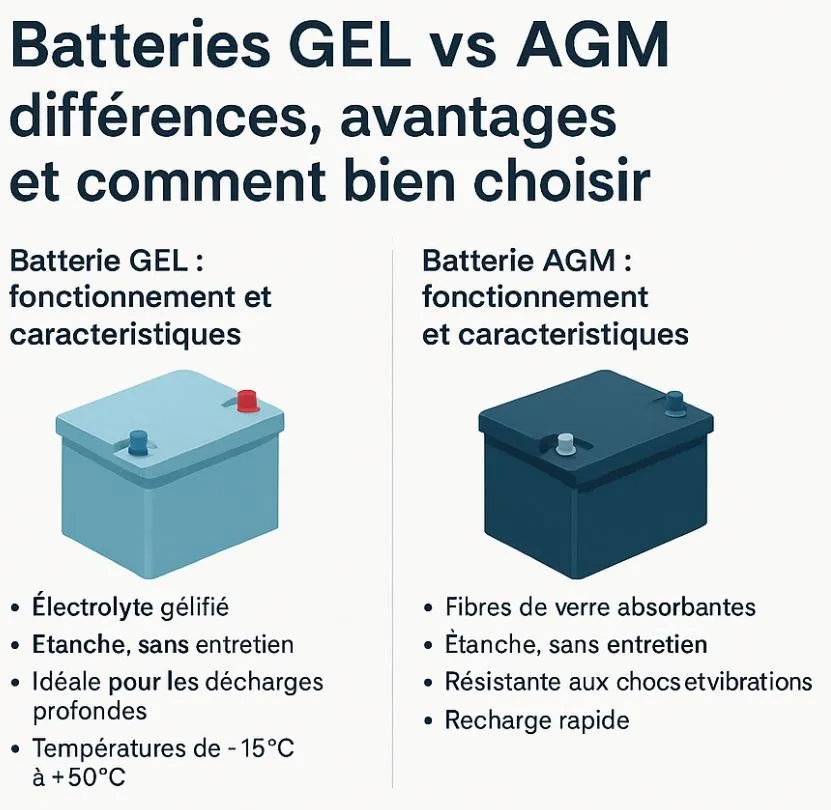
GEL battery: operation and characteristics
The GEL battery contains an electrolyte fixed with a silica gel. This gel traps the acid between the lead plates, preventing leaks and improving shock resistance.
Some GEL batteries also incorporate phosphoric acid to improve their longevity in deep cycling, especially in intensive or daily use.
Advantages:
- Supports a 100% discharge without rapid degradation
- Ideal for slow and deep discharges
- Long lifespan (high number of cycles)
- Excellent resistance to extreme temperatures: from -15°C to +50°C
- Can operate even when tilted or inverted
But then what are the notable differences between these two types of batteries?
There are several differences between these two types of technologies. The first easily visible but significant difference is the price. Indeed, the AGM battery is more price-competitive than the GEL battery due to its less costly technology.
But one should not stop at this first point even if it is important. This price difference has a reason; indeed, GEL batteries have a discharge rate of 100%, meaning you can completely discharge the battery, even with a long-term discharge, you will maintain its initial performance, thus retaining their properties over time. AGM batteries have a discharge rate of 80%. This is also a very acceptable discharge rate, but this means a gel battery can be completely emptied before being recharged, which is not desirable for an AGM battery that must be recharged at 80% of its discharge. The consequence of this is that the lifespan of a gel battery will therefore be slightly longer than that of an AGM due to the higher number of cycles.
The GEL battery is ideal for repetitive cycles, thus for daily use with slow and deep discharges. The AGM battery is ideal as a service battery as well as a marine battery and RV battery but can also be used, if necessary, as a starter battery.
In terms of temperature range, the GEL battery withstands temperature ranges from -15° to 50°, while the AGM battery withstands temperature ranges from 0° to 40°.
Gel and AGM batteries, also called VRLA, have three things in common: they are sealed, maintenance-free, and resistant to shocks and vibrations. This is a real plus for mobile use on land or at sea. In addition to this, gel batteries can be used in an inverted position.
AGM Battery: Operation and Characteristics
The AGM battery (Absorbed Glass Mat) uses separators made of glass microfibers absorbing the liquid electrolyte. It is also sealed, maintenance-free, and more affordable to purchase.
The electrolyte is distributed between the plates, ensuring good electrical conductivity and low internal resistance, ideal for strong currents like engine starting or powerful equipment.
Advantages:
- Cheaper than GEL
- Very good resistance to shocks and vibrations
- Ideal as a service or starter battery
- Faster charging time
- Efficient up to 80% discharge
Comparison: GEL vs AGM Battery

Weight, dimensions, and capacity: choose wisely according to your space
Dimensions and weight vary according to capacity. Here are some average examples:
- 75 Ah: 242 × 175 × 190 mm – 22 kg
- 105 Ah: 330 × 175 × 240 mm – 30 kg
- 200 Ah: 520 × 230 × 240 mm – 66 kg
For a limited space, it's sometimes better to have two 100 Ah batteries rather than one single bulky 200 Ah battery.
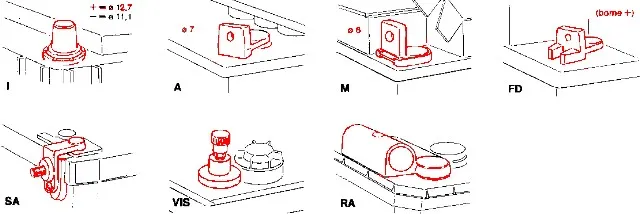
The different types of terminals
Depending on the use and planned connections, there are several types of connections:
- SAE terminals: standard tapered posts for vehicles
- Side terminals: recessed with bolt fastening
- L terminals: for special or light equipment
- Stud terminals: threaded for intensive applications
In summary: which choice for which use?
- 🔋 Choose a GEL battery if you are looking for excellent lifespan, full discharge capacity, and increased heat resistance, especially in isolated sites or for demanding solar use.
- 💰 Choose an AGM battery if you are looking for a good quality/price ratio, for versatile use as a service battery in a vehicle or a backup solution.
AGM or lithium (LiFePO4) battery?
Are you hesitating between AGM or lithium battery for an isolated site, a camper van, or a boat? In practice, for stationary and cycled uses, lithium iron phosphate (LiFePO4) – a family of lithium ions – offers the best endurance, while AGM remains unbeatable in entry cost and cold tolerance for mixed uses (service + starting).
- AGM: lower purchase price, fast charging, good starting intensity, ~80% recommended usable capacity.
- GEL: excellent performance in slow and deep discharge, very good cycling lifespan, wide thermal range.
- LiFePO4 (lithium ion battery): very light, high efficiency, stable voltage, 3000–6000 typical cycles at 80% depth of discharge (DoD), integrated BMS.
If your number one constraint is mass/volume or the number of cycles, lithium will often be the best choice. If the initial budget is a priority, AGM or GEL remains relevant.
Nominal capacity vs usable capacity
The nominal capacity (e.g., 100 Ah) is measured under standardized conditions, but the actually usable capacity depends on the depth of discharge, temperature, and current demand.
Reference formula: Theoretical energy (Wh) = nominal capacity (Ah) × voltage (V). Example: 12 V × 100 Ah = 1200 Wh. In actual use, a margin is applied (DoD). AGM: 80% usable ≈ 960 Wh; GEL: up to 100% usable in certain uses; LiFePO4: 90% usable current, or ≈1080 Wh.
How many cycles at 50% discharge?
The cycles at 50% discharge (often noted as “cycles at 50 discharge”) provide a good indicator of longevity. Typical values (may vary by brand and conditions):
AGM~600 to 1000 cyclesSensitive to repeated deep discharges GEL~800 to 1500 cyclesVery good in slow/deep discharge LiFePO4 (lithium ions)~3000 to 6000 cyclesLow self-discharge, BMS required/integrated
Concrete examples
Need: 800 Wh/day at 12 V (A+++ fridge, LED lighting, chargers).
AGM: 12 V × 100 Ah = 1200 Wh, usable ≈ 960 Wh (80%) → autonomy ≈ 1.2 days.
GEL: usable ≈ 1200 Wh (up to 100%) → ≈ 1.5 days.
LiFePO4: 12 V × 60 Ah = 720 Wh seems sufficient, but we aim for 100 Ah (1080 Wh usable ≈ 90%) for margin, mass ≈ -50% vs AGM.
🧠 FAQ: Frequently Asked Questions about GEL and AGM batteries
Can an AGM or GEL battery be used in an unventilated area?
Yes, AGM and GEL batteries are sealed (VRLA) and do not emit gases under normal usage conditions. They are therefore suitable for enclosed spaces, camper van trunks, or homes without specific ventilation.
However, GEL batteries offer increased safety: their gelled electrolyte remains stable even in case of shock or deep discharge, making them a wise choice for sensitive environments.
Which battery to choose for an isolated site?
For off-grid or isolated site use, prioritize a battery:
- with a long lifespan,
- supporting deep discharges,
- resistant to temperature variations.
🔋 The GEL technology is often more suited to these requirements. It offers excellent endurance, even with a full daily cycle.
Are GEL and AGM batteries recyclable?
Yes. Like all lead-acid batteries, AGM and GEL are 100% recyclable through specialized channels. It is important to deposit them at an authorized waste facility or return them to a responsible retailer.
Can these batteries be charged with a simple car charger?
No. GEL and AGM batteries require a VRLA-compatible charger, with precise charging voltages (14.1V to 14.4V for GEL, 14.4V to 14.7V for AGM in 12V). A wrong charger can reduce their lifespan or damage them.
💡 Tip: an MPPT solar controller with adjustable charging curve is ideal for preserving your batteries.
🔎 Installation tips to optimize your batteries
- Place the batteries in a temperate location, away from moisture.
- Never connect two batteries of different technologies in series or parallel.
- Plan for a circuit breaker or fuse system to protect the installation.
- Respect the maximum discharge current specified on the technical sheet.
- Avoid 100% discharges on AGM batteries: this greatly reduces their lifespan.
💡 Did you know?
A 100 Ah GEL battery can deliver up to 100 usable Ah (about 1200 Wh), while a 100 Ah AGM battery generally delivers 80 usable Ah (about 960 Wh) before reaching its recommended discharge limit.
This makes a difference of 240 Wh, or several hours of lighting or refrigeration!
🧰 And what about lithium?
Lithium batteries (LiFePO4) represent the future for many applications, with clear benefits:
- Reduced weight (up to 60% lighter)
- No maintenance
- Up to 5000 charge cycles
- Stable voltage even at the end of charging
But they remain more expensive to purchase, which makes GEL and AGM batteries still very interesting for residential, mobile, or backup uses.