

Electrical wiring and connections
Designing domestic electricity means knowing how to use cables and their countless wires and characteristics. It also means knowing how to properly manage the various necessary connections.
Cables and wires allow electrical flow but not without adhering to basic rules. Each cable has its family and uses within your home. As for connections, they also have their rules. Let's review to wire and connect properly!
How to install electrical cables?
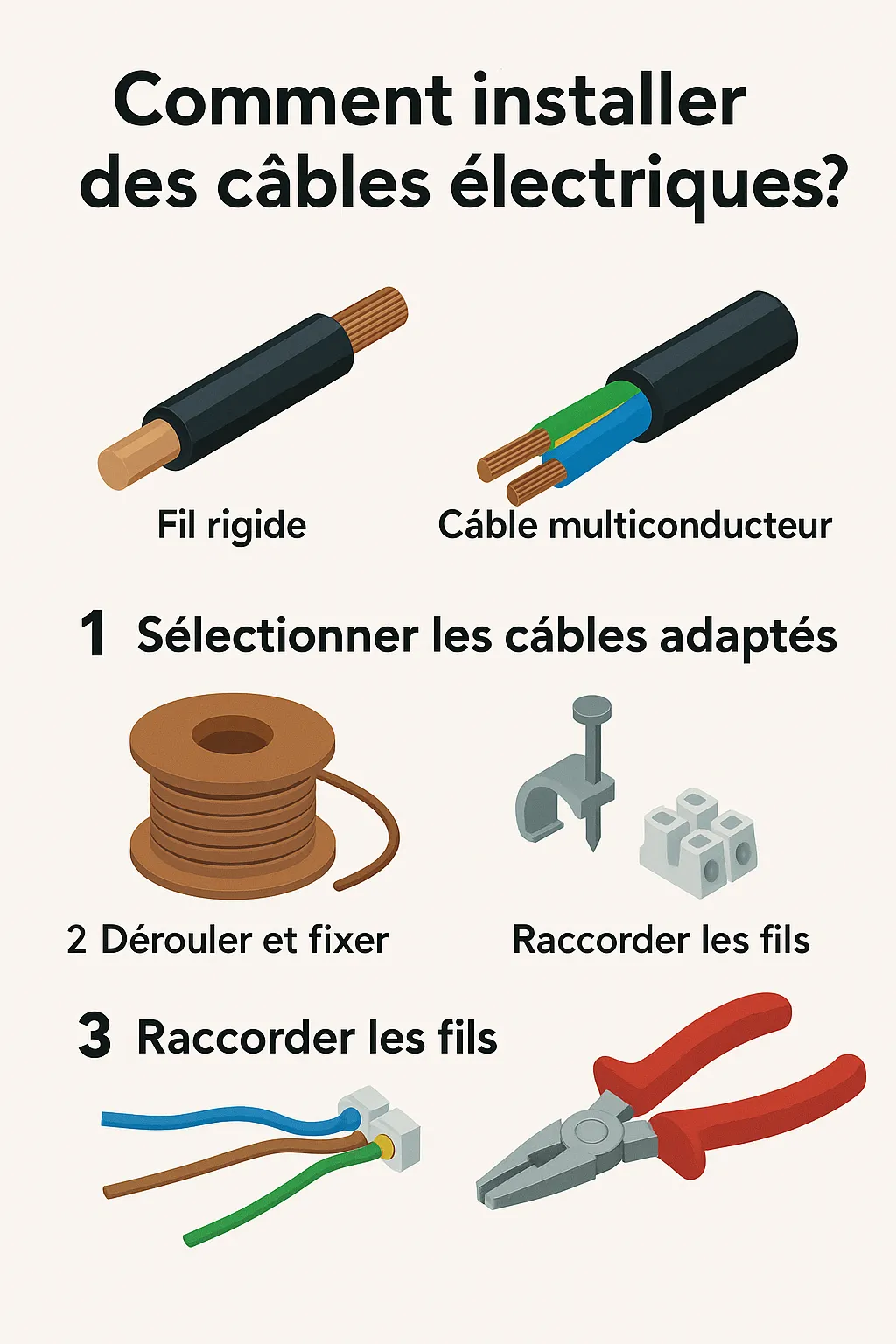
Electrical wires and cables are conductors, or electrotechnical components, through which electricity (or energy) and information circulate. The wire consists of a central conductive copper part encased in an insulating layer. It is also called a single conductor. Whereas the electrical cable is composed of several wires grouped together in a protective sheath, also called a multiconductor. Flexible cables are used for extensions and rigid cables more for fixed installation (masses too large to be moved unlike mobile installations).
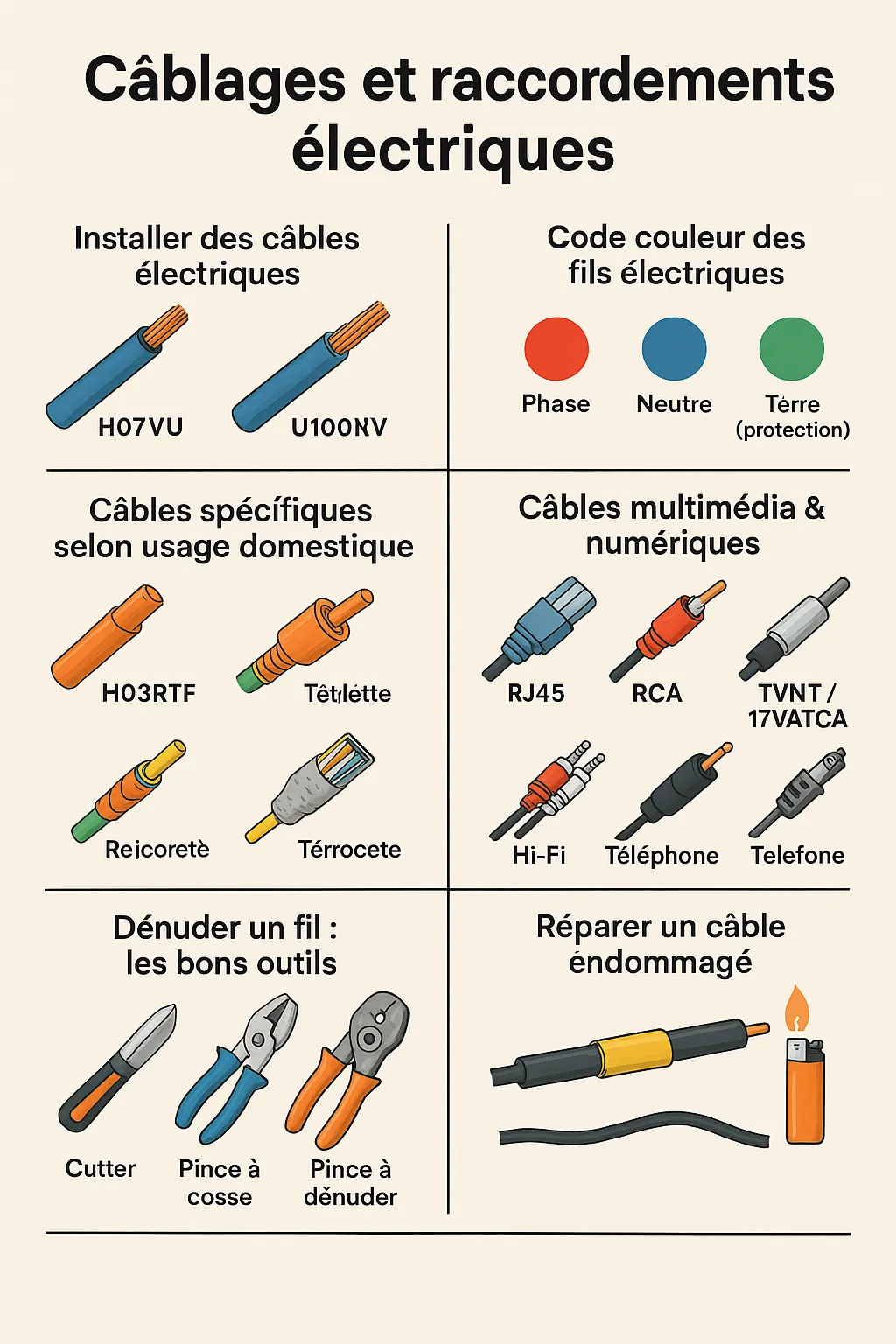
Each wire and each cable has a defined section in mm². The lengths change depending on the circuit and the intended use. The stronger the section, the more current the wire or cable will carry. Wires and cables are named using letters and numbers. Example: H07VU, translate H for harmonized wire, 07 for allowable voltage from 500 to 700 V, V for PVC sheath (or polyvinyl chloride) and U for the rigid central part.
Electrical color codes
To differentiate the various electrical wires, there is a color code defined by a specific electrical standard. It is essential to respect these color codes when setting up your domestic electricity:
- Phase electrical conductors. These conductors, through which the current arrives, can be black, brown, or red in color.
- Neutral electrical conductors. These electrical wires, through which the current returns, must be blue (or light blue) in color.
- So-called protective electrical conductors. These electrical wires, twisted and connecting the electrical installation to the ground, are green and yellow in color. They are always used together and not separately except in specific cases where only the ground cable is concerned
Electrical wires and installation cables
Installation wires and cables are used to set up fixed installations and the wiring of the electrical distribution board. This family has its codes and numbers.
The H07VU, H07VR, and H07VK are used for domestic installations, housing, and offices. They are the most common. They also play an important role as they manage the transport of electrical energy from the meter provided by EDF to the concerned poles. Once the section exceeds 4 mm², it is referred to as HP7VR wire and no longer H07VU. While the H07VK wire is flexible, the H07VU and H07VR wires are rigid.
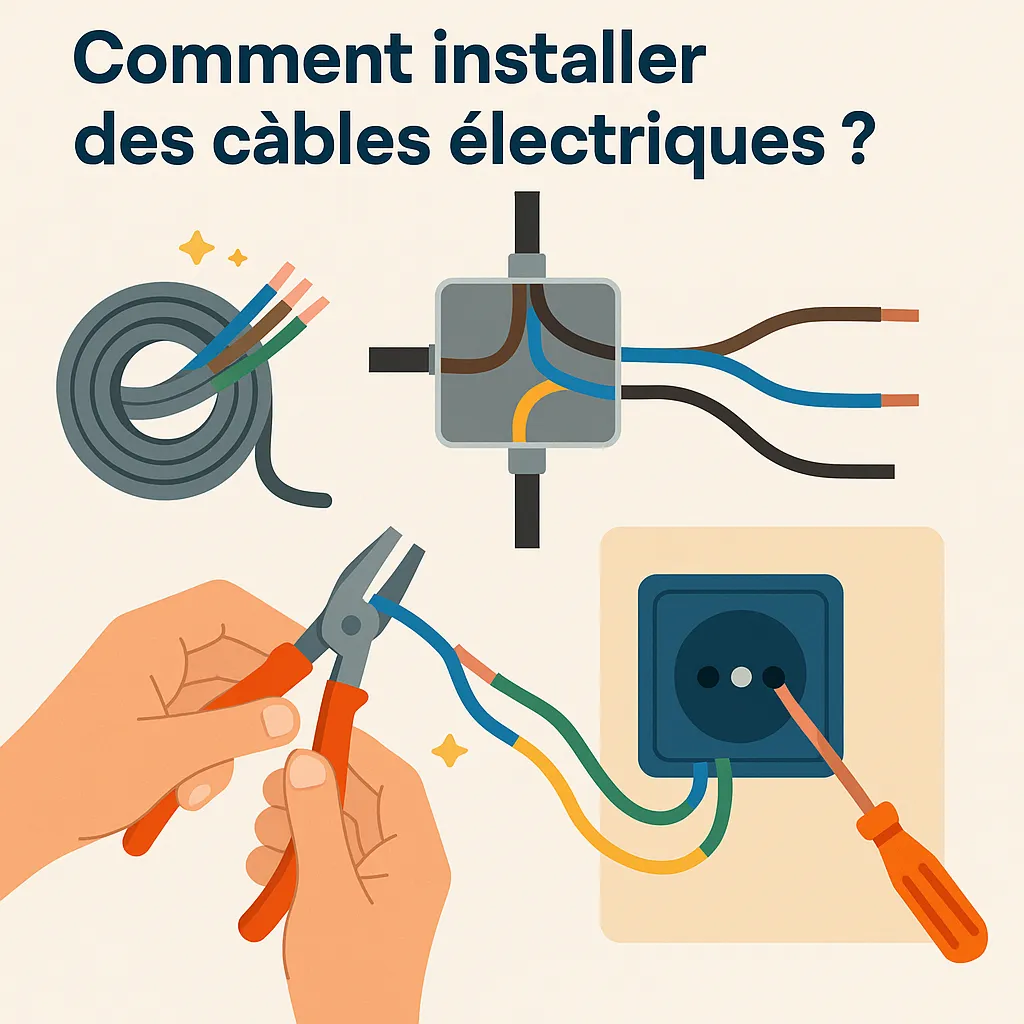
How to install them? Installation wires and cables do not require molding, trunking, or even skirting. If you want them embedded, your electrician will protect them with a suitable sheath. This accessory will be very useful for passing and installing the wires.
The U1000R2V cable is recommended for the installation of fixed electrical circuits. EDF also recommends it to ensure the connection between the 500 mA branch circuit breaker and the meter provided by them.
How to install it? Easy to install, U1000R2V cables are mounted on the wall with clips (an element used to make contact between two conductors) or even with the help of moldings, trunking, or skirting. These cables must, of course, be surrounded by a sheath before being embedded in the walls.
A ground cable. A funny name for an essential cable as it allows grounding of your electrical installation: it connects the ground rod to the main ground terminal.
Special wires and cables. These specific wires and cables are used for the electrical installation of suspended halogen spots. Rigid, they are therefore made of copper.
Finally, the tele-report cable. This one connects the EDF box to your home. It is primarily used by the energy operator to read your meter from outside your home as it carries information about your consumption.
Domestic electrical cables
Flexible, domestic cables power mobile devices and are also used for making extensions.
The HO3VVH2F. This domestic cable is used to power lighting fixtures and small household appliances like coffee makers, toasters, irons, hair dryers, or shavers... Don't even think about using it to power large household appliances. Flexible means powering small devices that do not require high intensity. Your electrician will be able to specify this for you anyway.
The H03RTF. This cable will be used to power a chandelier, a large lighting fixture depending on the model. Advantage of this cable: its finishes have been designed to blend with the structure of your chandelier.
Multimedia wires and cables
Multimedia wires and cables are widely used and allow for many connections. They are used to set up fixed installations and especially to carry out the wiring of your electrical distribution board.
Hi-Fi cable, precious. As you may have guessed, for the music to be good, a Hi-Fi cable is essential as it powers your audio equipment, whatever it may be. The particularity of this cable is that it comes in red and black color pairs (which you probably know better), white and blue, or even transparent.
The telephone cable, famous. Composed of one or more wires depending on whether it is used for the ringtone, intercom, alarm, or the telephone itself.
The television cables, classic. There are two, the 21VATCA cable and the 17VATCA cable. The latter is of better quality as it withstands signal loss better.
The network cable, indispensable. The cable that will be able to create a connection to your computers is the RJ45, recommended by the NF C 15-100 standard. The RCA cable, on the other hand, is useful for connecting the audio outputs of VCRs and increasingly DVD players.
Finally, the TVNT cable allows a connection to digital television. Given all the possibilities with digital, this cable should be found in many households.
The colors of multimedia cables
- Blue wire, neutral = current transport at a voltage of 0V, green and yellow wire, protection = grounding wire, and black, red, or white wire, phase = current transport at nominal voltage or shuttling between two two-way switches.
- Cables must not occupy more than one-third of the conduit section.
How to strip an electrical wire?
Anyone who can strip an electrical wire will have acquired the basics of the complex world of electricity. A bit of dexterity is enough to obtain a properly stripped wire. Everyone has their method, cutter, crimping pliers, or wire stripper.
Stripping a wire using a cutter. Start by making a notch in the sheath protecting the wire with the cutter without damaging the wires. It's up to you whether you prefer to cut along the length of the wire or follow the circular cut of the wire.
Stripping with crimping pliers. First step, insert the electrical wire into the serrated notches adapted to different cable and wire diameters (markings are usually indicated on the pliers). After tightening the crimping pliers on your electrical wire, simply slide and the wire strips easily.
Stripping with a wire stripper. Commonly used because it's practical, the wire stripper lives up to its name. Simply install your wire according to the length you wish to strip, close the notches on the wire by pushing on the pliers' wheel. With one hand, you press the tool's handles and with the other, you hold the wire while making a half-turn of your wrist to slide the wire, which strips quickly.
Copper wires
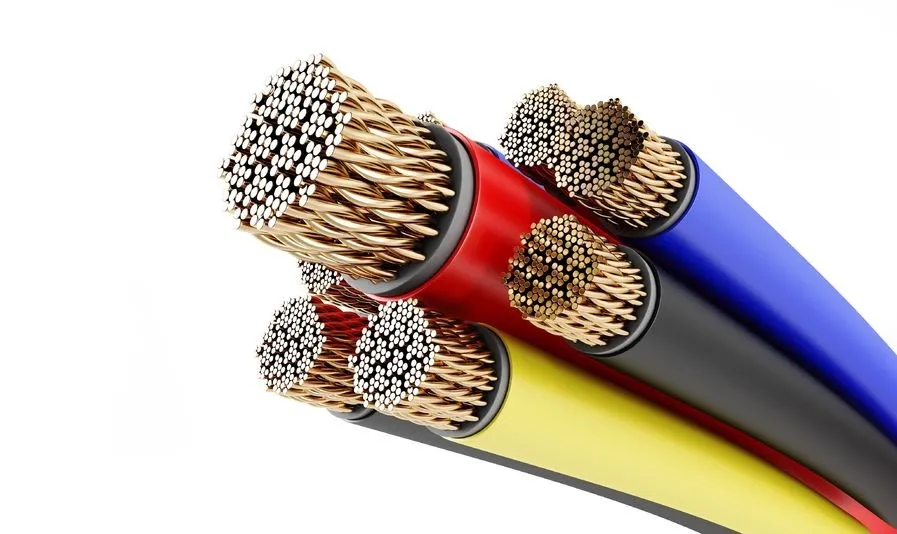
Copper is the most common metal for designing electrical wires and cables due to its high electrical conductivity. It is used either as a single-strand cylindrical wire, meaning rigid, or as a multi-strand cylindrical wire, meaning flexible. Copper wire is usually protected by a layer of varnish or plastic. These protective films act as insulators.
Copper wire is often twisted and can have between two and several hundred wires within a cable. These cables are themselves wrapped by a film of aluminum or copper. Copper wire can even be surrounded by steel if it is intended for more specific places like underground. You will therefore often encounter this type of electrical wire on the path of your electrical installation and, due to its virtues, you will know why it is chosen over others.
Summary of electrical sections
Types of electrical installation / Sections Intensity / Current
- Lighting: Minimum 1.5 mm² 8 usage points per circuit, 16A for circuit breakers
- Roller shutters: Minimum 1.5 mm² Variable usage points, 16A for circuit breakers
- VMC (Ventilation): Minimum 1.5 mm² 1 single usage point per circuit, 2A for circuit breakers
- Power outlets: 16A Depending on intensity, minimum 1.5 mm² (16A) or 2.5 mm² (20A) 5 usage points per circuit if 16A circuit breakers and 8 usage points if 20A circuit breakers
- Specialized circuits 16A: Minimum 2.5 mm² 1 single usage point per device, 20A for circuit breakers
- Electric water heaters: Minimum 2.5 mm² 1 single usage point per circuit, 20A for circuit breakers
- Single-phase stoves and cooktops: Minimum 6 mm² 1 single usage point per circuit, 32A for circuit breakers
- Three-phase stoves and cooktops: Minimum 2.5 mm² 1 single usage point per circuit, 20A for circuit breakers
How to repair an electrical cable?
An electrical cable is not eternal and repairs are sometimes necessary. To successfully carry out this repair mission, start by stripping the concerned electrical wire(s), ensuring to insulate them with a specific adhesive element. Then, solder the damaged wires together. Next comes the sheath, protective and essential, which will surround the part of the soldered wires. To ensure the sheath adheres best, you can even heat it with a lighter, which will make it shrink around the repaired cable part.
Electrical connection
This time, I am not going to talk to you about the electrical connection you request from EDF when you move in. The electrical connections concerned are those that your electrician will make within your installation itself. Thanks to state-of-the-art connectors, connections are now child's play for any self-respecting specialist. Junction boxes, connection terminals, connectors, terminal blocks, and more, connections are not lacking. To a cable and a connection corresponds an appropriate conductor.
To connect wires and cables. Terminal blocks, also called "connection strips" or "dice," are used to make connections and derivations as well as complex circuits. Terminal blocks are integrated within a connection box that can contain up to 4. Automatic terminals are used to pass flexible cables and screw terminals for rigid wires. Very important, the connector must necessarily have a size corresponding to the type of cable, otherwise it will not be possible to connect the different wires. Additionally, electrical standards govern the main principles regarding the use of connectors.
The screw, effective. Many professionals agree that tightening with screws remains the most effective solution to ensure optimal conduction. The screws must be tightened but not excessively to avoid damaging the wires.
In the connector family… The connection strip will be very useful for creating a small circuit, flat automatic connectors can accommodate between 3 and 5 rigid conductors, cap terminals are often used with conductors twisted together, fixed base terminals are preferred for connecting high-intensity circuits, mainly for connecting main communication lines.
Connections are made in specific boxes, visible or embedded. If they are embedding boxes, you can easily hide them with wallpaper. I also recommend using terminal blocks to make your connections, taking into account the section of the electrical wires.
Examples of Electrical Connections
Example No. 1: Connection in a box. Start from the base of a box, fixed with dowels and screws. The three key cables (phase, neutral, earth) come into play. First, pass them through the designated paths in the strip fixed to the wall and strip the cables with a wire stripper. Next come the connectors to ensure a good connection. Automatic connectors seem suitable for this electrical work. Most are clip-on, which is very practical and saves time. To do it right, the wire must go to the end of the connector hole, which then clips the wire. The cables finish their journey once they are connected to the point of use. Therefore, they must be pulled to the designated location, passing again through the strip paths. The box can be completed with its cover and properly closed. The connection is made.
Example No. 2. Installing a wall light. After verifying that the power is off, mark the necessary surface with a pencil. After drilling the holes, dowels fill them. Then, take care of the phase and neutral wires (previously stripped) and connect them according to their color code (compliance with electrical standards) to a junction box (which will have been fixed beforehand, of course). Finally, simply screw the light fixture to the assembly.
Example No. 3. Connecting terminal blocks. Terminal blocks, or connection strips, are very useful accessories in setting up domestic electricity. First, it's better to remind you, even if you think about it, to turn off your main circuit breaker before starting your task. Focus first on the wires: they need to be pulled and stripped. Then, slightly loosen the screws of the terminal blocks. If you have flexible wires (or single strands), twist the stripped part, which will allow easier insertion into the terminal blocks. The stripped electrical wires are inserted in pairs. Once the operation is completed, all that's left is to tighten the screws of the terminal blocks.
Connections are essential electrical work throughout the installation of domestic electricity. And for good reason, everything connects! The list could be much longer, but that is not the goal.
Wiring Outdoors
Installing outdoor lighting involves adhering to specific rules and standards. The first golden rule, a 30 mA differential device must protect the circuit from the electrical panel. The second golden rule, provide a ground conductor connected to the main ground terminal of the house, which is responsible for protecting all circuits. The third golden rule, cables must be buried at a depth of 0.60 to 1 meter. Although not recommended, any connections must be made from their box.
🔧 To go further: good practices in domestic electricity
In addition to the basic rules on cables and connections, here are some essential points to remember to ensure safety, compliance, and performance in your electrical installations.
- Always turn off the power before any intervention, even minor. Use a voltage tester to confirm the absence of power.
- Respecting color codes is not optional: a red or brown phase wire should never be confused with a blue (neutral) or green/yellow (earth) wire. These markers are essential when connecting an electrical outlet, a switch, or an appliance.
- The section of electrical wires depends on the maximum intensity planned for the circuit. Lighting will work with 1.5 mm², but a single-phase cooktop requires 6 mm².
- Terminal blocks remain very practical for making a clean connection, but automatic terminals now offer a quick, reliable, and secure solution, especially in junction boxes.
- The U1000R2V cable, often used for main lines, must be protected by a sheath if embedded in a wall, or fixed with suitable clips if installed visibly.
- For outdoor installations, safety involves a 30 mA differential circuit breaker, a well-connected ground wire to the main ground terminal, and cables buried at least 60 cm deep.
- Never overload a circuit of outlets: respect the limits set by the NF C 15-100 standard (5 or 8 outlets depending on the section and circuit breaker).
- Finally, each connection must be protected in a box designed for this purpose, visible or embedded. A clean installation is also an installation that is easily controllable and adaptable.
📘 Need practical guides?
Check out our section dedicated to wind and solar wiring diagrams, or our measurement tools to test your installations.