

Find the best position for a solar panel?
As we have already seen, the efficiency of a photovoltaic module varies with the angle of incidence of the solar rays. The position you will give to your solar panels will therefore influence the production. The aim of this article is to help you determine the optimal position of the solar panels for an off-grid installation.
The position of a panel is actually:
- its orientation, or azimuth, that is, the angle it will make with the north-south axis in the horizontal plane.
- its tilt, that is to say the angle it will make with the horizontal plane.
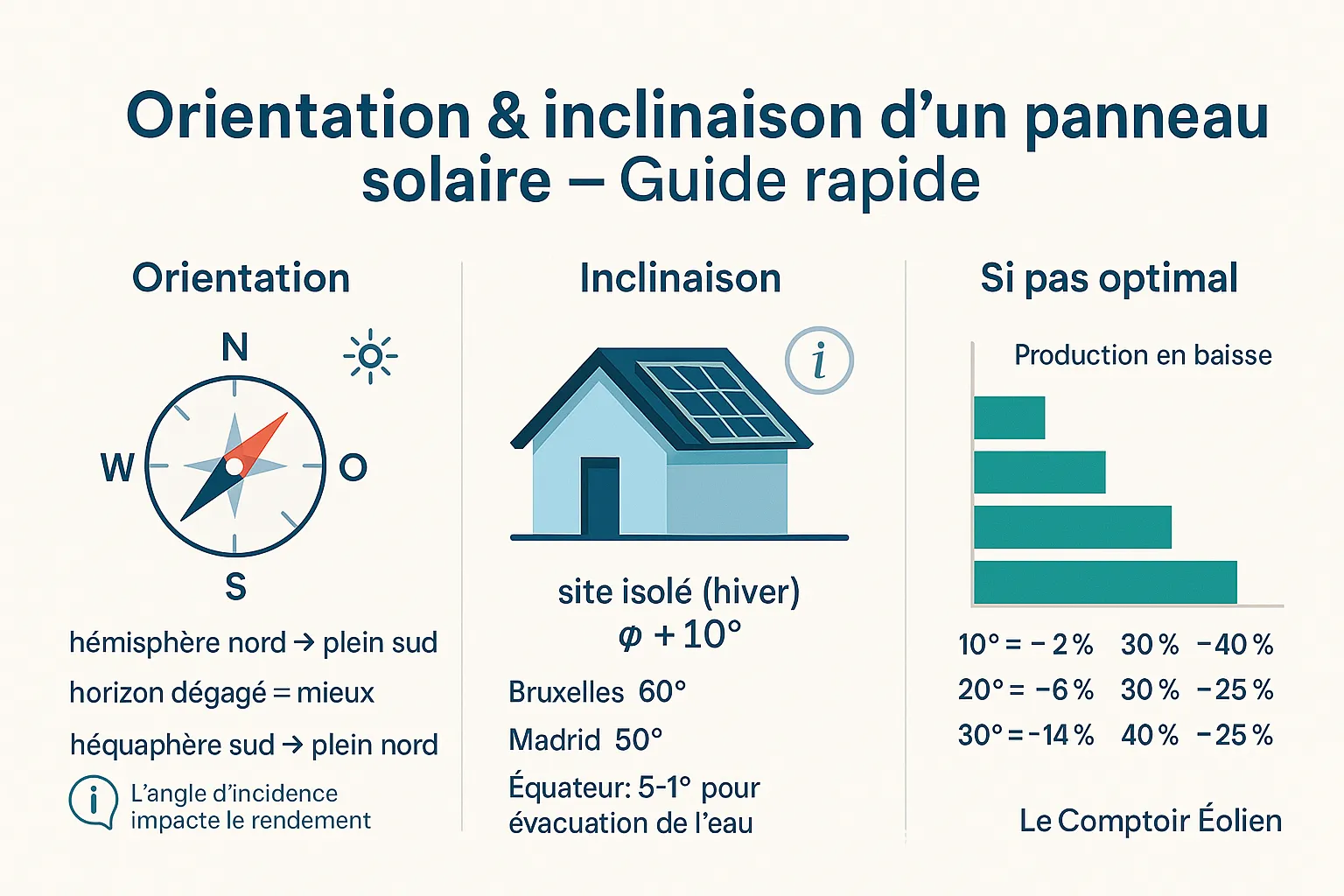
Optimal orientation
For orientation, it's relatively simple: as long as the horizon is clear, you should orient your solar panel towards the south if you are in the northern hemisphere and towards the north if you are in the southern hemisphere.
Near the equator, the optimal tilt is roughly horizontal, therefore, the orientation of the solar panel is not really important.
Optimal tilt
For an off-grid solar installation, that is to say without connection to an electrical network, the optimal tilt is generally the one that optimizes the production of solar panels during the least sunny month. Indeed, the sizing of your panels is based on this month.
You must therefore start by determining the sunlight to identify the least favorable month.
Once you know the least sunny month, you obtain the optimal tilt by adding the latitude of the location where your installation is to the number corresponding in the table below:
This number is actually the sun's declination, that is to say the angle a sunbeam makes with the equatorial plane, for each month of the year.
For example, for temperate regions where winter is the worst period, the chosen tilt is often the latitude plus 10°: 60° in Brussels, 50° in Madrid...
For regions near the equator, the optimal tilt is close to zero but it is preferable to give a tilt of at least 5 to 10° to your solar panels to facilitate the drainage of rainwater and the removal of objects and dust that might settle on the panel.
And if it is not possible to be optimal...
Depending on your project, it is sometimes impossible to fix your solar panels according to the optimal orientation and/or tilt. This is notably the case as we have just seen near the equator but also when the panels must be fixed to the roof of an existing building, or even when they are intended to be used on a boat or another mobile installation.
In this case, be aware that the production of a solar panel decreases little if the deviation from the optimal tilt is small but these losses increase rapidly if the deviation exceeds about twenty degrees.
Example:
A deviation of 10° from the optimal tilt results in a production decrease of less than 2%
A deviation of 20° results in a decrease of about 6%
A deviation of 30° results in a decrease of about 14%.
A deviation of 40° results in a decrease of nearly 25%