

Foldable solar panel
Solar panels can be installed independently, but also integrated into a home designed from the outset to consume as little energy as possible: the passive house.
There are 3 types of photovoltaic solar panels:
- Monocrystalline photovoltaic solar panels: the solar cells are made from a single block of melted silicon, so they are very "pure." These panels offer the best efficiency (between 13 and 17%), but are more expensive to produce, and therefore to sell. The cells are generally octagonal and of a uniform dark color (navy blue or gray).
- Polycrystalline photovoltaic panels: their solar cells are made from a block of silicon crystallized into multiple crystals. These photovoltaic panels have an efficiency of 11 to 15%, but their production cost is lower than monocrystalline panels. The cells are rectangular, dark blue with reflections. These panels are generally considered to have the best quality/price ratio.
- Amorphous photovoltaic panels, whose cells are produced from a "silicon gas," which is deposited on glass, flexible plastic, or metal. Amorphous cells have a lower production cost, but their efficiency is only 7% to 10%. This type of cell is used for flexible or foldable panels.
The foldable solar panel
In addition to absorbing sunlight, flexible solar panels readily adapt to various household manipulations.
What is a foldable solar panel?
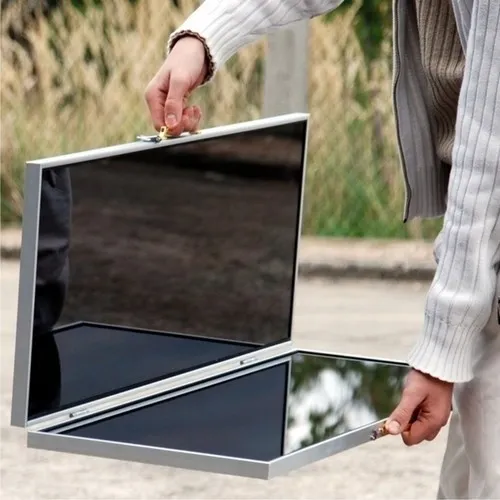
A foldable solar panel is a solar collector made up of electronic cells. These cells are exposed to light (photons) which simultaneously generates two types of phenomena: an electrical voltage and a direct current. As its name suggests, the foldable solar panel can be folded and is therefore easily transportable. As lifestyles evolve towards greater mobility, the foldable solar panel meets real needs for energy autonomy as well as ecological demands.
What technology underlies the foldable solar panel?
Flexible solar cells are often embedded in urethane or other specific materials that behave like rubber: Thin Film CIGS technology or approved by the manufacturer...
What are the applications for this type of panel?
The foldable solar panel is particularly suitable for charging small portable electronic devices such as mobile phones, cameras, PDAs, MP3 players, auxiliary lighting, and many other electronic devices. But depending on its power, the foldable solar panel can also meet other requirements: laptop battery charger, various batteries in vehicles, etc. Foldable solar panels reach power levels beyond 55 watts and can meet many outdoor or extreme uses (hiking, marine, 4X4...).
The advantages of the foldable panel:
The foldable solar panel offers many advantages. First, autonomy, a sine qua non condition for mobility and nomadism. Simplicity of use: unfold the solar panel, orient it towards the light, and you're done! And that's not all. If it starts to rain, know that most foldable solar panels are waterproof and water-resistant. Durable, they can be used outdoors even with low light levels. To top it off, some manufacturers integrate protection against reverse currents. This technique allows you to leave your electrical device plugged in all night without risking draining the battery. Finally, and not the least of the advantages, the foldable solar panel, like all solar panels, helps preserve the environment.
How to choose?
Choose the power suited to your needs. Each use corresponds to a power expressed in watts. Make sure that all the advantages listed above are offered on the model of foldable solar panel you are considering purchasing.