

Install a wind turbine at home: terms, cost, profitability...
Whether to reduce your electricity bill or for ecological reasons, installing a wind turbine at home may seem very appealing. But, can a domestic wind turbine be installed everywhere? How much does it cost? Is it profitable? Here are some questions one might ask before investing in "small wind".
Why install a wind turbine? — The real benefits
Installing a wind turbine at home is no longer just a symbolic gesture: it's a concrete lever for self-consumption. With the cost of a kilowatt-hour having risen by +18% since 2022 and expected to continue its upward trajectory, a well-sized small wind turbine reduces:
- 40 to 60% of the annual electricity bill in windy areas;
- the household carbon footprint of 1.2 tons of CO₂ per year on average;
- dependence on networks, thanks to 24/7 operation, even at night, unlike solar.
To remember: the installation of a personal wind turbine becomes profitable as soon as the average wind speed exceeds 5 m/s and domestic consumption reaches 3,000 kWh/year.
Types of domestic wind turbines
By domestic wind turbine, we mean devices intended for individuals with small and medium power, that is to say from 100 W to 20 kW of nominal power.
The most common are mast-mounted wind turbines. On average, it is considered that a wind turbine 12 m high and 3.5 m in diameter can suffice for a French household. According to the Environment and Energy Management Agency (ADEME), a domestic mast-mounted wind turbine can allow a production of 30 to 50% of the electricity consumed by a family of four in one year. Indeed, it is the size and power of the wind turbine that will determine its annual production, not to mention the exposure to wind, of course.
There are also gable-mounted wind turbines, which are installed on the roof. These will never produce as much electricity as mast-mounted wind turbines. However, if you have little or no land, this solution can be considered "if the installation is carried out carefully by a professional", either alone or coupled with solar panels. This is called a hybrid solution.
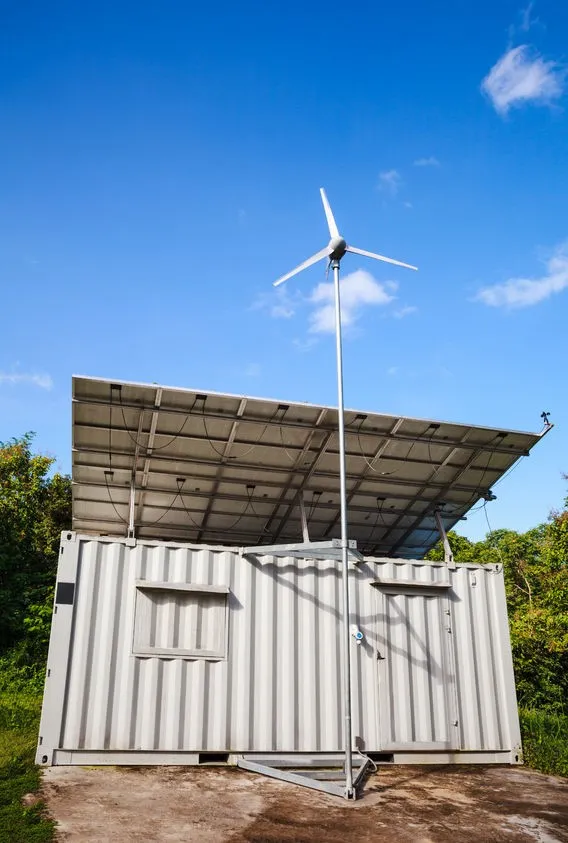
Wind study: the first step to successfully installing your wind turbine
Before any wind turbine installation, the wind study ensures that the project is viable:
- Continuous anemometric measurement for 6 to 12 months; connected stations send their data to the cloud for real-time analysis.
- Evaluation of terrain roughness (isolated house, forest edge, relief); a clear ground increases production by 15%.
- Production simulation: using tools like Windographer or the "Comptoir Éolien" calculator, you estimate annual production and return on investment.
The professional then compares these data to the wind turbine power curves. This data-driven approach limits costly oversizing and enhances profitability.
Administrative procedures in France: permits, declaration, ZDE
- Wind turbine < 12 m: a simple prior work declaration at the town hall is sufficient. Administrative silence is considered approval after the legal period of 1 month.
- Wind turbine ≥ 12 m: building permit required, simplified impact study, consultation with Bâtiments de France if a listed monument is within a 500 m radius.
- Wind Development Zone (ZDE): to sell all or part of the energy, your plot must be located in a ZDE or be subject to an approval request with the network manager. Otherwise, the wind turbine will operate exclusively in self-consumption, often more profitable for "small wind".
Also consider neighborhood rules: a written amicable agreement avoids future disputes over noise and view.
Budget and profitability: key figures
- Material cost: €2,000 to €4,000 depending on power (1 to 2 kW) and mast height.
- Professional installation: €200 to €1,000 for foundations, wiring, and commissioning.
- Annual maintenance: €20 to €50 (tightening check).
- Lifespan: 20 to 30 years for recent generations (composite frame, permanent magnet alternator).
With an average domestic kWh price of €0.25 and a production of 3,500 kWh/year (2 kW wind turbine in Brittany), the payback period is around 6 years. High-end models, better optimized, sometimes drop to 4 years in very windy areas.
Key steps in wind turbine installation
- Wind study validation and choice of suitable power.
- Foundations and anchoring: dimensioned reinforced concrete slab.
- Mast assembly: fitting, guying, verticality check with laser level.
- Installation of generator and blades: tightening to the torque recommended by the manufacturer (e.g., 85 N·m).
- Electrical connection: MPPT regulator, cable section ≥ 16 mm² to battery box or grid inverter compliant with DIN VDE 0126-1-1.
- Commissioning: rotation tests, safety braking, open-circuit voltage reading.
Expert advice to maximize production
- Raising by 1 m above any nearby obstruction increases annual production by 12%.
- Orienting the mast more than 2 m from the ridge of a roof reduces turbulence and increases the lifespan of the bearings.
- Battery + hybrid inverter coupling: store the nighttime surplus to use during EDF peak hours, increasing the value of the energy produced.