

Solar battery
Designed for photovoltaic or wind power installations, 2V or 12 volt batteries known as "solar" have particular characteristics of slow and frequent shallow discharges, unlike conventional car batteries, which ensures optimal use of the energy-producing installation over time (longer lifespan, low maintenance, weather-resistant, etc.). The main uses of a solar battery are for solar or wind installations in isolated sites, boats, motorhomes, and caravans to store the energy produced by photovoltaic panels or the wind turbine to ensure electrical supply in all circumstances (day or night, clear or cloudy skies).
Among the most commonly used batteries, we distinguish open lead-acid batteries, sealed lead-acid batteries with free electrolyte, and sealed lead-acid batteries with gelled electrolyte. The electrolyte being a mixture of water and sulfuric acid participating in the electrochemical reaction, the nature of the electrolyte has a significant effect on the performance of the batteries.
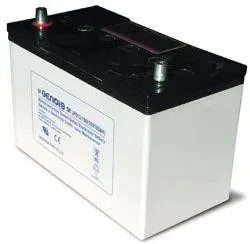
Open lead-acid batteries:
These batteries require relatively low maintenance (expect one to two top-ups every 6 months, depending on usage, taking care to use an acid suitable for solar batteries, namely with a density between 1.24 and 1.28).
Sealed lead-acid batteries:
Sealed lead-acid batteries can be AGM (liquid electrolyte impregnated in a mat) or GEL (gelled electrolyte). Although these 2 categories are a bit more expensive to purchase than open lead-acid batteries, they both offer many advantages that we list below:
Advantages of AGM Batteries
- Best value for money
- Better performance in rapid discharge
- Better performance in rapid recharge
Advantages of GEL Batteries
- Ability to leave the battery 100% discharged without immediate recharge
- Resistance to a greater number of cycles (see chapter on battery lifespan)
Battery lifespan:
The lifespan of a solar battery is quantified by the number of charge/discharge cycles it can withstand. It primarily depends on the technology used: open lead, AGM, GEL, as well as atmospheric conditions and usage conditions (depth and frequency of discharges).
As an indication, under normal usage conditions and for discharges around 40%, the following lifespans can be given by type of deep cycle batteries:
– Open lead solar battery: 400 to 500 cycles
– AGM solar battery: 600 to 700 cycles
– GEL solar battery: 800 to 900 cycles
Translated into years of use under normal conditions, their lifespan can be estimated between 8 and 15 years.