

Skip to content

Disconnect/reconnect a battery: safety, steps, tools

Follow this simple and safe tutorial to disconnect and then reconnect a car battery without risking a short circuit or damaging the wiring. Most vehicles have a negative ground (–) connected to the chassis: always disconnect the – first, and reconnect the + first.

The - of your battery is the ground (it's what is connected to the frame or chassis of your vehicle)

The + of your battery is the terminal that sends current into your electrical harness

If a cable (+) touches the chassis while you haven't disconnected the ground (-), it will cause a short circuit or damage to the battery or electrical harness.

Here are the tips for disconnecting your battery

First, disconnect the negative terminal (the - on the battery or the black-colored terminal) to avoid any short circuit (this prevents damage to the battery or electrical harness).

Of course, when performing this operation, be careful not to touch the positive terminal (the + or the red-colored terminal) with your tool to avoid any short circuit.

Then, once the negative terminal is no longer in contact with your battery, your vehicle is no longer at risk, and you can then disconnect your positive terminal (the + on the battery or the red-colored terminal).
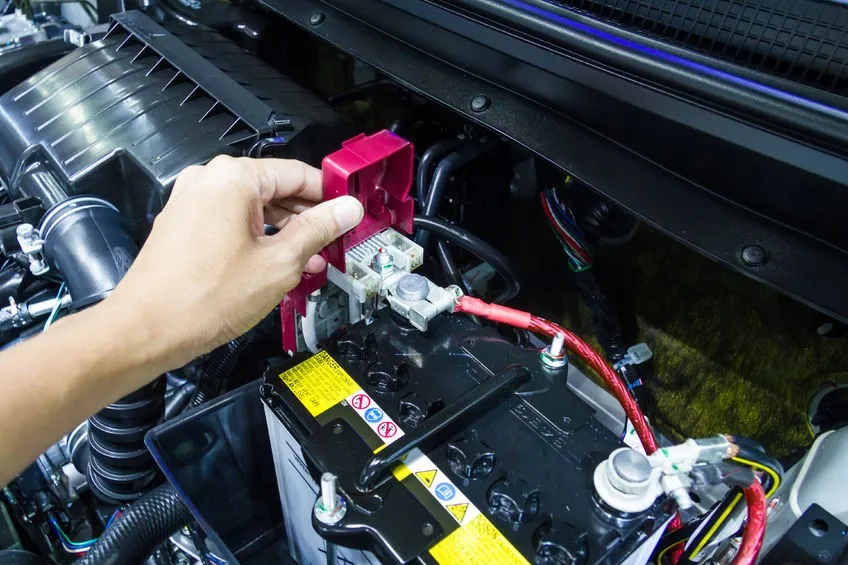
Tips for disconnecting your battery
Photo credit: Stocklib — Image ref: 1-39278772

To reconnect your battery

You must connect your positive cable to the positive terminal (+) of your battery first to avoid any short circuit and any problem, then you can reconnect your negative cable (-) to your battery's negative terminal.

How to start your vehicle without removing the battery?

If your car breaks down, you can start it without removing your battery and without connecting your car to another, thanks to small devices called boosters available in our next section: Lead-acid battery chargers

Frequently Asked Questions

How to properly disconnect a battery?
Turn off the ignition and remove the key. Always start by disconnecting the negative terminal (− terminal or black terminal) to remove the ground and avoid any short circuit. Move aside and insulate this terminal, then disconnect the positive terminal (+ terminal or red terminal). Do not let any tool touch both the + terminal and the chassis simultaneously.
How to safely reconnect a battery?
First reconnect the positive terminal (+ terminal or red terminal) and tighten it properly, then connect the negative terminal (− terminal or black terminal). This order limits the risk of electrical arcing and short circuits. Check the tightness of the terminals and, if necessary, apply a thin layer of contact grease to limit oxidation.
Why should you always disconnect the negative terminal first?
The negative terminal is connected to the vehicle's ground (the chassis). By removing it first, a tool touching the positive terminal cannot close the circuit via the bodywork, preventing a potentially destructive short circuit.
How to start a vehicle without removing the battery?
Use a jump starter compatible with the vehicle's voltage (12 V or 24 V). Connect the red clamp to the + terminal of the battery and the black clamp to the − terminal or to a grounding point provided by the manufacturer. Strictly follow the polarities and the booster’s instructions.
What tools are needed to disconnect a battery?
A suitable wrench (often 10 mm), possibly a ratchet wrench, a clean cloth, and ideally, gloves and safety glasses. A soft wire brush can help clean oxidation from the terminals before reconnecting.
What to do if a positive cable touches the chassis?
Immediately move the cable away from the chassis. If the negative terminal was not disconnected, a short circuit may have occurred: check the fuses and inspect the wiring. To avoid this risk, always disconnect the negative terminal first and insulate the terminals during the operation.
Which jumper cable gauge to choose?
Opt for thick and certified cables: often 25 mm² for most cars, 35 mm² for large engines/diesel, and up to 50 mm² for utility vehicles or in very cold weather. Avoid cables that are too thin, which heat up and drop in voltage. If you are looking for a car battery cable action, compare the actual gauge, the quality of the clamps (copper/strong grip), and the indicated standards.
LiFePO4 battery: is there a danger or special precautions?
The term LiFePO4 battery danger mainly refers to unsuitable uses: do not recharge below 0°C without a suitable system, avoid short circuits (very high current), use a charger or DC-DC compatible with LiFePO4, and check that the BMS supports the required currents. When replacing a lead battery, ensure alternator/charge compatibility and mechanical mounting.
Can I replace a lead battery with a LiFePO4 for starting?
Yes, only with a LiFePO4 designed for starting (BMS with high peak current and suitable cold start current). Ensure charge compatibility with the alternator (often via a dedicated DC-DC charger) and compliance with voltage/end of charge specifications.
After reconnecting, I have lights on or lost settings: is this normal?
Yes, some computers reset, and presets (clock, radio, windows) may be lost. Drive for a few minutes, then redo the settings. If a light persists, perform a diagnostic.

Your legal guarantee rights

Your legal guarantee rights

europa.eu/youreurope/citizens/consumers/shopping/guarantees/index_en.htm