

Skip to content

Switch to 100% renewable self-consumption

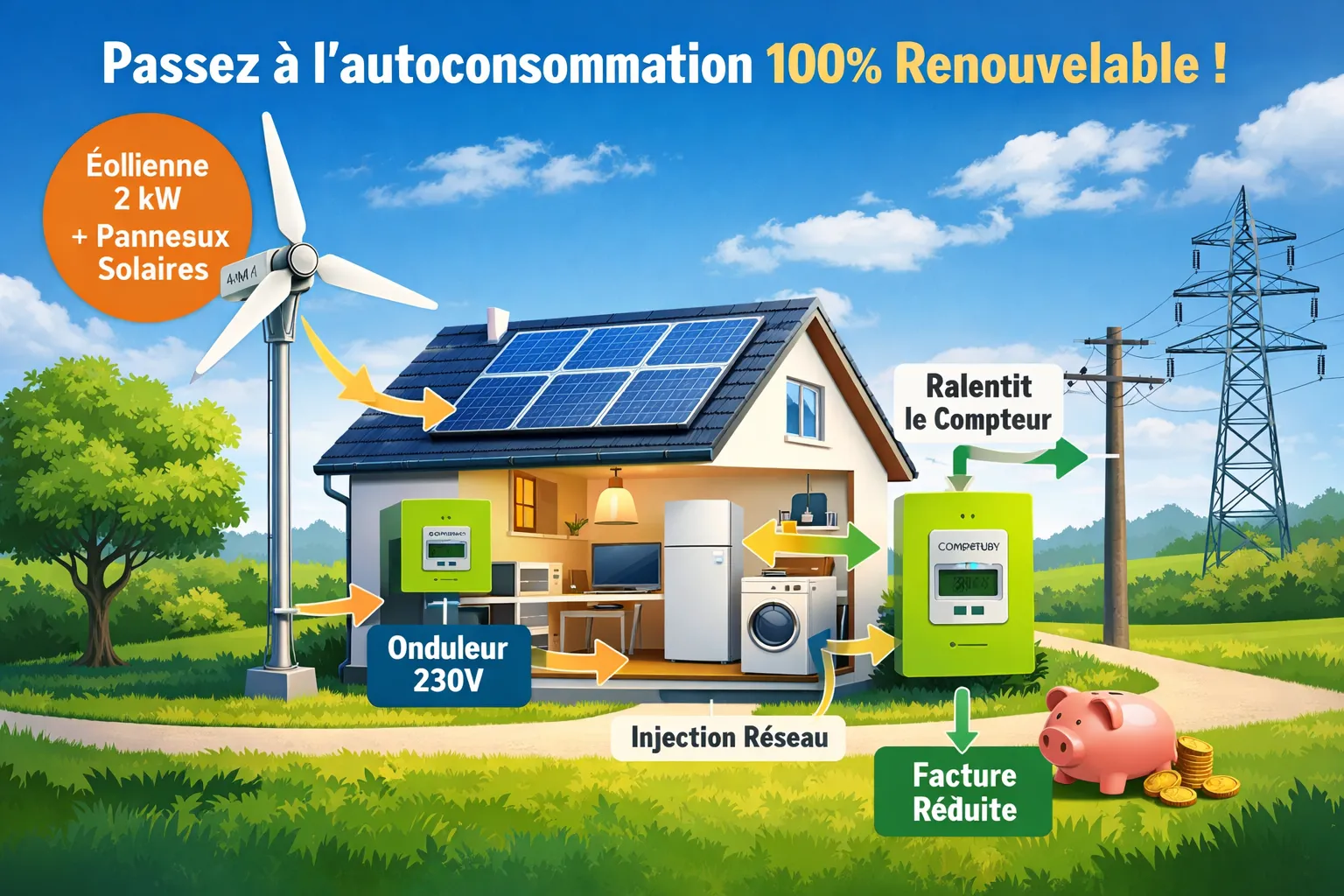
This video illustrates a simple scenario: a house powered by a wind turbine + solar panel duo to reduce the share of electricity purchased from the grid.

Example presented: Wind Kit + 2000 W Mast (48 V → 230 V) – ref. 15296. The principle of self-consumption is to prioritize consuming the energy produced on-site. When the inverter is synchronized with the grid, the production supplies the household appliances, which slows down the incoming meter and reduces the bill.


Why this kit can be relevant

  • 4 m steel mast: captures more regular wind (less turbulence).
  • 3-blade aluminum wind turbine (Ø 2.30 m): starts at 2 m/s (7.2 km/h).
  • Grid injection via inverter MPPT 2000 W (pure sine wave, efficiency > 92%).
  • Compatible with Linky.
  • Plug and play: wind turbine → inverter → standard 16 A socket.
  • Integrated protections: anti-backflow, polarity reversal protection, overvoltage.

Operation

  • The inverter synchronizes with the grid (230 V, 50 Hz).
  • The production primarily powers your devices.
  • Result: the “incoming” meter slows down and the bill decreases.
This content is provided by YouTube, which may set cookies.

Manage cookies

Self-consumption diagram: house powered by a 2 kW wind turbine and solar panels with 230 V inverter (Linky)

Frequently Asked Questions

Does a wind turbine produce all the time?
No. Production depends on the wind. For good results, a clear site, appropriate height, and sufficiently regular wind are needed.
How does self-consumption with grid injection work?
The inverter synchronizes with the grid (230 V, 50 Hz) and injects the produced energy. The house prioritizes this production, which slows down the incoming meter and reduces the bill.
Is this kit compatible with a Linky meter?
Yes, the presented kit is indicated to be compatible with Linky smart meters.
Why is the height of the mast important?
A taller mast generally captures more stable and less turbulent wind, which improves production and regularity.
Can wind power be supplemented with solar?
Yes. Solar and wind are complementary: solar mainly produces during the day and in good weather, while wind can produce when there is wind, often in winter or at night.

Your legal guarantee rights

Your legal guarantee rights

europa.eu/youreurope/citizens/consumers/shopping/guarantees/index_en.htm