

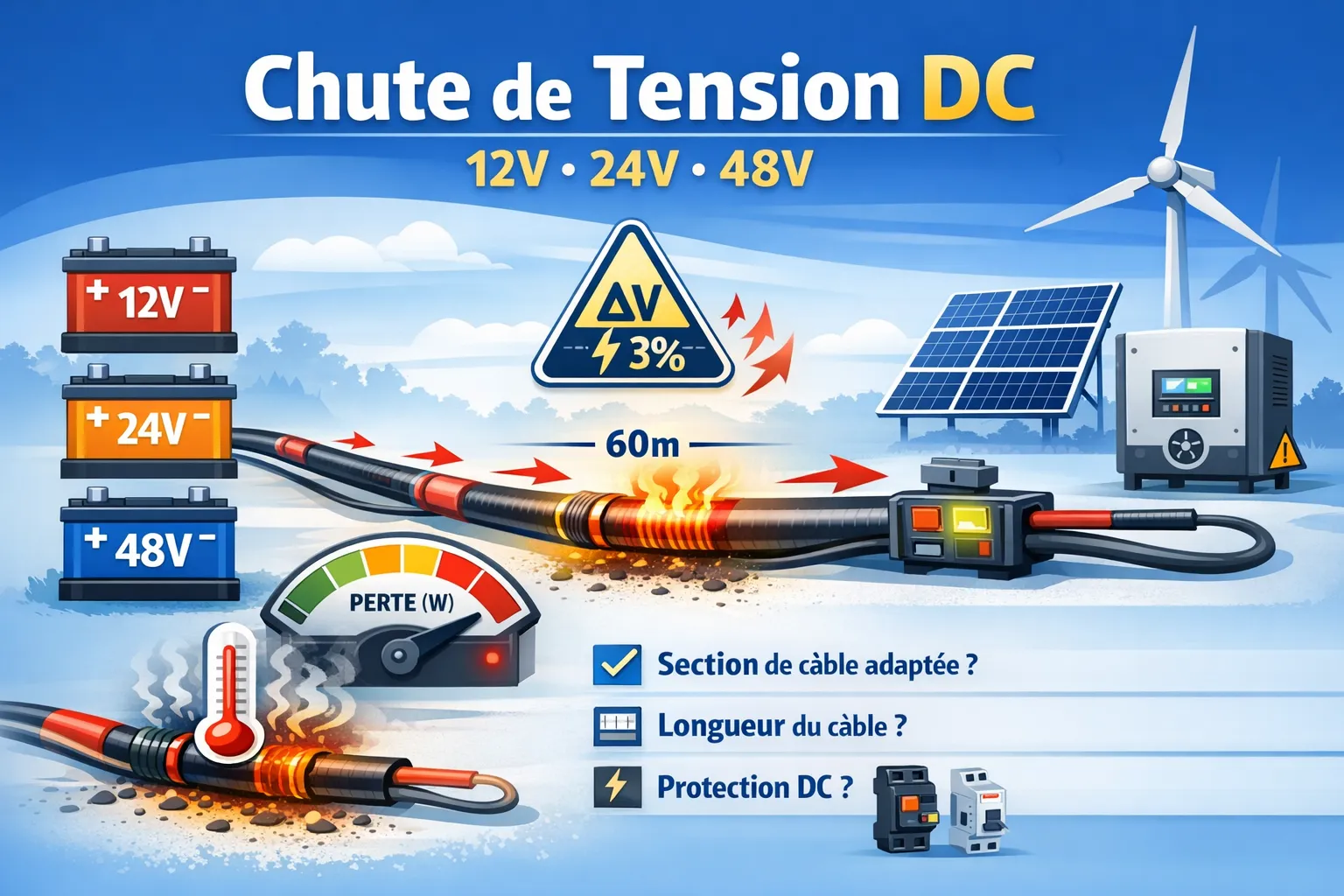
Voltage drop 12V / 24V / 48V in direct current
At low voltage (DC), a few volts of loss can represent a lot of lost efficiency. This page explains how to estimate voltage drop, what targets to aim for, and how to choose a consistent cable size.
Key points
In 12/24/48V DC, we generally recommend 2–3% maximum voltage drop. For a sensitive load or a long distance, aiming for 1–2% is preferable. 1) Practical formula
Voltage drop depends on length, current, and cable size. To properly size the cable, the simplest way is to use our dedicated page: Cable size calculation (tool + examples)
Tip: the length to consider is often round trip (thus 2× the physical length) in a DC circuit.
2) Recommended targets 12V DC ≤ 3% ≤ 2% 24V DC ≤ 3% ≤ 2% 48V DC ≤ 3% ≤ 1–2%
The lower the voltage, the more penalizing the losses become (higher current at the same power).
Concrete example: 48V over 30 meters
Typical case
48V DC, 30 m distance (one way), 10 A current. The electrical length is often 60 m (round trip). If the target is 3%: 3% of 48V = 1.44V. Then choose a size that keeps the voltage drop below this threshold (and maintain a thermal margin). Perform the exact calculation (recommended size)
Also check: cable type (outdoor/UV), temperature, installation method, quality of connections.
Why you need to monitor voltage drop
Energy loss (W)
A voltage loss turns into heat in the cable: P = I × ΔV.
The higher the current, the greater the loss. Risk of overheating
A cable that is too thin can heat up, especially with average connections (poorly crimped lugs, insufficient tightening).
Simple tips to reduce losses
- Shorten lengths: bring batteries/regulator/inverter closer if possible.
- Increase cable size: often the best “efficiency gain.”
- Limit connections: each joint can add resistance.
- Favor copper in DC (better conductivity and more reliable connections).
- Check crimping and torque tightening (frequent overheating = connections).
To go further
We recommend using appropriate DC protection (fuse/circuit breaker) and having cable/protection choices validated by a professional, especially in the presence of batteries (high short-circuit currents).