

Wind energy regulation
We recommend not building the mast foundations less than 5 m from the house or any other construction to avoid weakening their foundations. No legislation requires you to maintain a safety distance between the wind turbine and your house; indeed, a stopped wind turbine offers much less wind resistance than a tree or a roof. However, if possible, it is preferable to maintain a safety distance corresponding to the height of the mast plus the blade.
Legislation in France:
"The Minister of Ecology and Sustainable Development (Response to Question No.: 111784 published in the JO on: 20/02/2007 page: 1812): As indicated by Article R. 122-9 of the Environmental Code, the installation works of wind energy production structures with a mast height of less than or equal to 50 meters are subject to an impact notice. However, as Article L. 122-1 of the Environmental Code reminds us, all development works undertaken by a public authority or requiring authorization or approval decision, as well as urban planning documents, are subject to an impact study or impact notice. However, the installation of a wind turbine with a height of less than 12 meters is neither subject to a building permit nor to a works declaration, resulting in the impact notice not being mandatory."
Noise
WHAT THE LAW SAYS:
The regulation concerning the noise of a wind turbine is not very restrictive.
The noise possibly caused by a wind turbine must not exceed a certain level of decibels. This level is determined by Decree No. 2006-1099 of August 31, 2006, corroborating Article 1 of the Public Health Code relating to neighborhood noise.
Thus:
The difference between:
the ambient noise level (including the noise emitted by the wind turbine).
and:
the residual noise level (consisting of all usual, external, and internal noises corresponding to the normal occupancy of the premises and the usual operation of equipment, in the absence of noise emitted by the wind turbine).
must not exceed:
5 decibels during the day (from 7 a.m. to 10 p.m.) and 3 dB at night (from 10 p.m. to 7 a.m.).
REMINDER ABOUT DECIBEL LEVELS:
Decibels increase their effects logarithmically:
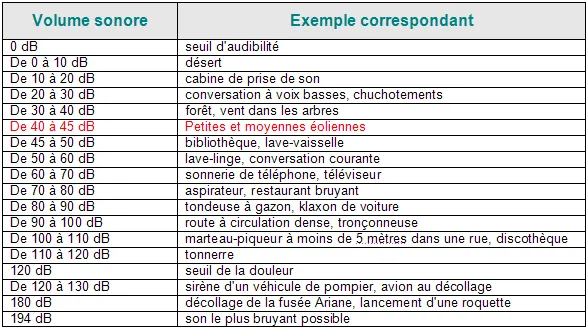
3 additional decibels double the sound volume produced.
Below 20 dB, the sound is practically inaudible to the human ear. It begins to become painful beyond 100 dB and unbearable from 120 dB. The pain threshold is, of course, not absolute. It depends on each individual.
For information and by way of comparison, here are some common examples and their corresponding sound levels:

Urban Planning
The legislation regarding the installation of a small wind turbine is not very restrictive. However, it is necessary to consider the following elements:
The property boundary to be respected in all cases is as follows:

The mast must never be less than 3 m from the property boundary, and the blades must never overhang the neighbor's land.
Thus, a 10 kW wind turbine with a rotor diameter of 12 m must not be installed less than 6 m from the property boundary. On the other hand, a 5 kW wind turbine with a rotor diameter of 5 m can be positioned at a minimum of 3 m from the property boundary.
We recommend not laying the mast foundations less than 5 m from those of the house or any other construction to avoid weakening their foundations. No legislation requires you to maintain a safety distance between the wind turbine and your house; indeed, a stopped wind turbine offers much less resistance to the wind than a tree or a roof. However, whenever possible, it is preferable to maintain a safety distance corresponding to the height of the mast plus that of the blade.
A wind turbine installation less than 500 m from a listed historical monument (church, fountain, cemetery gate, etc.) will not be authorized by the Architects of the Buildings of France.
Nevertheless, certain exemptions may be granted by the Architects of the Buildings of France. Recently, an agreement was given to one of our clients for the installation of a wind turbine 250 m from a listed historical monument, provided the entire wind turbine (mast, generator, and blades) is painted gray.
Insurance
In the case of a grid connection, it is necessary to request from your insurer an extension of the Civil Liability insurance to the wind turbine, to cover any potential damage caused by the wind turbine.
Your civil liability insurance certificate, covering bodily, material, and immaterial damage that may occur during the operation of the wind turbine, must clearly mention the presence of a production installation connected to the public distribution network.
In the vast majority of cases, the wind turbine is covered by your insurance at no additional cost.

Building permit
The installation of a wind turbine, or any other construction not generating floor space, is not subject to any authorization under urban planning when these constructions are less than 12m in height. A refusal of urban planning authorization could not be based on potential neighborhood issues, as these do not fall under urban planning legislation but rather civil relations between property owners. »
(Text published in the Official Journal of the Senate on November 15, 2007)

The installation work for wind energy production structures with a mast height of less than or equal to 50 meters is subject to an impact notice. When the mast height exceeds 50m, the installation work is subject to an impact study and a public inquiry. However, as Article L. 122-1 of the Environmental Code reminds us, all development work undertaken by a public entity or requiring an authorization or approval decision, as well as urban planning documents, are subject to an impact study or impact notice. However, since the installation of a wind turbine less than 12 meters in height is neither subject to a building permit nor a work declaration, it follows that the impact notice is not mandatory. » (Article R. 122-9 of the Environmental Code)
A mayor cannot oppose (whether arguing about potential noise or visual nuisances) the installation of a wind turbine if the prohibition is not clearly mentioned in the Land Use Plan or the Local Urban Plan.