
Skip to content

Wind generator: key elements

The components of the wind turbine

The blades located at the top of the tower are driven by the wind.
This movement drives the generator, which is also placed at the top of the mast. It is this motor that produces electricity (alternating current).
A mast supports the blades and the generator. The mast + blades + generator assembly is what is called a wind turbine.
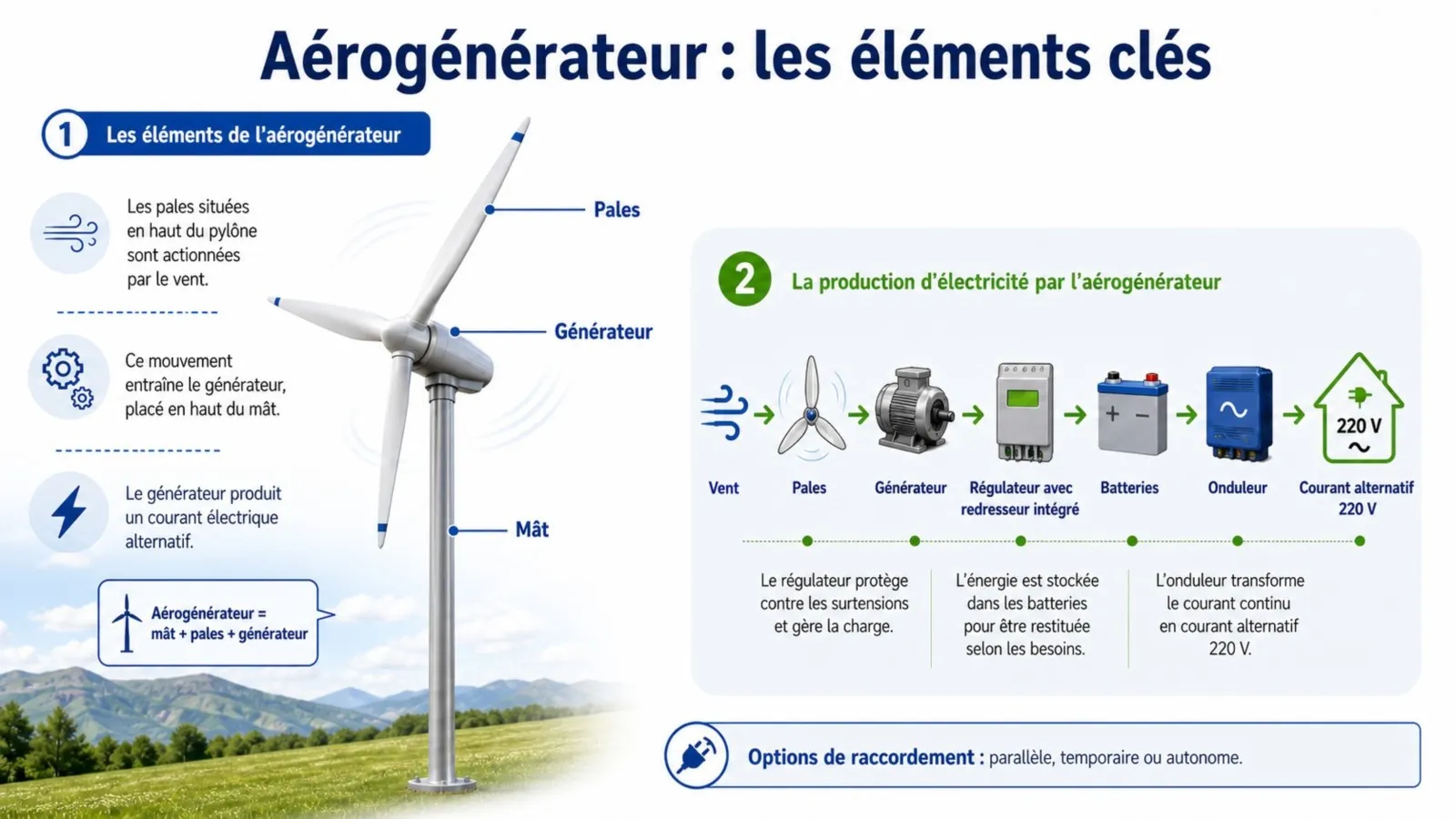
Infographic on the wind turbine: blades, generator, mast, and wind power production

Electricity production by the wind turbine

The electricity produced is converted by a regulator with an integrated rectifier (which also prevents overvoltage and can switch to photovoltaic solar panels in case of undervoltage) and routed into the batteries. The energy is thus stored to be released according to needs.
Before being able to use the direct current redistributed by the batteries, it must be transformed into 220 V alternating current using an inverter.

You will have a choice regarding the options for connecting to the electrical grid (parallel, temporary, or standalone).

Frequently Asked Questions

What is a wind turbine in a windmill?
A wind turbine refers to the assembly consisting of the mast, blades, and generator (motor) located at the top of the tower. The blades, set in motion by the wind, drive the generator which produces electricity (alternating current).
How does the wind turbine produce electricity?
When the wind turns the blades, the mechanical movement is converted into electrical energy by the generator (motor). This generates an alternating current (AC) which is then rectified or managed by a regulator to be stored in batteries or injected into a grid.
What is the role of the regulator with an integrated rectifier?
The regulator, equipped with a rectifier, converts the alternating current produced by the wind turbine into direct current (DC) and protects the system against overvoltage. It can also switch to other sources, such as solar panels, if the wind turbine does not provide enough current (undervoltage).
How is the produced electricity stored?
The regulator sends the electricity in direct current into batteries. The energy is thus stored to be used later, for example when there is no wind or when consumption is higher.
Why use an inverter in a wind system?
The inverter transforms the direct current (DC) from the batteries into alternating current (AC) at 220 V or 230 V. This is the standard voltage used by most household electrical appliances.
What grid connection options are available?
You can: • Operate off-grid, where the energy is only stored in the batteries. • Connect in parallel to the grid to prioritize consuming the energy produced by the wind turbine. • Opt for a temporary or mixed connection, depending on regulations and your energy needs.

Your legal guarantee rights

Your legal guarantee rights

europa.eu/youreurope/citizens/consumers/shopping/guarantees/index_en.htm